

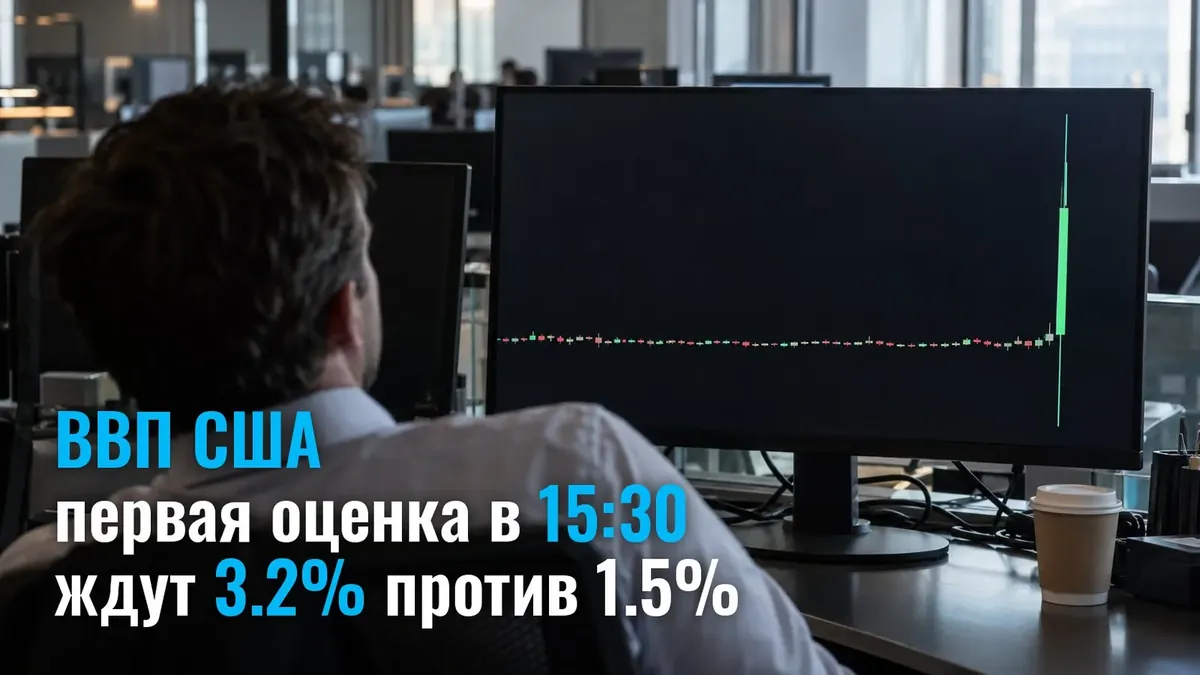
US releases its first estimate of quarterly economic growth on October 29 at 15:30 Moscow time. The market expects 3.2% year-over-year versus 1.5% a quarter earlier.
Advance GDP is a preliminary estimate of gross domestic product. It is later revised twice, but the main reaction comes from the first release: it comes out before everyone else.
For a trader, this is a window of heightened volatility. The figure changes expectations for the Fed rate, and the dollar, gold and indices move behind them.
What numbers are on the table?
Time: 15:30 Moscow time, Wednesday, October 29. Advance GDP is the first, preliminary estimate of gross domestic product for the quarter. It is later revised twice, but the market is moved by the first release, because it comes out before everyone else.
- 3.2% quarter-over-quarter annualized - forecast for the new release
- 1.5% - previous value
- 1.7 percentage points - gap between the forecast and the actual figure last quarter
What this means. If the actual figure lands in line with the forecast, it will indicate a sharp acceleration of the economy after a weak quarter.
Why is this important for a trader?
The GDP figure directly feeds expectations for the Fed rate path. A strong economy is an argument not to rush easing, a weak one is the opposite.
Hence the reaction in assets:
- DXY - the dollar index against a basket of currencies
- EUR/USD and USD/JPY - major currency pairs
- XAU/USD - gold
- S&P 500 and Nasdaq - US indices, and crypto after them
What are the volatility scenarios?
Two scenarios, without guessing direction:
- Scenario A. The actual figure comes out close to 3.2%. A short impulse in the first seconds and a quick return, the market switches to the next data.
- Scenario B. A deviation from the forecast by several tenths in either direction. Then it is a sharp move in the dollar and metals, widening spreads and slippage in the first minutes after 15:30.
Key point: in the first minutes after the release, the risk is created not by direction, but by spread and slippage.
What next?
Further along the calendar, attention stays on Fed rhetoric. The GDP data will become one of the input arguments before the next rate decision.
It is convenient to keep the next releases at hand in the economic calendar. If you trade news on indices, it is worth choosing a challenge for your style in advance.
Will you be in the market at 15:30?
The moment of publication itself looks the same for everyone. A timer, a number, a candle half the screen and a spread that turns into an abyss for a second. The question is not whether you will guess the reaction, but whether your program even allows holding a position in the window of the statistics release and how it calculates slippage into the daily loss. For some prop firms this is a working tool, for others it is grounds to close the account retroactively. Checking the rules takes less time than waiting for the release.