

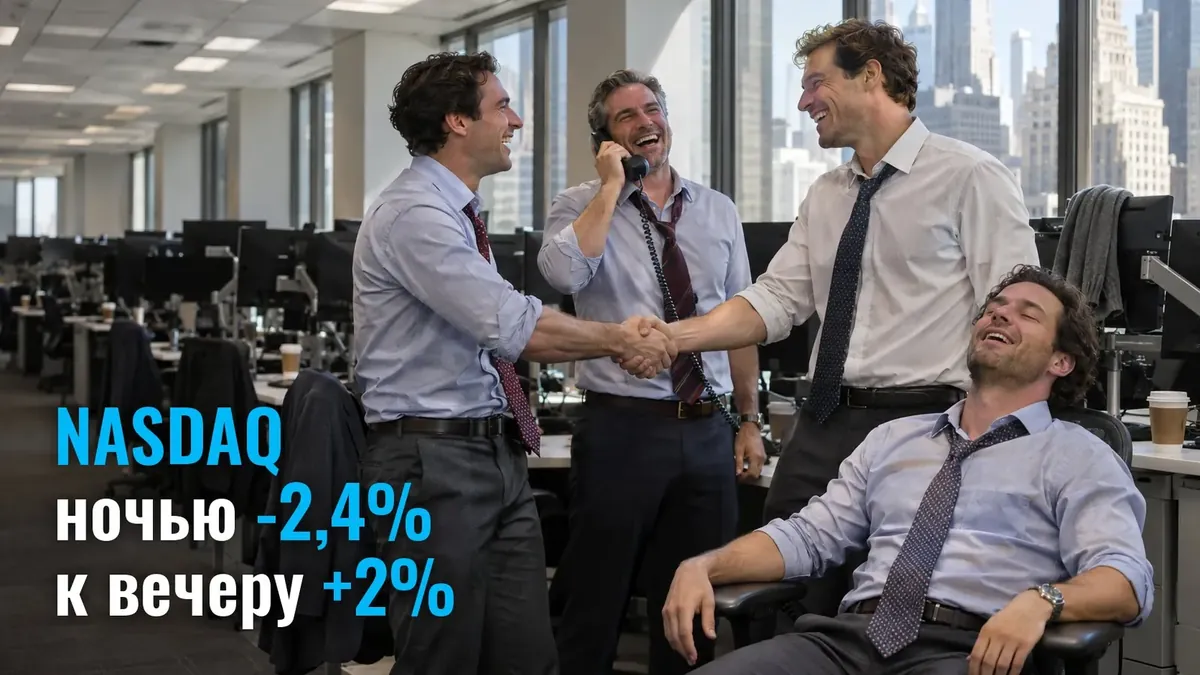
Nasdaq-100 futures went overnight from -2.4% to positive territory. The decline began after the results of the US midterm elections: the Democrats took Congress. By 16:11 Moscow time the drop had been fully recovered, and by 17:44 Moscow time Nasdaq was showing gains of about 2%.
What an index future is. It is a contract on the future value of an index. The Nasdaq-100 gathers the 100 largest US technology companies. Futures trade at night, when the main session is closed, and show sentiment before the open.
Why this matters to a trader. Moves of 4-5% within a day opened and closed within a few hours. The overnight shift in futures did not set the direction for the day.
How did the indices move?
The main session on November 3 closed higher. The Nasdaq Composite added 0.83% and stopped at 25,372.01. Overnight the election results came in, and futures headed down.
By 16:11 Moscow time the picture had reversed:
- Dow Jones - +1.4%
- S&P 500 - +1%
- Nasdaq futures - +0.54%
Why did the market reverse?
The Democrats took both the House and the Senate. Congress passes under the control of the opposition to the White House.
The market worked this out in two stages:
- First, the risks. Investors were pricing in artificial intelligence regulation, corporate taxes and trade policy. All of this landed on an already-started selloff in AI-sector stocks.
- Then, the other side. With divided power, passing major laws is difficult.
What about company earnings?
Earnings were ignored at this point. AMD reported record third-quarter revenue of $13.4 billion (+45% year on year) against an expected $13.09 billion. Adjusted profit was $2.09 per share against a forecast of $1.88, and server-segment revenue nearly doubled.
- Lisa Su, AMD CEO - called the quarter a record, coming in above the upper end of its own guidance
- Super Micro Computer - revenue of $19.9 billion against its own guidance of $14.5-15.5 billion
- Super Micro's full-year forecast - raised from $65-72 billion to $72-82 billion
What happened in Asia?
Asia had a wide-ranging day. Japan's Nikkei 225 lost as much as 4.8% and closed at -1.42% (62,188.63). South Korea's Kospi fell about 4% but finished up 0.62% (5,683.80).
Key point: for a trader, the main thing in this session is the amplitude. Moves of 4-5% within a day arose and closed within hours, and the overnight shift in futures gave no direction for the day.
What to do next?
The next nights like this are known in advance. Check the dates of Fed meetings and data releases in the economic calendar.
If you trade indices, your approach to risk matters more than a guessed direction. You can find a challenge for indices and compare conditions in the prop firm catalog.
Did you watch the overnight futures plunge?
The night on indices looked similar for everyone: a futures plunge, a return by morning and the usual position size. A 2.4% move there and back on a two-thousand-dollar account gives a couple dozen dollars for a sleepless night. In prop trading, the company provides the notional of the trade: first its risk-based selection, then its account and an agreed share of profit to the trader. It is calmer to work through the mechanics before the next night like this.