

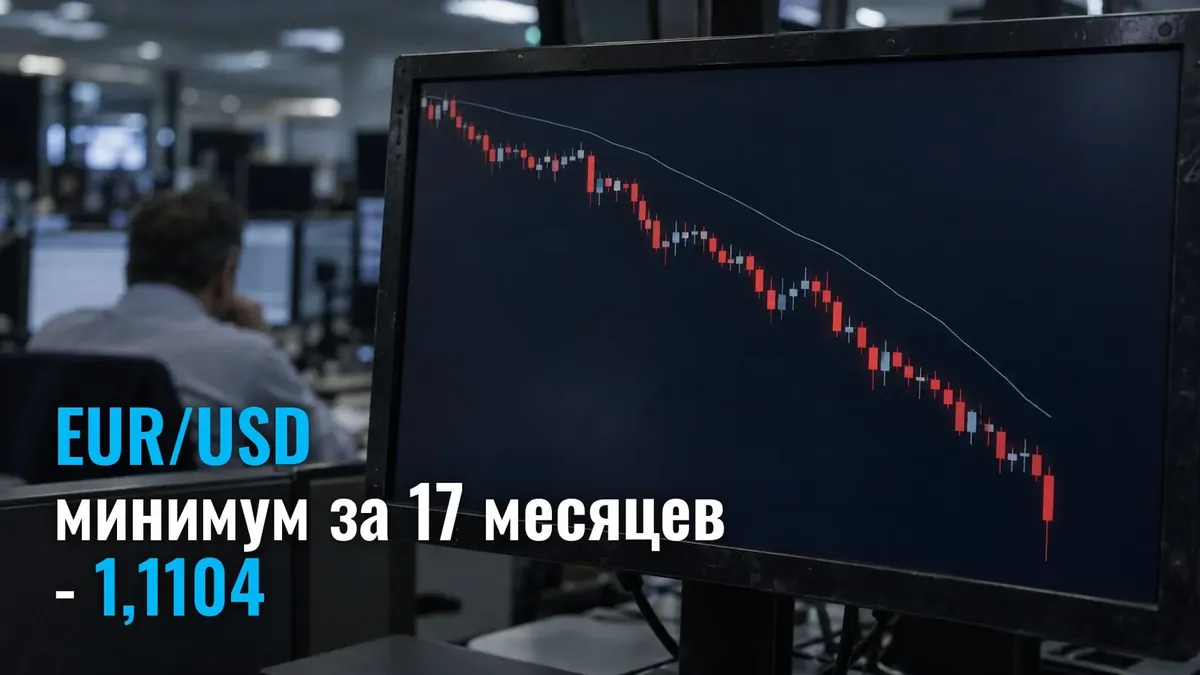
Euro fell to 1.1104 on October 29 — the weakest level against the dollar since May 2025. Two events on the same day pushed the pair down at once. The ECB kept rates unchanged, and fresh data showed accelerating inflation in the US.
Fed expectations have flipped. Previously, the market expected the American regulator to cut rates. Now the majority is betting on a hike in December. A rate hike makes the dollar more expensive, and the EUR/USD pair falls as a result.
For a trader, this is a trend, not noise. The EUR/USD move is unfolding against the backdrop of decisions by two central banks and has been going on for more than a day.
Where is the price now?
- 1.1120 — the rate as of 16:57 Moscow time, down 0.28% for the day
- 1.1104 — the low of the day and a 17-month low
- 36 — the relative strength index
On RSI, briefly. A level of 36 is a zone where the move is already strong but not yet an extreme.
Why didn't the ECB help the euro?
At its October meeting, the regulator kept all three rates unchanged. The soft wording on inflation gave the euro no support.
- 2.65% — the main refinancing operations rate.
- 2.5% — the deposit rate.
- 2.9% — the marginal lending rate.
The tone of the statement. Core inflation is "broadly stable," but rising energy prices are flagged as a risk of acceleration.
A separate detail for the euro. Christine Lagarde will leave the post of ECB President in February 2027; no successor was named.
What did the US data show?
The statistics came in stronger than forecasts on all four points. That is what flipped rate expectations.
- 3.6% vs. 3.4% — September PCE year-on-year, +0.5% for the month
- 3.1% vs. 3.0% — core PCE
- 3.4% — Q3 GDP versus a forecast of 3.2%
- 194K — jobless claims versus an expected 199K
PCE is the personal consumption expenditures index, the main inflation gauge for the Fed.
What has the Fed already done?
On Wednesday, the regulator left the rate range at 3.75–4.00%. The vote was 10 against 2: two committee members favored a 0.25 pp hike.
Fed Chair Kevin Warsh repeated that the goal is to restore price stability. CME FedWatch futures now give an 83% probability of a rate hike in December.
Key point: the market has stopped expecting easing from the Fed and has repriced the rate in the opposite direction. It's convenient to keep the dates of upcoming meetings in the economic calendar.
What's next?
Eurozone statistics are mixed. The business climate index turned positive for the first time in three years (0.09). But the economic sentiment index at 96.9 is worse than the 97.5 forecast.
- Friday — Bank of Japan decision
- USD/JPY — already above 158.00
If you trade moves like these, it's worth choosing a challenge to match your style in advance.
Been shorting the euro all week?
The EUR/USD trend has been running for days. It's captured not with a single trade but with a series of overnight and weekend holds. This is exactly where prop firms' rules diverge: some programs require closing everything on Friday evening, some treat holding as normal work, and others close the account for a position held over the weekend. Add to that the limit on volume per pair and the method for calculating drawdown. It makes sense to sort this out program by program now, while the move is still underway.