

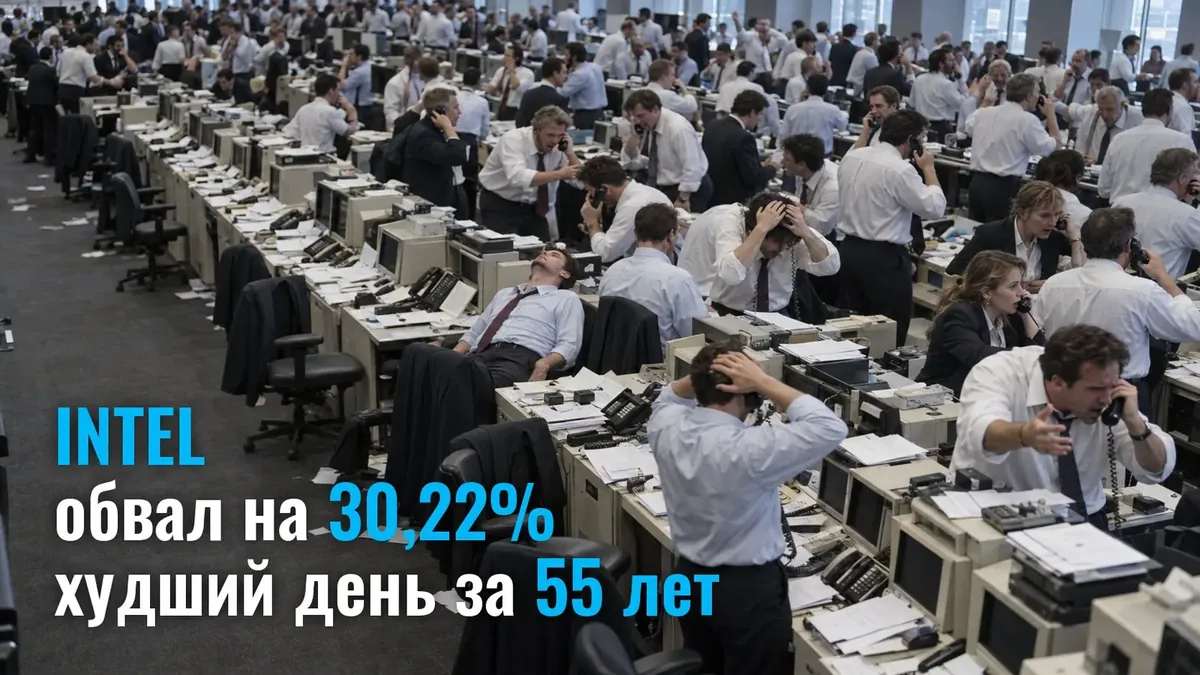
Intel shares plummeted 30.22% in a single Friday session. The stock fell from $92.07 to $64.25, and the company lost about $147 billion in market capitalization. It hadn't had a day like this in 55 years of trading on the exchange.
Intel trades on Nasdaq, an American venue that hosts the largest technology companies. Market capitalization is the total value of all of a company's shares combined.
Why this matters to everyone. The drop dragged down the entire semiconductor sector and the S&P 500 index on the last trading day of October.
How deep was the plunge?
At 16:55 Moscow time, the stock was worth $64.25 — down 30.22% from Thursday's close of $92.07.
- The 1974 record is broken. The July 5, 1974 crash was 29.9%, which from the current base is $64.54, and Intel went past that level.
- $66.34 — the price by the end of the session, or -27.95%.
- 26.1% — the August 2024 plunge, already surpassed.
- $136-147 billion in value wiped out by the move, with 5.28 billion shares outstanding.
- $350.57 billion — the company's market capitalization now.
Why did the market reverse?
The reason isn't the earnings report: the quarterly figures came in above Intel's own guidance.
- The report was strong. Quarterly revenue was $16.51 billion, up 21%. Earnings of $0.52 per share versus $0.23 a year earlier.
- The guidance crashed the stock. For the next quarter, the company expects revenue of $15-16 billion versus the market's ~$17 billion, earnings of $0.25 per share and a gross margin of 38%.
- An explosion at a plant. The accident in Kiryat Gat on October 14 takes away about $300 million and roughly 200 basis points of margin. A basis point is one hundredth of a percent.
- The CFO's words. David Zinsner added that 2027 is unlikely to bring positive free cash flow.
- Analysts cut their targets. Susquehanna cut its price target from $105 to $75, StoneX from $140 to $100.
What does this mean for a trader?
The main point: the sell-off in a single stock erased the S&P 500's monthly gain and hit the entire semiconductor sector.
The year's picture is different. Year to date, Intel is still +74%, despite Friday's plunge.
Trading moves like these requires a suitable account and risk limits, which are easier to select through the challenge calculator.
What's next?
Intel's next earnings report will be released on January 28, 2027.
- $20 billion — the company's capital expenditures this year; next year they will rise sharply.
- Free cash flow in 2027 is unlikely to be positive, Zinsner warned.
- Report and macro event dates are convenient to keep in the economic calendar.
Did you watch that INTC candle?
A 30% drop in a session is something you see once every few years, and usually you watch it from the sidelines. What gets in the way isn't chart markup or reaction speed, but nominal size: with a couple thousand dollars in an account, even a perfectly executed day in semiconductors closes out at the level of a trip to the store. Prop trading works differently: the company provides a trading account and risk limits, you pay for the selection and share the result. It's worth understanding the mechanics before the next report like this, not after.