Notes
20 sections · 2395 wordsCan you use robots and copy trades
Prohibited strategies
Five things to check before buying a Challenge
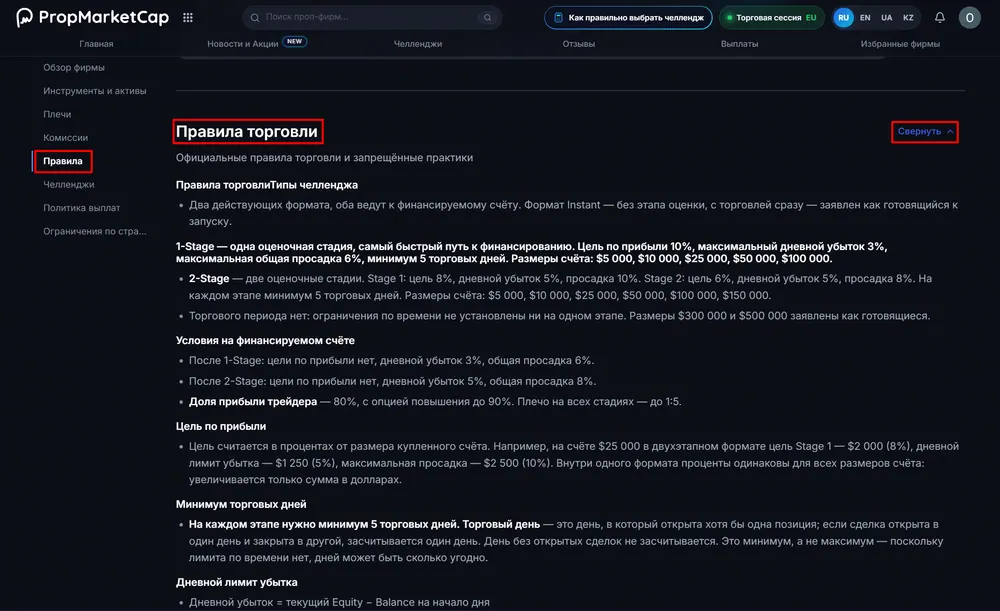
1Profit Target
What is it?
For example:
Account size: $10,000Profit Target: 8%You need to make: $800
Once you reach $10,800, the profit target is met. But that doesn't necessarily mean the Challenge is passed — the other rules must be met too. An important point
A low Profit Target doesn't always mean the Challenge is easier. One company may have:
But stricter drawdown limits at the same time. Another may have:
But more room for risk. That's why the Profit Target can't be judged separately from the other conditions. What to check? First stage target✓ Second stage target, if there is one✓ Number of stages✓ Drawdown limits✓ Additional passing conditions
2What Balance and Equity are
Before talking about drawdown, we need to understand two important concepts.
Balance shows the state of the account including trades that are already closed. For example:
You have $10,000 in your account. You closed a trade with a +$200 profit. Your Balance is now:
$10,200
Equity takes into account not only closed but also open trades. For example:
Balance: $10,000
You have an open trade that is currently showing:
−$300
Then:
Equity = $9,700
If the trade starts showing +$200:
Equity = $10,200
Meanwhile, Balance stays at $10,000 until the trade is closed. Why does this matter? Because some Prop Firm limits may count not only closed losses, but also the current result of open positions. Therefore:
When studying the rules, always check exactly what the Prop Firm uses — Balance, Equity or another formula set by the specific program.
3What Drawdown is
In Prop Trading, two limits are usually especially important:
Daily Drawdown
The maximum you can lose in one trading day. Maximum Drawdown
The maximum overall drawdown the program allows. Let's look at them separately.
4Daily Drawdown
For example:
Account: $10,000Daily Drawdown: 5%
The daily limit is $500. But this is where the most important part begins. It is not enough to see:
You need to understand exactly how these 5% are calculated. What to check?
- •What value is the limit calculated from?
- •Is Balance or Equity used?
- •Are open positions counted?
- •What time does the new trading day start?
- •Can the size of the limit change?
Example
Imagine:
Balance: $10,000
Daily Drawdown: $500
You opened a trade. At some point it shows:
−$550
After a while the market reverses and you close the trade at:
+$100
But if the rules of a specific Prop Firm use Equity, the violation may have happened at the moment the open position showed −$550. Remember
Your working risk should be much more controlled and match your trading plan.
5Maximum Drawdown
For example:
Account size: $10,000Maximum Drawdown: 10%
With a simple static model, the lower limit will be:
$9,000
If the limit set by the rules is breached, the Challenge is considered failed. And here it's important to understand one of the key things in Prop Trading:
$100,000 ACCOUNT ≠ $100,000 OF RISK
Imagine:
Account size: $100,000
Maximum Drawdown: 10%
This does not mean the trader can lose $100,000. Their room to maximum drawdown with a simple static model is $10,000.
That's why the account size can't be considered separately from the risk conditions. In the closed part of PropMarketCap Academy we will look separately at how to build your own risk model for a specific Challenge.
6Static and trailing drawdown
Maximum Drawdown can be calculated in different ways. Two important concepts:
With a static model, the critical limit is set by the program rules and doesn't move as the account grows. A simplified example:
Starting balance: $10,000Maximum Drawdown: 10%
Limit:
$9,000
The account grew to:
$11,000
With a fully static model, the lower limit still remains $9,000.
With a trailing model, the drawdown limit may move up as Balance or Equity grows. For example:
The account grows → the lower permitted limit may rise along with it. The exact formula depends on the Prop Firm. So you need to check:
- •Does the limit move from Balance or Equity?
- •When is it recalculated?
- •How often does it change?
- •Can it only move up?
- •Is there a point when the Trailing stops moving?
Which is better? You can't say:
Static = good
Trailing = bad
It all depends on the trading system. What matters for a trader is not finding the “best” type of Drawdown, but understanding its mechanics before buying a Challenge.
7Minimum Trading Days
Some Challenges can't be passed in one or two days, even if the Profit Target has already been reached.
This is the minimum number of trading days required to pass a stage. For example:
Profit Target: 8%Minimum Trading Days: 5
You made the required 8% in three trading days. The profit target is met, but the trading days requirement is not yet. What to check?
- •Is there a Minimum Trading Days requirement?
- •How many days are required?
- •What does the Prop Firm count as a trading day?
- •Are there additional activity requirements?
The key point
8Consistency Rule
In simple terms, the company wants to see that your result doesn't consist of one random big winning trade. Example
Imagine the terms of a specific program say:
no more than 30% of total profit may come from one trading day. You made:
$1,000
With this formula, one day should account for no more than:
$300
If one day brought $600, you need to look at the rules of the specific program: you may need to make additional profit, or other conditions may apply. Important
The Consistency Rule may work differently at different Prop Firms. So check:
- •Is there a Consistency Rule at all?
- •What percentage is set?
- •Is it calculated per trade or per day?
- •Does it apply to the Challenge?
- •Does it apply to the Funded Account?
- •What happens if it is not met?
Don't carry over the rules of one Prop Firm to another.
9Can you trade during the news: News Trading
For example:
- •an interest rate decision;
- •inflation data;
- •employment data;
- •other important economic events.
At such moments the market can move much faster than usual. Some Prop Firms allow News Trading. Others may restrict opening or closing trades immediately before and after certain news. What to check?
- •Is News Trading allowed?
- •Which news is restricted?
- •How many minutes before and after the news are certain actions prohibited?
- •Can you keep a previously opened position?
- •Are the rules the same on the Challenge and the Funded Account?
Especially important
If news trading is part of your strategy, check this point before buying a Challenge. The Challenge should fit your trading system, not force you to change it after the purchase.
10Can you hold trades over the weekend: Weekend Holding
For an intraday trader this parameter may hardly matter. For a trader who holds positions for several days or weeks, it can be one of the key ones. What to check?
- •Is Weekend Holding allowed?
- •On which instruments?
- •Are there additional restrictions?
- •Are the rules the same on the Challenge and the Funded Account?
If your strategy involves holding trades for a long time, check this condition in advance.
11Can you use robots and copy trades
Three more terms come up here.
Trading Bot
Copy Trading
For example, a trader opens a trade on one account, and a special program automatically repeats it on another. Why does this matter? Automation rules differ between Prop Firms. Before buying, check:
- •Are EAs allowed?
- •Are trading bots allowed?
- •Is Copy Trading allowed?
- •Can you copy your own trades between your own accounts?
- •Are there restrictions on using identical strategies?
- •Are the rules the same on the Challenge and the Funded Account?
Remember
If a trading platform technically allows you to do something, that doesn't mean the Prop Firm's rules allow it.
12Prohibited strategies
Each Prop Firm may have its own rules about permitted trading methods. Restrictions may concern:
- •certain types of arbitrage;
- •high-frequency trading;
- •exploiting quote delays;
- •some automated strategies;
- •trade copying;
- •trading between linked accounts;
- •other methods specified in the rules of a specific company.
Why don't we give one universal list? Because Prop Firm rules differ. A strategy allowed by one company may be restricted by another. So the main rule is:
Especially if your trading system uses automation, trade copying or non-standard execution methods.
13How profit is split: Profit Split
After successfully passing the Challenge, the trader can get a Funded Account.
Now the next term appears:
Profit Split
Profit Split shows what part of the profit earned is due to the trader. For example:
Profit Split 80/20
Or:
Profit Split 90/10
14How payouts work: Payout
For example:
The trader made $2,000. The Profit Split is 80% to the trader. Without other adjustments, their share will be:
$1,600.
Before buying, check:
Profit SplitWhat share does the trader receive? First payoutWhen can it be requested?
Additional conditionsDo other requirements need to be met? Payout methodsHow can you receive the money? FeesAre there additional fees? The key point
A 90% Profit Split doesn't automatically mean better conditions than 80%. You need to compare the entire payout policy.
15Five things to check before buying a Challenge
Now let's put it all together. You don't need to try to remember the rules of dozens of Prop Firms. Before buying a specific Challenge, check five main blocks.
1Target
How much do you need to make?
- •Profit Target;
- •number of stages;
Minimum Trading Days.
2Risk
How much can you lose and how is it calculated?
- •Daily Drawdown;
- •Maximum Drawdown;
- •Static or Trailing;
Balance or Equity.
3Restrictions
Can you trade the way you're used to?
- •News Trading;
- •Weekend Holding;
- •EA;
- •Bots;
- •Copy Trading;
- •prohibited strategies.
4Consistency
Is there a Consistency Rule? If so:
- •how it is calculated;
- •where it applies;
- •what requirements must be met.
5Funded and payouts
What happens after passing the Challenge?
- •will the trading rules change;
- •what is the Profit Split;
- •when is the first payout;
- •how often you can receive payouts;
- •are there additional conditions.
Checklist before buying a Challenge
Save this list and use it before every purchase. PASSING
☐ What is the Profit Target?
☐ How many stages?
☐ Is there a Minimum Trading Days requirement? RISK
☐ What is the Daily Drawdown?
☐ What is the Maximum Drawdown?
☐ How is drawdown calculated?
☐ Static or Trailing?
☐ Is Balance or Equity used? MY STRATEGY
☐ Is news trading allowed?
☐ Can positions be held over the weekend?
☐ Can EAs or bots be used?
☐ Is Copy Trading allowed?
☐ Are there other prohibited strategies? ADDITIONAL RULES
☐ Is there a Consistency Rule?
☐ What rules apply to the Funded Account? PAYOUTS
☐ What is the Profit Split?
☐ When can you get the first Payout?
☐ How often are payouts available?
☐ Is there a minimum amount?
☐ Are there additional conditions? Key takeaway of the lesson
They are the rules within which your trading system will operate. So don't choose a Challenge just because you saw:
$100K Account
−25% discount
90% Profit Split
First, answer four questions:
How much do I need to make? How much can I lose and in what way? Do the rules fit my trading system? What awaits me after getting a Funded Account?
How PropMarketCap helps with this
Searching for the Profit Target on one site, Drawdown on another, payout terms in the FAQ and strategy restrictions in a separate document is inconvenient. That's why on PropMarketCap the main parameters of Prop Firms and their Challenges are collected in a single format.
You can study and compare offers by key conditions, not just by price or account size. However, before buying, always also check the current official version of the chosen Prop Firm's rules — program terms may change.