

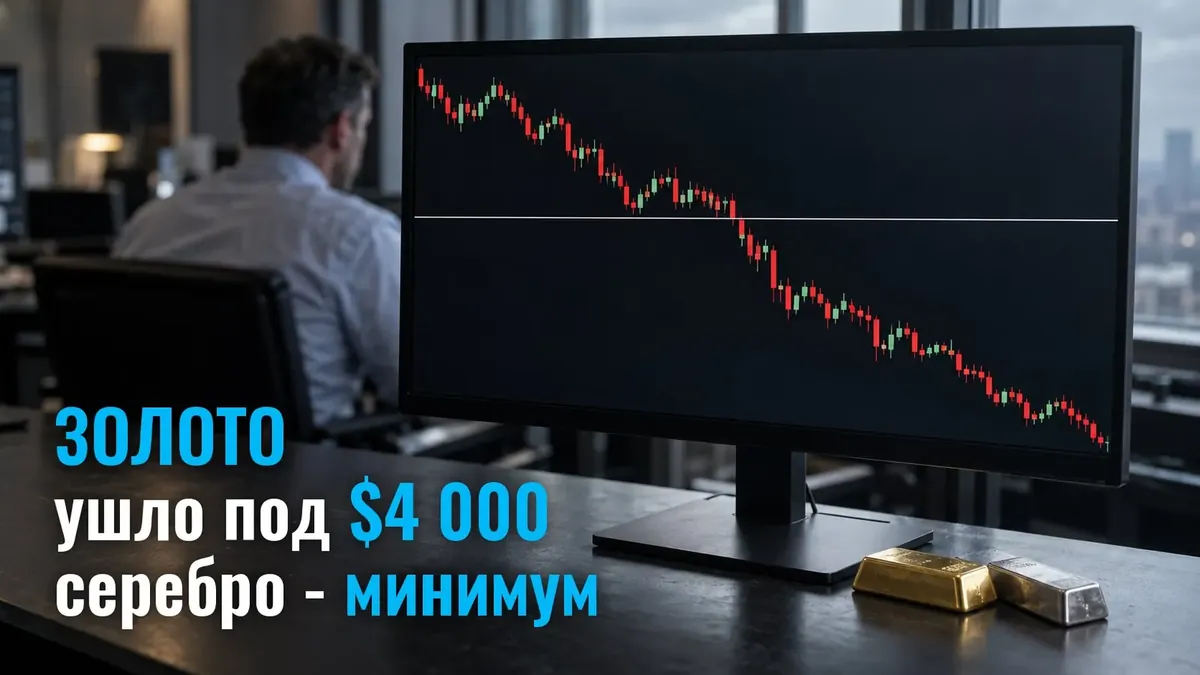
Spot gold on Friday fell below the psychological mark of $4,000 per ounce. The metal was worth $3,997.25, down 0.58% for the day. Silver fell almost 2%, to $51.147 — the lowest since November 2025.
Spot is the price of metal with immediate delivery; it is the market benchmark. For gold, this is the second consecutive day of decline and about -3.5% for the month.
For a trader, it matters where the blow came from. Metals are currently being driven not by the dollar or yields, but by expectations for the Fed rate.
Why did metals go down?
The reason is US statistics. The data came in stronger than the market expected.
- Inflation. The PCE index for September rose 0.5% from August and 3.6% year-on-year; core — by 0.3% and 3.1%. PCE is a measure of Americans' spending and the Fed's main inflation gauge.
- The economy. In the third quarter, the US grew 3.4% annualized versus 2.2% a quarter earlier. The forecast was 3.2%.
Why does the market expect a rate hike?
The market reads these figures as a path to a hike. At its October meeting, the Fed left the range at 3.75-4%, but the probability of a hike in December according to CME FedWatch is 74.9%.
The higher the rate, the more expensive it is to hold metal that pays no interest.
David Meger, Director of Metals Trading at High Ridge Futures: inflation keeps running hotter than the Fed's targets, and this clears the way for expectations of a December hike.
Fed Chair Kevin Warsh, when asked whether price stability has been achieved, answered briefly: "We're working on it."
What does this mean for a trader?
The backdrop for gold was rather friendly. US Treasury yields were falling, and the dollar was weakening for the third day in a row on expectations of Middle East talks. Rate expectations outweighed both.
- $3,975 — support at the monthly low, the next support below is $3,946.
- $4,025-4,030 — the nearest resistance, above that is the zone around $4,093.
- Risk sizing — for moves like these, limits are calculated in advance, for example via challenge selection.
What happens next?
The main date ahead is the December Fed meeting. Until then, metals will track rate expectations.
- The Fed meeting in December — keep the date in the economic calendar.
- Probability of a hike — currently 74.9%, and this figure will change until the very decision.
Were you in a gold trade below $4,000?
A round level gets pierced once. After that, what decides everything is not the idea, but how many ounces were in the position. In an account of a couple thousand dollars, a $20 move in gold is lunch; on a large notional, it's a work week. In prop trading, the company provides the capital to trade: the trader pays for the selection, works within its risk limits, and takes a share of the result. Before the December Fed meeting, metal will move like this more than once, so it makes sense to understand the mechanics now.