

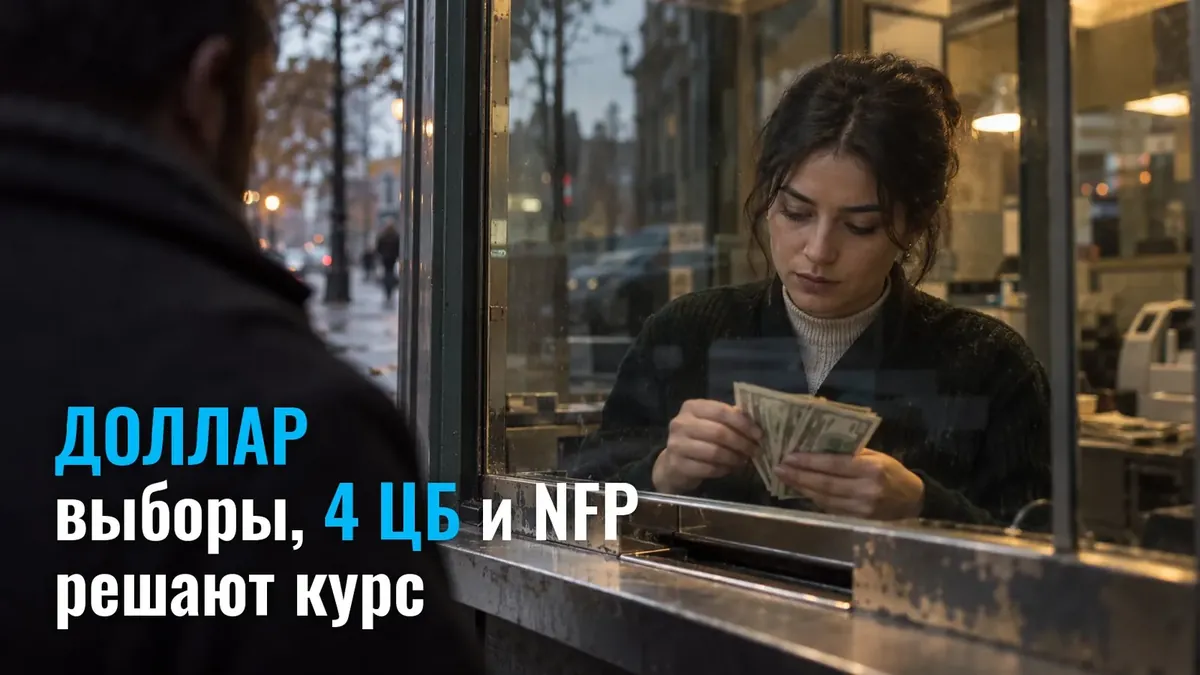
From November 2 to 6, the dollar will get four reasons to move at once. These are the US midterm congressional elections, decisions from four central banks, and Friday's US employment report.
What these events are. The midterm elections update the composition of Congress in the middle of a presidential term. NFP is the monthly report on the number of new non-farm jobs in the US. For the dollar, this is the main statistic of the month.
Why this matters to a trader. The dollar entered this week after two weeks of decline. For the first time in a long while, it is sitting at its 200-week moving average.
Where are the markets now?
DXY (the dollar index against a basket of currencies) is trading around 102.00 after a weekly high of 102.50.
- EUR/USD - fell to 1.1100, a 17-month low, then bounced above 1.1200
- GBP/USD - rising for the third week and reached 1.3430, a six-week high
- USD/JPY - closed the week around 157.00, having been above 158.00
- AUD/USD - holding above 0.7000
- Gold - around $4,000 per ounce
Why did the dollar turn upward?
There are two reasons. Oil and Fed rhetoric did the trick.
- Oil. Prices are rising steadily amid the unresolved Middle East crisis.
- A hawkish Fed signal. It came from the October 28 meeting. Lorie Logan (Dallas Fed President) spoke of two more rate hikes. Alberto Musalem (St. Louis Fed President) spoke of a hike in the near future.
What's on the calendar for the week?
The events come three days in a row. The full list is in the economic calendar.
- Tuesday, November 3. US midterm election results begin to come in, and JOLTS job openings data is released. The same day brings the Reserve Bank of Australia decision (+25 basis points expected, i.e. +0.25%).
- Wednesday, November 4. ADP employment, the ISM services business activity index, preliminary eurozone inflation, and the Swedish central bank.
- Thursday. The Bank of England, where +25 basis points is also expected, and a speech by Christine Lagarde (ECB President).
- Friday, November 6, 16:30 Moscow time. US non-farm employment and the unemployment rate. The US switches to winter time that night.
A separate backdrop is the Bank of Japan. It left the rate at 1.25% by a vote of 8 to 1. Board member Hajime Takata argued for 1.5%.
What does this mean for a trader?
There are two outcomes. Everything depends on whether the figures match forecasts.
- Scenario A. The data and elections match expectations. Moves are short, and volatility fades during the day.
- Scenario B. A divergence on at least one point. Then expect sharp impulses in DXY, the pound, the yen, and gold, with spreads widening in the first minutes.
The main thing: the week offers four entry points, but in the first minutes after releases, spreads are wider than usual. For this style, it's worth choosing a challenge in advance.
Planning to trade NFP on Friday?
Traders mark weeks like this on the calendar in advance and wait for the impulse. But prop programs treat this differently. Somewhere, trading on the data release is the norm, while somewhere a trade two minutes before the release is zeroed out along with the account. These lines of the rules are read on the weekend, not on Friday evening under NFP. A style filter immediately shows where this approach is allowed.