

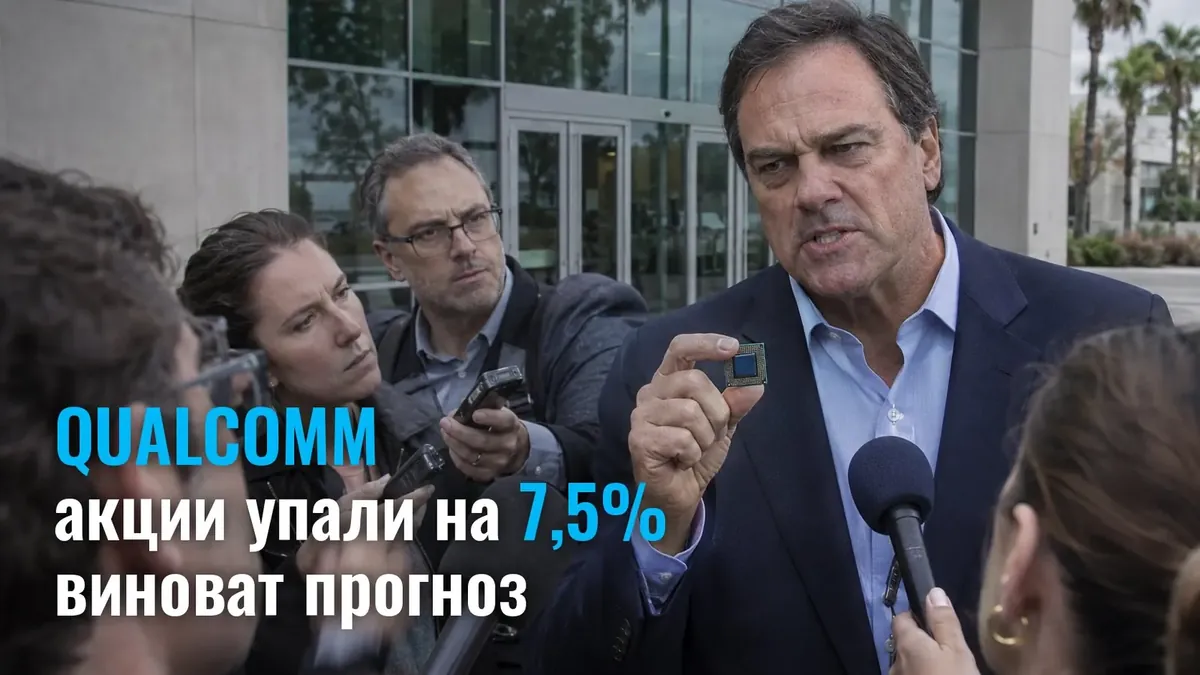
Qualcomm reported better-than-expected results for the fourth fiscal quarter, but the stock crashed 7.5%. It wasn't the report itself that scared investors, but the profit forecast for the current quarter: it came in below market expectations.
Qualcomm is the largest developer of smartphone chips. Its processors are in most Android phones, ticker on NASDAQ - QCOM.
Why this matters to a trader. The entire crash happened outside the main session: the stock fell after the market closed, when placing a stop is impossible.
How much did the stock fall?
On Wednesday, November 4, the stock closed at $173.19, gaining 5.33% (+$8.76) with a daily range of $162.75-$174.00. Then the report came out.
- $160.16 - price on the extended session by 03:59 MSK, down 7.52%
- $156.85 - low in overnight trading on the Blue Ocean venue at 09:44 MSK, down 9.43%
The extended session is trading after the official market close.
The report itself was strong. Revenue came in at $10.32 billion versus expected ~$10.12 billion, adjusted profit - $2.17 per share versus $2.16.
What scared the market?
The reason is the forecast. For the first quarter, the company expects profit of $2.15-2.35 per share, midpoint $2.25 versus market expectations of about $2.32.
Revenue is forecast at $10.4-11.2 billion, which is above the consensus of ~$10.6 billion. More revenue at lower margins.
Qualcomm explained this by rising costs across the industry:
- Production got more expensive. Prices for silicon wafers and assembly rose.
- Memory got more expensive. Smartphone makers are raising phone prices.
- Demand is weakening. Expensive phones sell worse, and this hits orders.
Where did the segments diverge?
A gap within the report. The smartphone segment delivered $5.14 billion, down 26%: a year ago it was $6.96 billion, about $5.3 billion was expected.
The automotive segment posted a record - $1.99 billion, up 89%. For the full year that's $6.00 billion and up 52%.
Key point: the $0.94 billion gain did not offset the $1.82 billion loss in phones. Automotive growth does not yet compensate for the smartphone slump.
What happens next?
Wednesday was positive. SpaceX chose Qualcomm's Dragonwing technology for the 5G ground network of the Starlink Mobile project in the US, plus the market was rising after the midterm elections. The extended session erased all of that gain.
The consensus of 37 analysts is a Hold rating with an average 12-month target of $197.03. The yearly range is $121.99-$259.92, with the nearest levels at $150 below and $174 above.
- Thursday's main session will show the actual size of the drop
- Dates of upcoming reports and data can be found in the economic calendar
- Programs for trading US stocks are easier to compare via the challenge selector
Held a position through the report?
The report came out when the main session was closed. In the morning you see a ready-made minus 7% and not a single chance to place a stop. In prop program rules this is a separate clause. Some explicitly prohibit holding a position through an earnings release, others treat the morning gap as an ordinary loss and deduct it from the daily limit. The difference between these two rules is your entire account. Half an hour spent reading the terms costs less than a lost account.