

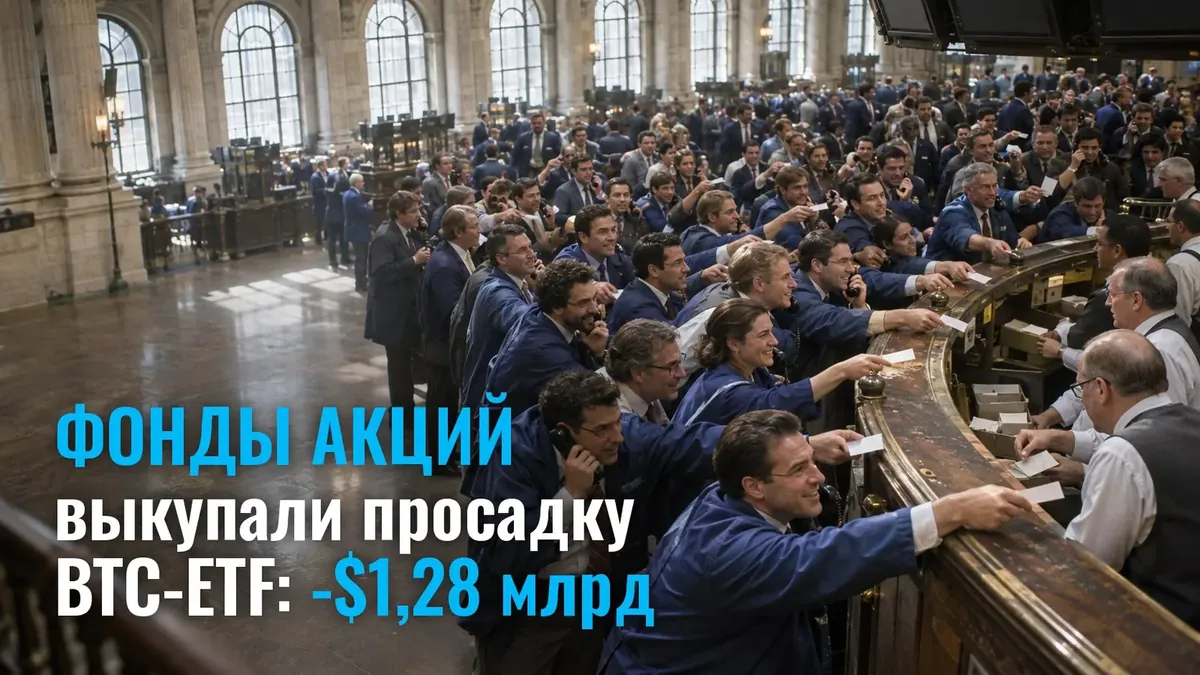
During the market drawdown, money flowed into stocks, while money left Bitcoin funds. Bloomberg ETF analyst Eric Balchunas tallied the inflows over five trading days: about $12 billion a day, and the top 17 positions on the leaderboard were all taken by equity funds.
An ETF is a fund that trades on an exchange like an ordinary stock. You buy one share and get a stake in a basket of assets. Large capital enters the market through such funds.
For a trader, the reversal of money itself matters here. The stock decline was bought up, while crypto funds lost capital on those same days.
What did Balchunas calculate?
A rare picture. Balchunas wrote that he isn't sure he has seen anything like it before.
- about $12 billion a day - the average inflow into exchange-traded funds over the five-day period
- 17 positions in a row - all the leaders on the list turned out to be equity funds
- about $1.28 billion - net outflow from Bitcoin ETFs from November 2 to 6, according to Farside
- $411.9 million - of that sum came on Friday
- four days out of five - that's how many days money was withdrawn from crypto funds
Who bought the dip?
Two opposite groups converged on the drawdown. Supporters of Vanguard's cheap index funds, who hold securities for years without unnecessary trades, and gamblers.
- Different rules, same conclusion - the decline must be bought
- Many combine both approaches - the core of the portfolio sits in a broad index fund, with risk moved to a separate account
Where else did the money go?
- Leveraged ETFs. Retail investors put a record $3.3 billion into them over the week while the Nasdaq lost 3.4% in the tech-sector selloff. Such funds multiply the index's daily move, both up and down.
- Inverse funds. Another $2.2 billion was pulled out of them. These funds profit from a falling market.
- Bond ETFs. Since the start of the year they have gathered $525 billion - more than ever before, according to NovaDius Wealth Management president Nate Geraci.
What does this mean for a trader?
The main point: demand through exchange-traded funds remains one of the main channels through which large capital buys BTC. As long as this channel doesn't switch on during drawdowns, the crypto market has less support, even if stocks recover.
The money is in stocks right now. If you trade indices, you can pick a challenge for this market, and work through the mechanics of the account and payouts in the academy.
Did you buy this dip with your own deposit?
Large capital brings in $12 billion a day. For a retail trader, buying the dip runs into the size of the account: even a correctly guessed direction leaves you a couple hundred. In prop trading you pay for selection, and then you trade the company's account with a fixed loss ceiling and receive an agreed share of the profit. When inflows into crypto funds return, what will decide it is the notional size you're sitting in the market with. It makes sense to work through the mechanics before that moment.