

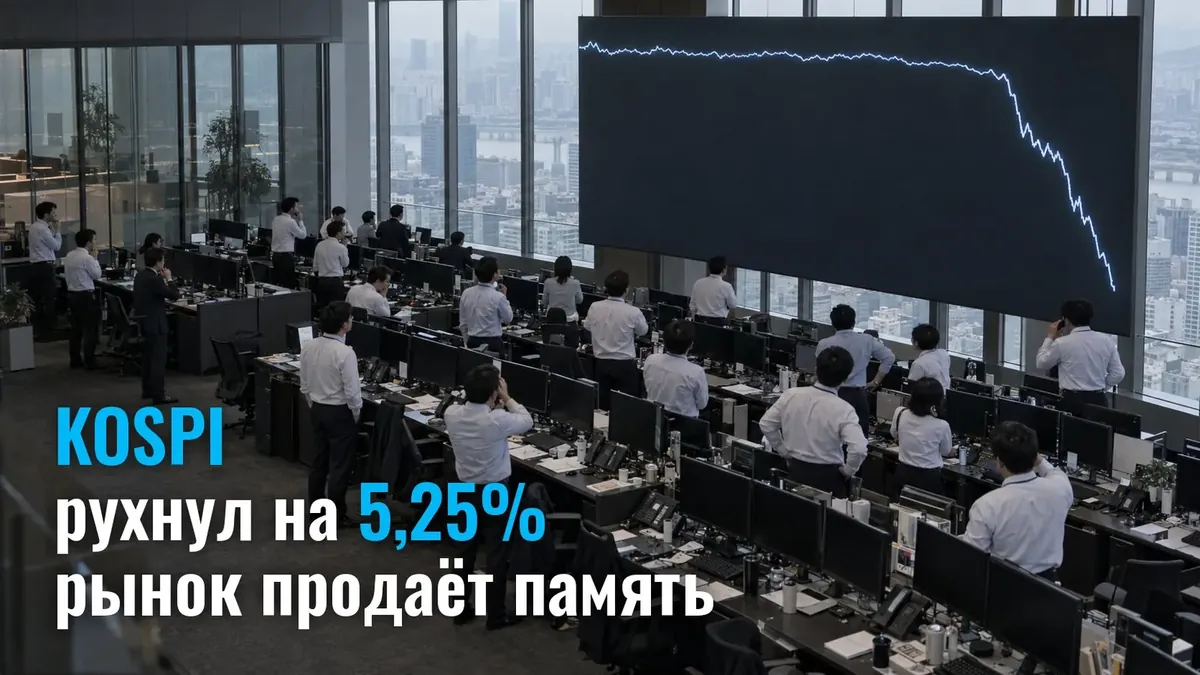
South Korea's main KOSPI index plunged 5.25% on Friday. By 05:20 Moscow time it had fallen to 5,626.02 points. Memory chip makers fell the most: SK hynix lost 8.65%, Samsung Electronics - 6.03%.
The reason is not the earnings reports. Investors doubted that tech giants' gigantic investments in artificial intelligence will ever pay off. Memory makers live on this money, so they are the first to be sold. DRAM and HBM are types of memory chips needed for servers and AI training.
For a trader, this is an example of a session where the index and individual stocks cover a week's range in a single morning.
How did the open unfold?
At 04:04 Moscow time, the sell-side exchange circuit breaker triggered on the Seoul exchange. This happened for the first time in 11 trading sessions. A circuit breaker is an automatic short pause on program orders during a sharp decline.
By 05:25 Moscow time, flows in Korean stocks looked like this:
- 553.7 billion won - sold by foreign investors
- 240.9 billion won - sold by institutions
- 709.3 billion won - the amount retail traders bought the dip for
Why did the market reverse?
The trigger was Alphabet's earnings report. On Thursday the stock fell 12.6%, the Nasdaq Composite index - 1.38%.
Two figures in the report scared investors:
- Free cash flow. For the quarter it went negative.
- Capital expenditures. They more than doubled.
- Market reaction. They started selling suppliers whose growth rests on these expenses.
Chris Weston of Pepperstone told Reuters that investors are questioning the "adequate return on the huge capital deployed."
Why didn't good numbers help?
The most telling thing is the reaction to strong reports. Sandisk reported revenue of $11.0 billion versus the expected $10.7 billion. Data center revenue grew 61% for the quarter.
The company gave guidance for the current quarter - $12.2-12.6 billion. Plus it announced an 8-for-1 stock split with distribution of shares on November 19. The shares still fell 5.32% to $1,330.05 and another 3.8% after the close.
- Micron - closed at $934.27 (-4.98%, down $48.96 for the day)
- $902.43 - Micron's price after the close
- Wednesday's entire gain wiped out in one session. On Wednesday SK hynix said its DRAM and HBM capacity was sold out through 2029
What does this mean for a trader?
Korean manufacturers have record quarterly operating profit. Samsung's is 107.4 trillion won, SK hynix's is 83.33 trillion won.
The market is not currently trading the manufacturers' results. It is trading the tech giants' willingness to keep paying for them. While that willingness is in question, reports don't save the quotes.
- Watch the tech giants' capex - it is what moves memory suppliers
- Check report dates in the economic calendar before entering a position
- Check the list of instruments - choosing a challenge for indices is easier to do in advance
Were you holding a long on chips that night?
Five percent on the index in one morning and minus 8.65% on a single stock - that's a session where the rules matter more than the idea. Prop firms all differ here: some don't include stocks and indices in their list of instruments at all, some prohibit holding a position through an earnings report and the overnight break, and some count the opening gap in full toward the daily drawdown. It's more comfortable to figure this out in advance. And not during the next crash like this.