

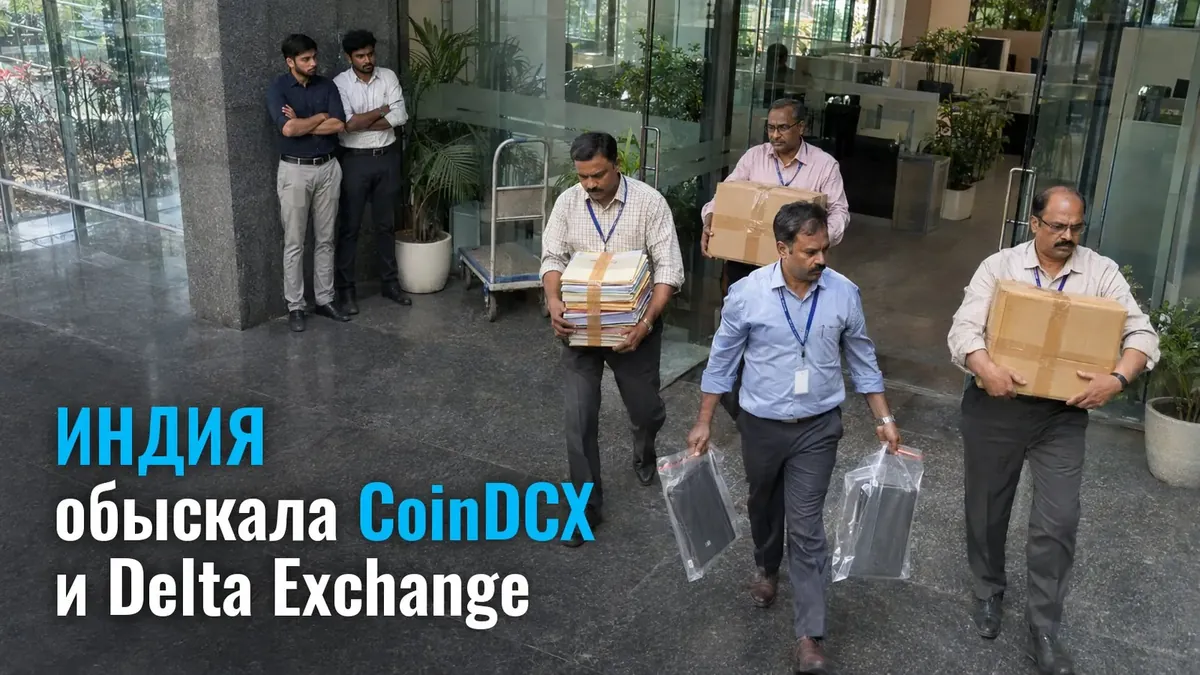
India's Enforcement Directorate raided the offices of two crypto exchanges. The raids took place on November 4 and 5, at three offices in Bengaluru at once. CoinDCX and Delta Exchange India were under scrutiny, suspected of circumventing currency legislation.
The Enforcement Directorate is the Indian agency that investigates financial crimes. CoinDCX is the country's largest exchange by turnover, Delta Exchange India trades derivatives. Derivatives are contracts on the price of an asset, such as futures and options.
This concerns traders directly. The claims are precisely that clients' money was routed through a stablecoin to foreign platforms.
What is the essence of the claims?
Formally, the raids targeted two operators. These are Neblio Technologies (operator of CoinDCX) and Excelium Technologies (operator of Delta Exchange India). The basis is Article 37 of the Foreign Exchange Management Act FEMA of 1999.
- Spot. Clients' rupees were converted into USDT and sent to Binance, KuCoin and Gate.io, where spot orders were executed. The trades went through the account of a company from Costa Rica, which the agency calls a "shell." USDT is a stablecoin with an exchange rate pegged to the dollar.
- Derivatives. Futures and options, according to the regulator, were mirrored one-to-one on Binance, KuCoin, Bybit and Gate.io through the same account.
- Tokenized stocks. Trading in US securities (Apple, Google, Tesla) was trading in derivatives on Hyperliquid, a foreign decentralized platform.
Scale. The volume of each of the three flows is tens of billions of rupees. Delta, according to case materials, sold the same products, and conducted a significant portion of trades through CoinDCX on foreign platforms: also several tens of billions of rupees.
What do the exchanges say?
Both platforms stated on November 6 that trading, deposits and withdrawals are working.
- CoinDCX called the visit a routine check and cited compliance with FEMA and client verification rules.
- Delta insists that client funds are held in Indian banks and that there are no cross-border transfers of crypto assets.
- Since 2023, Delta has been registered as a reporting entity.
What does this mean for the trader?
The main point: the issue is not the crypto exchange rate, but through which accounts the exchange routed clients' money.
Where to look. The platform's terms and payout procedures should be examined before the first deposit, not on the day of the news: how this works at prop firms is covered in the academy and in the catalog of prop firms.
What happens next?
There are no charges or arrests yet; the investigation continues.
- In addition to FEMA, the agency cites the securities market laws of 1956, the SEBI regulator law of 1992 and the central bank law of 1934.
- About $700 thousand is CoinDCX's daily turnover according to CoinGecko. For the country's largest exchange with a population of a billion, that is little.
The exchange is under scrutiny, but the volume stays the same
A platform can be raided, its license revoked, withdrawals slowed. But the notional amount you actually work with still comes down to your deposit. On two thousand dollars, a perfectly caught BTC entry closes with a result worth one trip to the store. Prop trading works differently: the company provides the capital for trading, the trader pays for selection under its rules and shares the result with it. It is better to work through the scheme step by step on a calm day, not on the day of the next news story.