

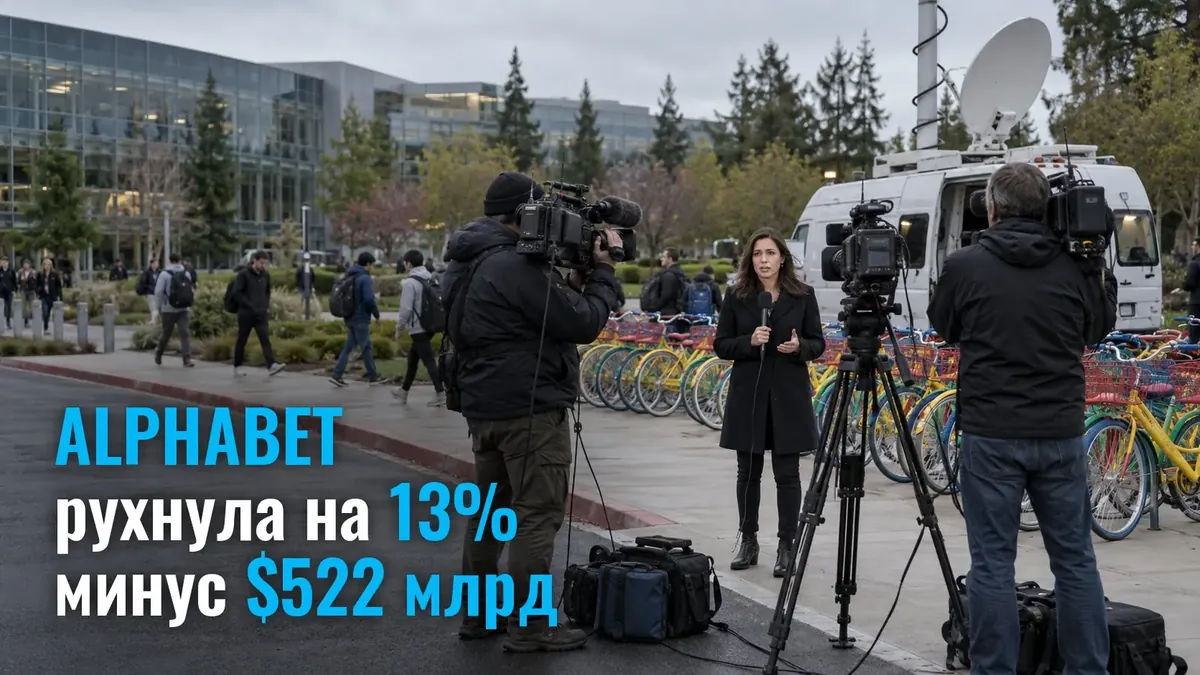
Alphabet shares fell 13.18% at the market open on Thursday. The price dropped to $279.47. This is the strongest one-day decline in the company's history. Market capitalization lost about $522 billion and declined to $3.44 trillion.
The reason is one line in the report. Alphabet holds a stake in SpaceX and revalues it at a new price every quarter. SpaceX shares fell in price, and the revaluation ate into profit.
Revaluation is the recalculation of the value of a shareholding in the financial statements, without selling the holding itself. For a trader, this is an example of how strong revenue doesn't save a stock if one figure misses the forecast.
What did the report show?
The quarter itself came in strong. The problem is only in the final earnings per share.
- $127.58 billion - third-quarter revenue, up 25%
- $30.71 billion - cloud segment, up 103%
- $40.58 billion - operating profit versus $31.23 billion a year earlier
- $2.12 - earnings per share versus a consensus of about $3.02
The decline in money terms. Minus $42.42 per share and a seven-month low.
Why did profit collapse?
The gap with the forecast came almost entirely from SpaceX. The net loss on equity investments was $8.66 billion. A year ago the same line brought a profit of $10.73 billion.
The result is minus $6.7 billion in net profit after a $1.9 billion tax benefit. Earnings per share lost $0.55.
Anat Ashkenazi, Alphabet CFO: other income and expenses went to minus $8.22 billion "primarily due to the unrealized loss on the SpaceX investment."
The price of the stake. SpaceX shares closed the quarter at $150.86 versus $170.86 three months earlier. Alphabet revalues the stake at this price every quarter.
The loss is on paper: the company didn't lose any money, but it goes fully into the financial statements.
What else scared the market?
The second sore figure is cash flow. Free cash flow went to minus $9.07 billion versus plus $24.46 billion a year ago.
- Capex. Rose to $51.36 billion, more than double last year's $23.95 billion.
- Operating cash flow. Fell to $42.29 billion.
- Data center construction. It is precisely this that is draining money from free cash flow.
What happens next?
The spending plan is unchanged. Capex for 2026 is left at $195-205 billion. In 2027, spending will "increase substantially," with the specific amount promised on the fourth-quarter call.
There is enough money. Cash and securities on hand total $265.10 billion, so data center construction is financed without debt. It's convenient to keep the upcoming reports and US market events at hand in the economic calendar.
Did you watch this opening gap?
Everyone sees such a gap in the first minutes of the session. The only question is how much volume you had in it. Minus $42 per share is one figure when a dozen shares fit into the account, and a completely different one at a notional of a hundred thousand. Prop trading changes exactly this link: the trader goes through the selection, and the company provides the trading notional within its limits and shares the profit. It makes sense to understand the mechanics before the next earnings season, not after the fact.