

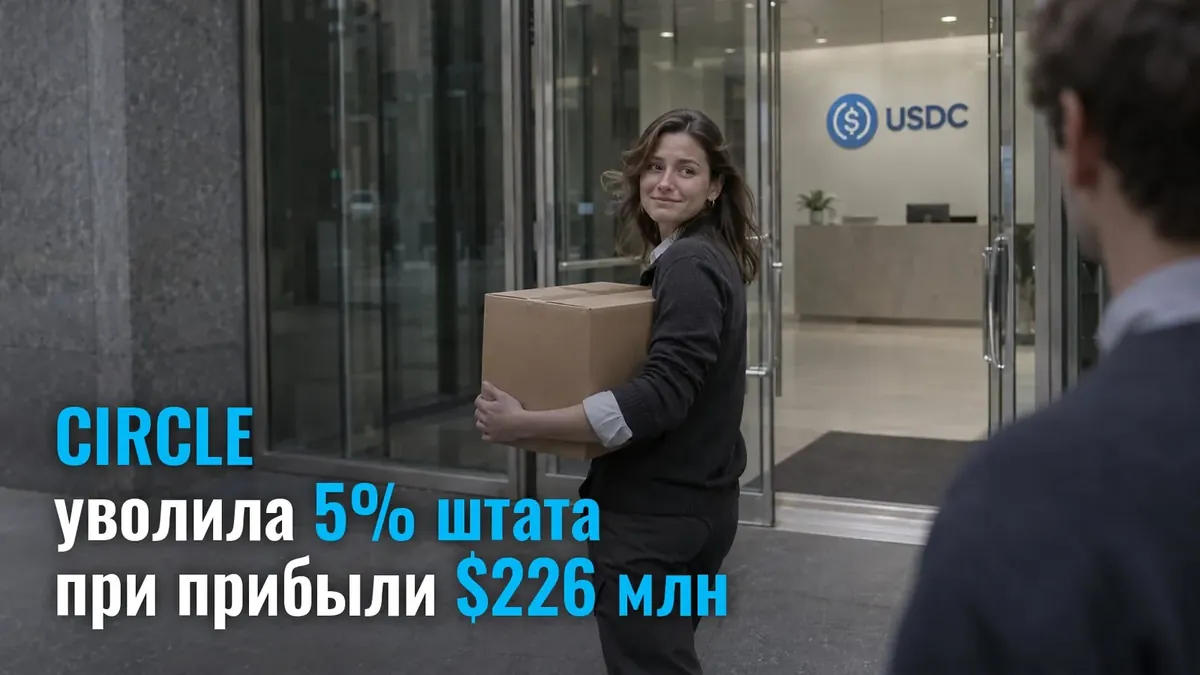
Circle laid off about 5% of its staff and paid $9.1 million for it. The company didn't write about the layoffs in a press release, but in a footnote to its third-quarter report. The quarter itself closed with a profit.
Circle is the issuer of USDC. It's a stablecoin, meaning a coin whose exchange rate is pegged to the dollar. For every coin, the company holds cash and US Treasury bonds, and it lives off the interest on those reserves.
The link to the rate is direct. The lower the Fed rate, the less Circle earns on the same volume of USDC. This is visible in the report and affects everyone who holds dollars at interest.
What did the report show?
There is growth, but it's one-off. The quarter's key figures look like this.
- $865 million - total revenue including income from reserves, up 17%
- $226 million - net income from continuing operations, up 5%
- $182 million of that growth came from the pre-sale of the ARC token, a one-off transaction
- $658 million vs. $711 million - income from reserves excluding it and other non-interest income
Why are revenues shrinking?
Interest is the core of the business. Income from cash and US Treasury bonds accounts for about 75% of the revenue of the company behind CRCL shares.
- The rate. The yield on reserves fell to 3.5%, down 0.61 percentage points. Every Fed rate cut directly cuts this line.
- Volume. USDC in circulation at the end of September was $73.9 billion, exactly the same as a year earlier.
- Market share. In the dollar stablecoin market, USDC holds 27%, down 1.83 percentage points over the year.
- Expenses. Operating expenses rose 16% to $244.9 million. Payments to partners for distributing USDC fell from $447.2 million to $409.2 million.
What does this mean for a trader?
Circle's report has become a bet on the Fed. The faster the regulator cuts the rate, the stronger the pressure on the main revenue line. It's convenient to keep meeting dates in the economic calendar.
Key point: about 75% of Circle's revenue is interest on reserves, and their yield has already dropped to 3.5%.
What's next?
The company is looking for income beyond the rate. Circle is investing in areas that don't depend on Fed decisions.
- On September 16, the Arc blockchain went live: 11 validators and more than 100 applications
- $41.3 billion - annual turnover of the payment network, with 205 financial institutions connected to it
- $570-585 million - forecast for adjusted annual expenses, the final figure depends on hiring
The company left its expense forecast unchanged. The previous layoff was in December 2024, when Circle cut "less than 6%" of staff.
Do you keep cash in a stablecoin between trades?
This report shows how yield on the dollar melts along with the rate. The same thing happens to your free balance on an exchange. On a personal two or three thousand dollars, neither interest nor well-timed moves produce a sum worth waking up at night for a report. Prop firms hand the trader their account after a discipline check and leave them most of the result. It makes sense to study the mechanics in a calm market.