

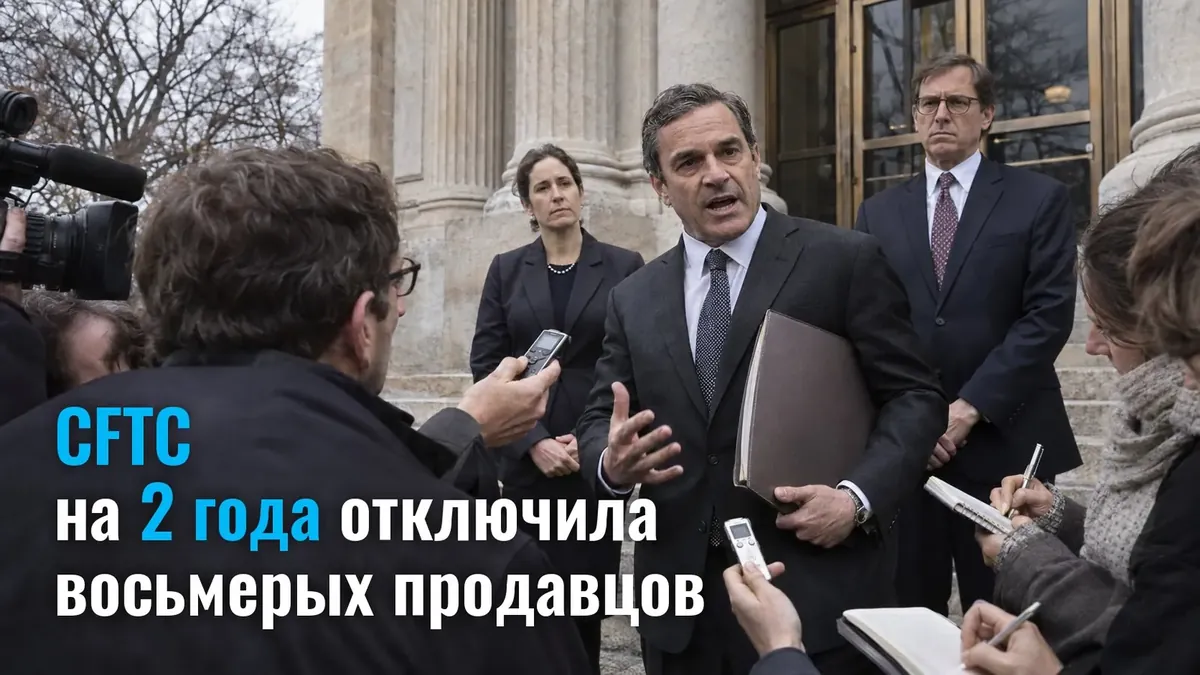
CFTC barred eight Americans from working in the industry for two years. The regulator announced the decision on November 9. These individuals brought US retail traders to unlicensed offshore brokers.
CFTC is the US Commodity Futures Trading Commission, the regulator of the futures and forex market. An offshore broker here is a company registered outside the US that has no American permission to work with clients.
The scale doesn't add up. Clients deposited about $391 million into four brands, while fines totaled $650 thousand. For the trader, this is about the price of easy entry: the account was opened quickly, but such brokers had no American license.
How much money did the brands collect?
- KOT4X - approximately $296 million. The largest brand, registered in Saint Vincent and the Grenadines, operated from 2019 to 2025.
- Prosperity LLC - $35 million.
- Envi LLC - $34 million.
- FxSway LLC - $26 million.
The fines were split among everyone. Seven owners owe $590 thousand. The eighth, Christopher Williams from Dubai, pays $60 thousand.
Where the money goes. All sums go to the SEC; the CFTC did not impose its own monetary penalty.
How were such brokers assembled?
The broker was assembled from ready-made parts. The owners bought them from providers and launched a brand.
- Storefront and product. The website and contracts for difference. A contract for difference is a trade on the change in the price of an asset without buying the asset itself.
- Technology. Accounting systems and a trading application under a sublicense.
- Market. Prices and liquidity from a provider.
- Money and documents. Storage of client funds and their verification.
The money scheme. Clients made deposits in Bitcoin and other crypto. The funds sat in the provider's collateral account, while the brands lived on a share of commissions and the fee for carrying a position.
The providers paid earlier. Netrios LP Ltd. and Red Acre Ltd. agreed in June to pay $2.5 million.
Who was banned?
There is a well-known name among those punished. The SEC describes Quillan Black as a blogger known online under the name Cue Banks. He and Anthony Tyler Williams must each pay $125 thousand.
- CFTC - forex, metals and crypto.
- SEC - contracts for difference on 37 American and European stocks.
- Two years - the period of the ban on registration; after that, an application can be submitted again.
What does this mean for the trader?
The legal channel for the same trades is tiny. Six US-registered retail forex dealers held $470.0 million in client money in August 2026. In June it was $462.3 million - the lowest at least since 2023.
The CFTC's warning list as of May 2025 contained about 300 companies.
The main point: an offshore account with easy registration rests on the provider, not on the regulator. Figuring out the risk rules before the first deposit is cheaper: the mechanics are described in the academy, and you can pick a challenge to suit your market.
What's next?
The regulator is preparing new rules. In October, the CFTC collected feedback on a draft of rules for retail leveraged crypto trading.
- Draft rules on leveraged crypto - feedback was collected in October.
- New applications from those involved - they can be submitted in two years.
- Money in legal US forex - a benchmark of $470.0 million as of August 2026.
Looking for more leverage and simpler registration?
On your own deposit, a hundred-pip move costs pennies. So you want higher leverage and fewer questions when opening an account. That's how you end up with a broker from Saint Vincent. In prop trading, the company allocates the capital for the trade: you pay for the selection, trade within its loss limits, and split the result under the contract. Understanding this mechanics is cheaper than sending a deposit in crypto to who knows whom.