

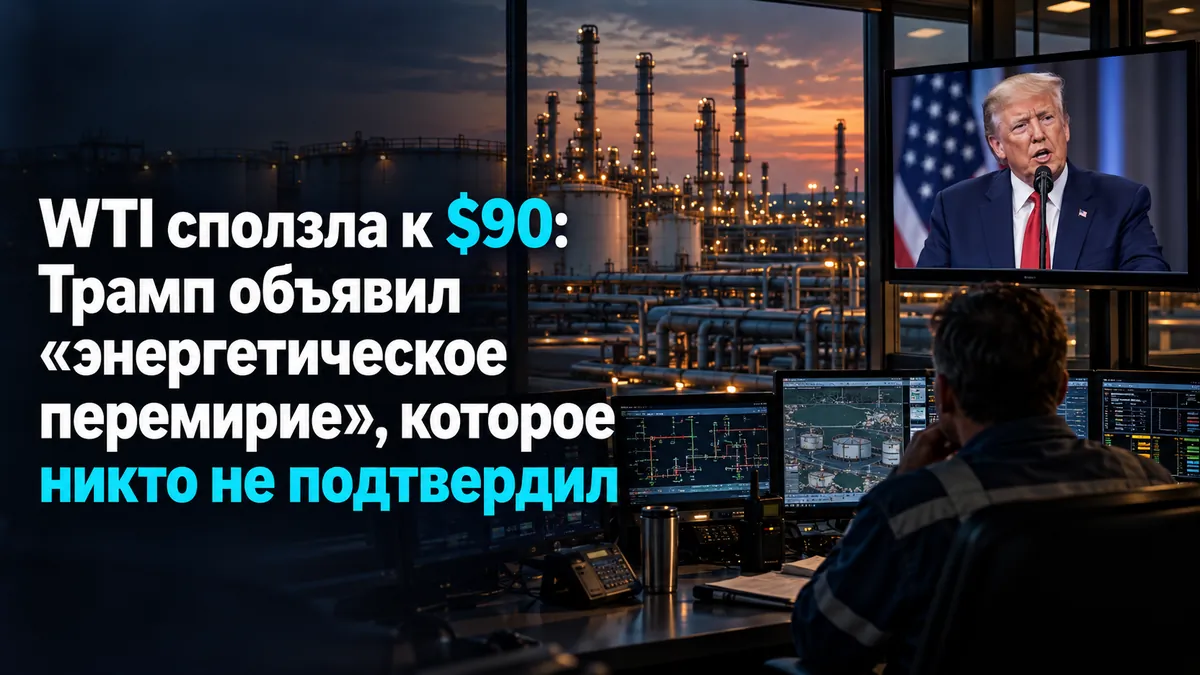
WTI crude oil fell by about 1.5% on Monday morning and returned to the $90 per barrel mark. Before that, quotes had risen for two sessions in a row. The trigger for the reversal was Donald Trump's statement about a possible agreement between Russia and Ukraine to stop strikes on energy infrastructure.
What Trump said
On Sunday, Trump said the parties had allegedly agreed to a so-called energy truce. This refers to ceasing strikes on energy infrastructure facilities. However, no specific timelines, conditions, or mechanism for monitoring compliance with the agreement were given. It is precisely the lack of details that remains the main question for the market.
No confirmation from either side yet
The Ukrainian side said it was ready to support a cessation of strikes on energy facilities provided Russia takes similar actions. However, there are still no final details of the agreement. Therefore, the market is reacting primarily to the expectation of reduced risk to energy infrastructure, rather than to a confirmed agreement.
The Russian factor is already weighing on oil
An additional factor was previous statements about Russian diesel supplies. Earlier, volumes of 300 thousand tons at once, 500 thousand tons in November, then another 1 million tons and additional supplies later were indicated. The very expectation of increased supply of petroleum products has already eased tension in the market. Now a potential scenario of reduced risks to energy infrastructure has been added to this.
Risks in the Middle East have not gone away
At the same time, the situation around the Persian Gulf remains tense. There are reports of new attacks on transport and oil infrastructure in the region. Incidents involving vessels and tankers create additional risk. The US has also begun using oil from strategic reserves. Despite these factors, at the start of the week the market is reacting more strongly to the possible reduction of risks around the Russian energy sector.
Why oil is falling even amid geopolitical tension
The price of oil reflects not only actual supply disruptions but also the probability of future shortages. If the market begins to believe that some energy risks are decreasing, the geopolitical premium can shrink quickly. This is exactly what is happening with WTI right now. There is no confirmed truce yet, but the probability of reduced attacks is already partially priced in.
Why the $90 level matters
The $90 per barrel mark has become an important technical and psychological zone for WTI. Systematic and algorithmic strategies are more active around this level. If the price consolidates below $90, selling pressure may intensify. A return above this level, on the contrary, would show that the geopolitical premium remains quite strong.
What's next
The main factor will be new statements from Washington, Moscow, and Kyiv. The market needs specific terms of a possible agreement, its duration, and confirmation from the participants. Until such details emerge, oil price movements may remain sharp. Additionally, traders will continue to monitor Russian diesel supplies and the situation in the Middle East.
Did you trade this overnight candle in oil?
Oil is now reacting to political statements literally within minutes. For a prop trader, such moves require especially precise risk control. Different programs have different available volumes, position rollover rules, daily drawdown limits, and trading conditions during periods of heightened volatility. In prop trading, the trading nominal is provided by the company after passing the challenge, so it is better to check the rules of a specific program in advance.