

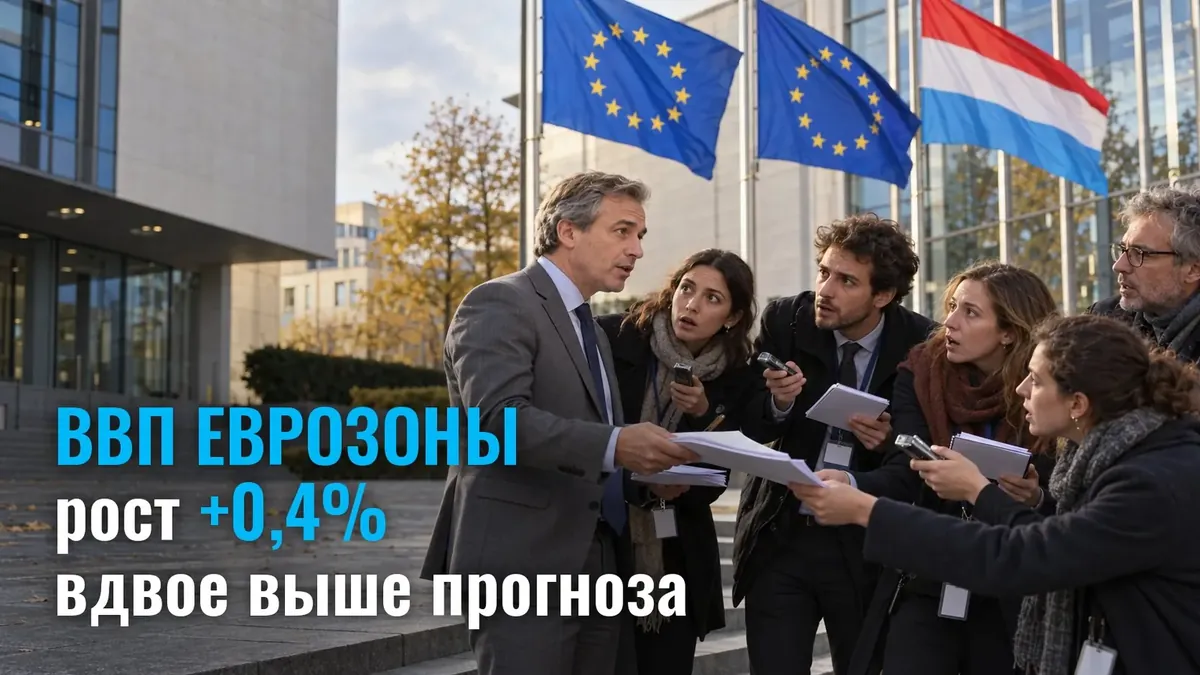
The eurozone economy grew by 0.4% in the third quarter instead of the expected 0.2%. The preliminary estimate was published on October 30 at 13:00 MSK. The market expected growth half as strong.
GDP is the total value of goods and services produced in an economy. "QoQ" means compared with the previous quarter, "YoY" means compared with the same quarter a year earlier.
For a trader, this is a signal on the rate. The stronger the economy, the fewer reasons the ECB has to ease policy. Hence the reaction in the euro and European indices.
What figures came out?
- QoQ: +0.4% - forecast +0.2%, previous value +0.6%
- YoY: +1.3% - forecast +1.1%, previous value +1.2%
Both indicators came in above the analysts' consensus.
Why is the release mixed?
The main thing in the release is its mixed nature. The quarterly and annual readings showed different directions.
- Quarterly growth slowed. The pace dropped from 0.6% to 0.4%.
- Annual growth accelerated. The indicator rose from 1.2% to 1.3%.
What does this mean for a trader?
GDP data is one of those releases around which the trajectory of the ECB rate is repriced. And therefore the demand for the euro as well.
The main thing: a release better than expected removes some of the arguments for looser policy.
In focus are EUR/USD, EUR/GBP, EUR/JPY and European indices. The dates of the next releases for the bloc are in the economic calendar.
What happens next?
The estimate is preliminary. Eurostat traditionally refines it in subsequent publications.
- The final figure may differ from the first one
- Trading indices and currencies is easier with an account suited to your style: choose a challenge
Were you watching EUR/USD at 13:00?
The figure came out twice the forecast. The reaction in the euro played out within a few minutes. What matters next is not the precision of the idea, but the size of the position. A move of 30-40 pips on EUR/USD on an account of a couple thousand dollars is an amount that isn't even interesting to count. Prop trading works differently: you pay for the selection yourself, while the company provides the trading notional and risk limits, leaving you a share of the result. There is time before the next eurozone macro release to figure out how this scheme works.