

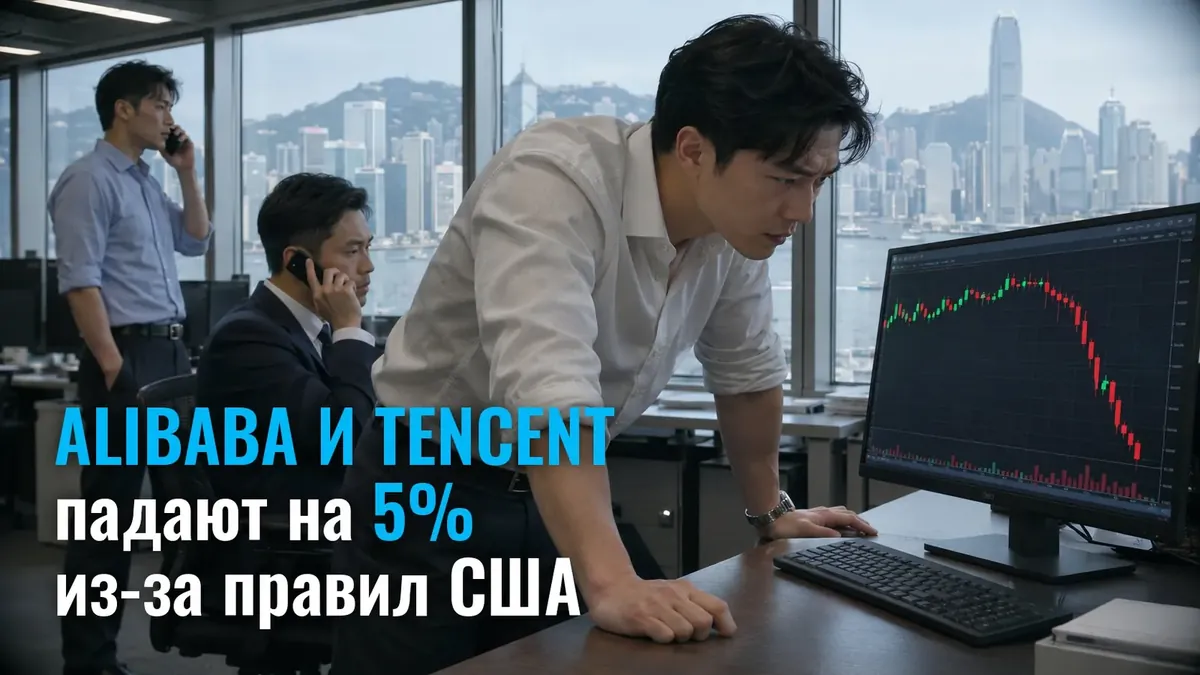
Alibaba and Tencent fell about 5% in Hong Kong. That is how the market reacted on the morning of November 12 to the preparation of new rules in the US. Washington wants to close Chinese AI companies' remote access to advanced chips through data centers outside the US and China.
What remote access is. It is renting someone else's servers over the network. A company does not bring chips into its own country but pays for computing at a facility in another country.
Why this concerns a trader. The chip theme moves the Hong Kong market more strongly than the companies' own reports. A single headline from Washington changes the price at the session open.
What did it look like in numbers?
- -5% - Alibaba (9988.HK) by 08:24 Moscow time.
- -5% - Tencent (700.HK) at the same moment.
- The two largest technology companies by weight in the Hong Kong market.
Domino effect. Because of that weight, movement in these stocks drags the entire local technology segment along with it.
What ban is being prepared?
The news source is The Information. According to its data, the US Department of Commerce is preparing to approve a ban on remote access by Chinese AI companies to advanced chips through overseas data centers.
Data centers are facilities with servers whose capacity can be rented over the network.
- How it worked before. The scheme allowed companies to work on Nvidia chips without physically importing them into China.
- What is changing. The regulator is taking on this workaround, that is, the renting of computing abroad.
Why did the market get scared?
- Renting abroad was plan B. Reuters writes that Chinese AI companies were precisely trying to secure more rented Nvidia-based capacity abroad.
- Spy scandal. Companies' concern is linked to the scandal around Nvidia's CEO. Companies believe he could push Washington to restrict specifically the remote use of chips.
- Sharp turn. On November 10, Washington allowed shipments of Nvidia H200 chips to companies on the blacklist.
What does this mean for a trader?
The Hong Kong tech sector remains hostage to the chip theme. A headline comes out at night or in the morning, and the price moves at the open.
Key point: the date for approving the rules has not been officially named, so the news can arrive in any session. It is worth checking in advance which indices are generally available in the program: find a challenge for indices or compare markets in the prop firm catalog.
Did you watch this gap in Hong Kong this morning?
The Asian session opens when half of traders are still asleep, and the 5% move is captured by whoever has access to the instrument. Prop firms differ on this: some have Hong Kong and Asian index contracts on the list, while others are limited to the US and Europe. Entering in the first minutes after the open falls under a separate limit. This can be read in the program terms before paying for the evaluation. A filter by market immediately rules out those where such trading simply does not exist.