

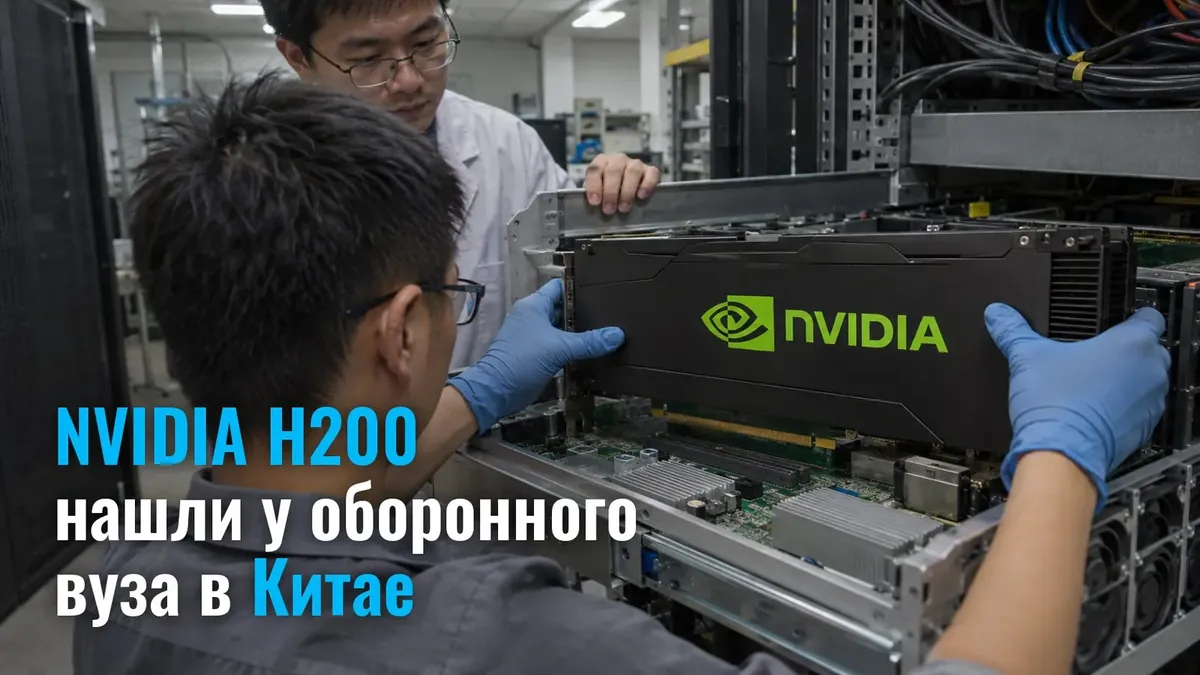
Reuters reported on November 11 that a Chinese defense university bought Nvidia H200 accelerators. The chips reached it bypassing US export restrictions.
An accelerator is a special microchip on which artificial intelligence models are trained. The H200 is Nvidia's top model for such tasks. It cannot be sold to China without permission from US authorities.
For a trader, this is a story about Nvidia, not about a university. The NVDA stock drags the US indices along with it, so any news about export controls moves the market.
Why is this case special?
- The first public buyer from the military sphere. Previously, organizations linked to the Chinese army were not publicly named among buyers of such chips.
- A defense-sector university. It should not have access to the H200 in principle.
- The H200 is on the prohibited list. This is equipment that is banned from being sold to China without permission from US authorities.
How does this relate to the November 10 decision?
The news landed on top of a fresh easing. On November 10, Washington allowed H200 deliveries to some Chinese companies from the blacklist; we wrote about this.
Now critics of this decision have a concrete example. Chips are reaching even those for whom they are officially closed off.
- Permission granted. Some companies from the blacklist received the right to the H200.
- Leak discovered. The accelerators turned up at a structure for which they are completely closed off.
- The topic is open again. The issue of export controls has returned to the market's agenda.
What does this mean for a trader?
Nvidia (NVDA) is one of the main drivers of the Nasdaq 100 and S&P 500. Tightening the rules or canceling permits hits the stock, and through it the indices as a whole.
The main point: the significance of the news is not in the university itself, but in the fact that export controls have once again become a tradeable topic. It is more convenient to plan such weeks via the economic calendar.
What happens next?
No reaction yet. Neither Washington nor Nvidia has officially commented on the publication.
Next, watch two things:
- Confirmation of the leak. Whether US authorities acknowledge the fact of chip deliveries to the university.
- The fate of the permission. Whether the November 10 decision remains in force.
Do you hold indices with Nvidia inside?
One publication about chips - and the Nasdaq futures move by percentages while you are reading the headline. Trading such headlines on someone else's account is far from allowed everywhere. Some prop firms explicitly prohibit entering indices on political news. Some restrict them to the main US session only. These lines of the rules are cheaper to read in advance than after an account is closed. The filter will show where indices and news trading are permitted.