

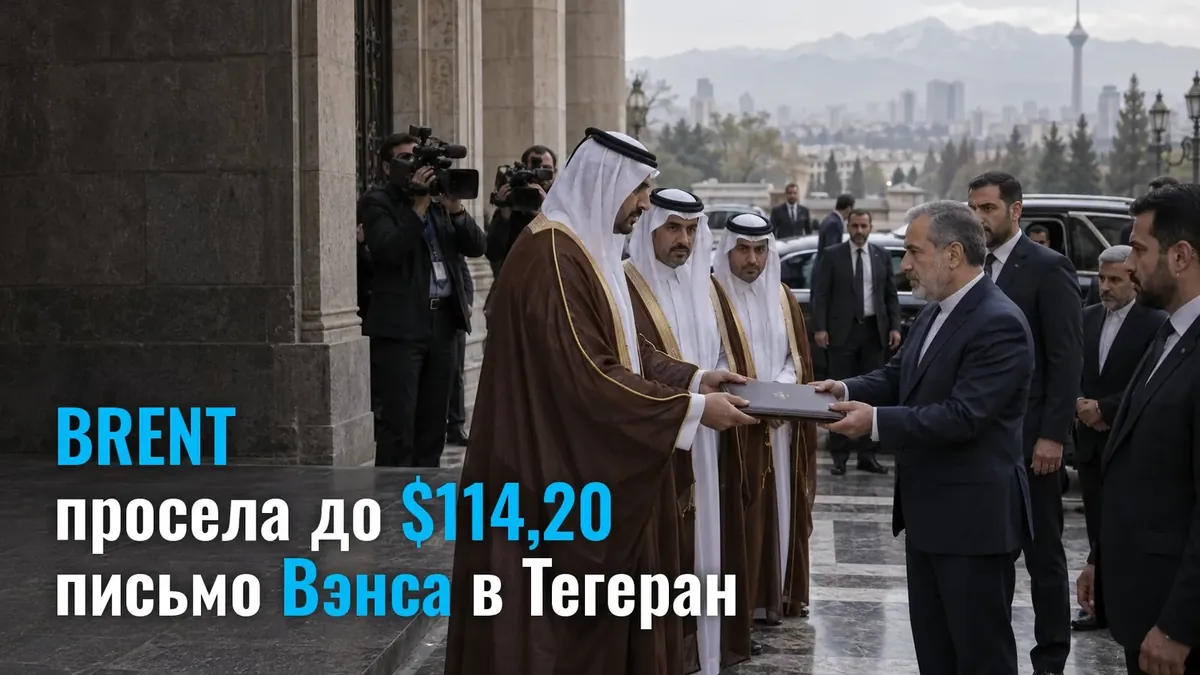
US Vice President JD Vance sent a letter to Tehran proposing to resume negotiations. After that, oil went down: Brent lost about 1% on Thursday, to $114.20 per barrel, WTI - 1.4%, to $101.40.
Brent and WTI are two benchmark grades of oil. Brent (North Sea) is used to price oil in Europe and Asia, WTI - in the US. Mohsen Rezaei, to whom the letter is addressed, is an Iranian security official.
Why this matters to a trader. The market is simultaneously pricing in two opposite scenarios from Washington: negotiations with Iran and preparations for a strike after the November 3 election.
Where does the downward reversal come from?
Before the letter, oil was rising. On Wednesday, December Brent closed up 1.3%, at $115.32, WTI gained 2.9%, to $102.78 - after a two-day decline.
- Almost double - that is how much Brent has risen in price since the start of the year
- $114.00 - spot Brent assessment at 09:41 Moscow time
- $114.20 and $101.40 - Brent and WTI futures on Thursday
What is being said about the war?
Signals from Washington are going in both directions. A day earlier, The Wall Street Journal, citing sources, reported that the US had warned Gulf countries about a short and intense campaign against Iran.
- Trump has not decided. He is leaning toward a major attack after the election, but has not made a decision. He told Fox News that "the time is coming to decide."
- Qatar handed over a draft. Mediators handed Tehran a draft agreement to end the war.
- Iran refused. An Iranian official called the document unacceptable and not an official proposal. The foreign minister said a chance for diplomacy still remains.
- A missile over the kingdom. The Saudi-led coalition said on Thursday morning that it had intercepted a ballistic missile flying toward the country's eastern regions.
- Refinery without confirmation. Riyadh has still not confirmed the Houthi-claimed strike on the country's largest refinery with a capacity of 550,000 barrels per day.
What did US inventories show?
US crude oil inventories fell by 1.9 million barrels in the week to October 23. This is the fourth decline in a row. The Reuters consensus expected a rise of about 15,000.
- 3.9 million barrels - that is how much gasoline inventories rose
Key point: on newspaper reports alone, Brent reverses twice in a day. For a trader, this is a risk of getting stopped out, not a reason to chase a trend.
What's next?
Today at 15:30 Moscow time, US GDP and the PCE index are released. PCE is the core inflation gauge for the Fed. These releases are in the economic calendar.
- $113-117 - the corridor in which Brent has been trading all week
- $108 and $120 - reference points at the edges of the range
Have you traded oil on these headlines?
A week in Brent is a four-dollar corridor. And two reversals per day on newspaper reports alone. At prop firms, oil is treated as a separate line item: at some, Brent and WTI are simply not on the list of instruments, at others the maximum volume for them is cut. And holding a position through a futures roll is considered a violation. These points are visible in the terms in advance, not after an account is closed. There is still time to check them before the November 3 election.