

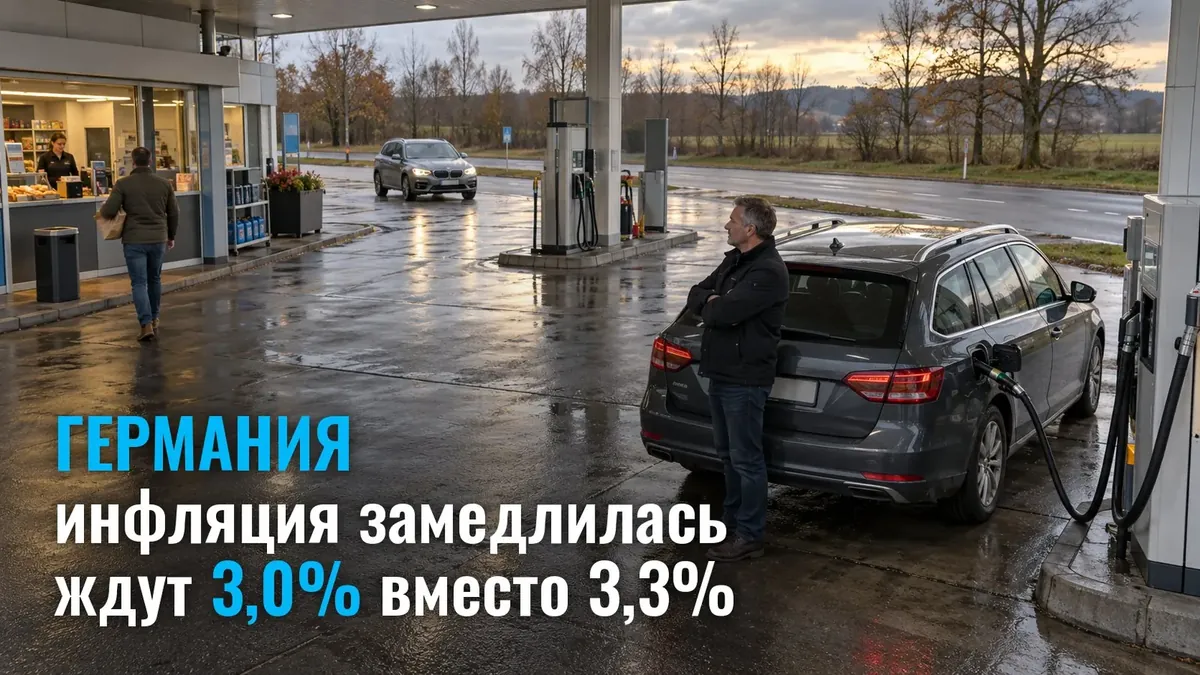
Germany's largest federal states reported slowing price growth. Preliminary data was released on October 30 at 12:11 Moscow time. In almost all regions, annual inflation turned out to be lower than a month earlier.
The states report before the country. Germany publishes statistics in two steps: first the regions, then the nationwide preliminary estimate. Therefore, the figures for the states are the first guide to inflation for the whole country.
This matters to traders because of the ECB. The regulator's rhetoric in December depends on the nationwide figure. And therefore so does the euro exchange rate and eurozone government bond yields.
How much have prices slowed?
Annual growth in consumer prices (CPI) by state:
- Bavaria: 2.8% versus 3.2% a month earlier
- Saxony: 2.9% versus 3.3%
- North Rhine-Westphalia: 2.7% versus 3.3%
- Baden-Württemberg: 2.6% versus 2.9%
Why have prices slowed?
There are two reasons, and both are one-off.
- Base effect. The comparison is against already high prices a year earlier.
- Taxes and discounts. Since the start of the month, reduced energy taxes and fuel discounts have returned.
But it's too early to relax. Pressure on prices is still higher than it was before the September acceleration.
What will the national figure show?
The consensus for the country is 3.0% after 3.3% in September. The state data points to a risk of a figure below forecast, around 2.9%.
An important caveat. Regional reports are historically a useful but not perfect guide. Divergence from the preliminary national estimate does happen.
What does this mean for the ECB?
The picture does not get any simpler for the ECB. Growth in the eurozone is weak, while price pressure is spreading across the region. Earlier, France and Spain showed acceleration.
The main point: the regulator still needs to act again in December. But there is a risk that an extra move will push the economy down.
What's next?
The preliminary national estimate for Germany is published the same day. Next, attention shifts to the December ECB meeting - its date is easy to find in the economic calendar.
Two things are under watch:
- The euro - its reaction to the actual national figure
- Eurozone government bond rates - expectations for the December ECB decision
Were you holding the euro when the figure came out?
Germany's regional reports come out in a batch. You have to react within minutes, even before the national estimate. But the question is not the idea, but whether you are even allowed to hold a position at that minute. With some prop firms, entering during the release window is normal trading; with others, it's grounds to close your account, and a sharp spike also eats into your daily drawdown limit. This is written in the program's rules, not in its advertising. There is still time to check before the December ECB meeting.