

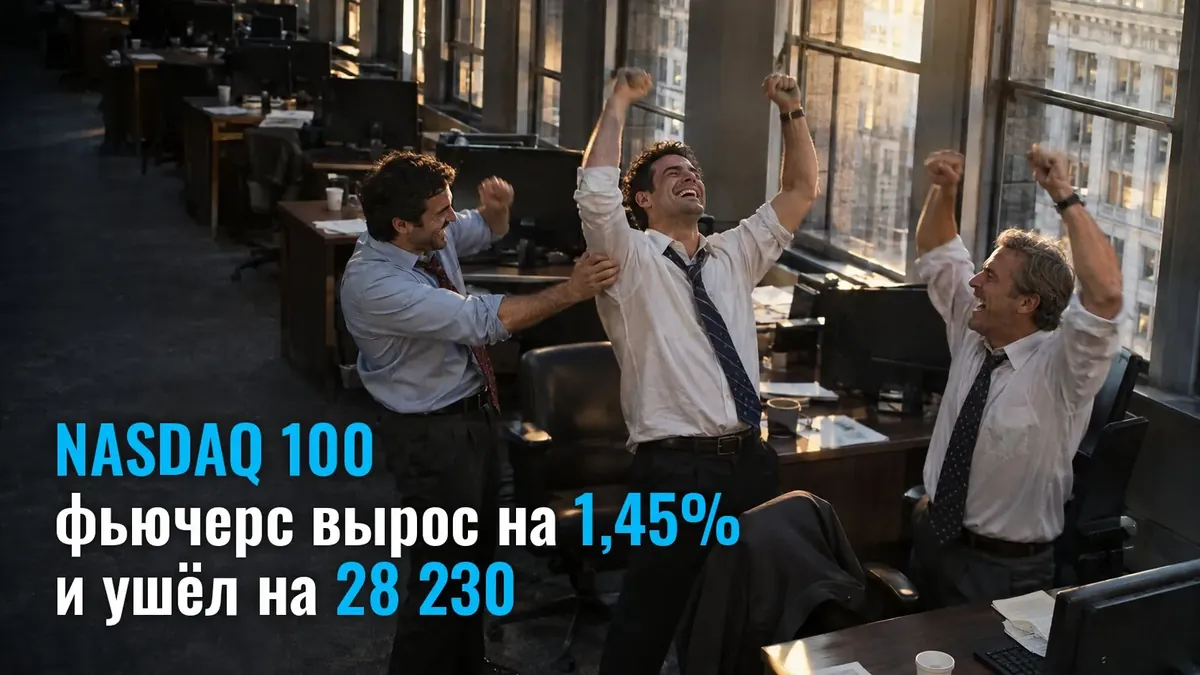
US index futures rose on the morning of November 11. The Nasdaq 100 contract gained the most. A day earlier, the same indices closed lower after inflation data.
A futures contract is a contract on the future price of an index. It trades before the US exchange opens, so the morning reversal is visible earlier than in the stocks themselves.
Two signals drove the reversal: de-escalation around Iran and strong reports in the artificial intelligence sector. For a trader, this means the move in the indices had already begun during the European session.
How much the indices gained
- Nasdaq 100 - up 1.45%, around 28,230.
- S&P 500 - up 0.60%, around 7,590.
- Dow Jones - up 0.16%, around 52,400.
Timing of the reading. These were the prices by the European session on Wednesday.
Why did the market reverse?
- Geopolitics. US President Donald Trump signaled that new military action against Iran may not be needed. At the G7 summit, Secretary of State Marco Rubio backed this line.
- CoreWeave report. The company reported better than forecasts and raised its guidance; the stock rose almost 8% in evening trading. CoreWeave is a data center operator for AI workloads.
- Anthropic IPO. According to reports, the company could go public as early as next week. It aims to raise up to $90 billion at a valuation of about $1.4 trillion.
What happened on Tuesday?
On Tuesday the market moved the other way.
- Dow Jones - down 0.35%.
- S&P 500 - down 0.38%.
- Nasdaq Composite - down 0.74%.
The reason was inflation. The headline consumer price index rose 0.4% for the month versus a forecast of 0.3%, and the core index rose 0.3% versus 0.2%. According to CME FedWatch, the probability of a Fed rate hike in December rose to 85%. The dates of such reports are in the economic calendar.
What does this mean for a trader?
The key point: the indices reversed twice in a single day - first down on inflation, then up on geopolitics and earnings.
The conclusion is simple. Such morning surges are caught by those who are already in the market in the morning, not after the US exchange opens. You can pick a challenge for index trading in advance.
What's next?
- PCE data. Jan Hrun of Societe Generale called the October core reading an upside surprise and sees PCE as the next test for inflation. PCE is American spending, which the Fed watches.
- US government funding. The deadline is approaching, and Democrats in Congress intend to use it as leverage.
Did this morning's Nasdaq surge pass you by?
One and a half percent on the index in a single European morning is a good day for those who trade index futures. But in an account of a few thousand dollars, such a surge is barely visible. That is why prop trading exists: the company runs a paid evaluation, then gives you its own trading account with strict loss limits and takes a share of the result. The market right now lives between inflation and earnings. It is worth understanding this mechanics before the next such morning.