

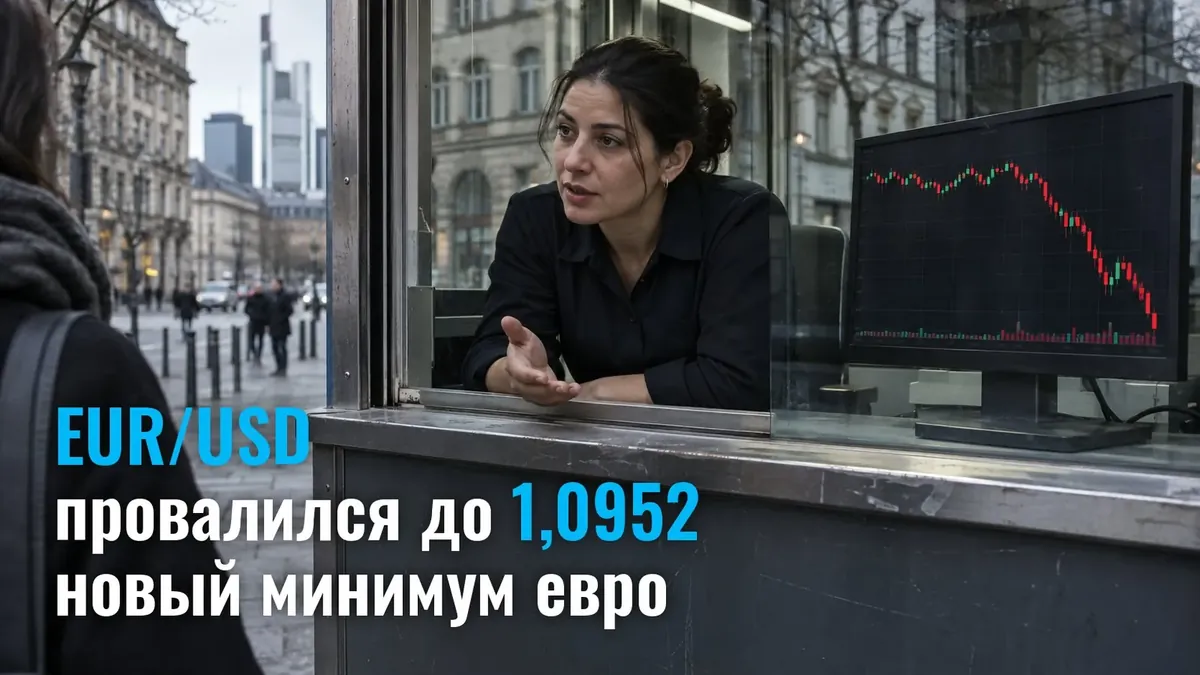
The euro on Wednesday, November 19, fell to a new low against the dollar. Intraday, the EUR/USD pair reached 1.0952 and closed at 1.0973. The euro consolidated below the round mark of 1.1000.
EUR/USD is the main forex currency pair. Its rate shows how many dollars one euro costs.
The day's move is normal for forex, just -0.22%. At the same time, the euro is heading to new lows for the third time in a row, and the pair fails to rise above 1.1025.
Session results
Wednesday ended in the red for the euro across all of the day's benchmarks.
- 1.0952 - the day's low
- 1.0973 - session close
- -0.22% - the day's result
- 1.1000 - the mark below which the pair consolidated
- 1.1025 - the level above which the euro has not yet risen
For forex, this is a normal daily range. But it pushes the euro to new lows for the third time in a row.
Why isn't the euro rising?
The dollar is weighing on it. The eurozone's own data on Wednesday was mostly positive, and it didn't help the rate.
- Empty calendar: only the current account for September was released in the eurozone. This is the difference between what a country receives from abroad and pays abroad.
- Germany's surplus: came in stronger than expected, despite expensive energy.
- Business confidence: remains high in the eurozone.
- Forecast for 2027: economic growth was revised upward.
The euro didn't benefit from this. Which data comes out next can be seen in the economic calendar.
The dollar is also weighing on its neighbors
- AUD/USD at 0.6650 - the lowest since January after weak Australian employment data
- USD/JPY around 159.50 - closer to 160.00, the market expects talk of Japanese currency intervention
- Gold lost 3.19% on Wednesday and dipped below $3700 - it hasn't been there since September 2025
All three instruments fell under the dollar on Wednesday.
UOB and ING levels
- 1.0950-1.0995 corridor: at UOB (Quek Ser Leang and Lee Sue Ann) they consider it the nearest for the pair.
- A close below 1.0950: in their assessment, on a one-to-three-week horizon it opens the way to 1.0925, as long as the pair holds below 1.1025.
- Acceleration downward: UOB does not record it.
Chris Turner of ING does not expect a reversal of the strong dollar until mid-December and keeps 1.0880 in mind.
The benchmarks for the coming weeks are set: 1.0925 below, 1.1025 above. A challenge for trading currency pairs can be selected in the calculator.
Did you short this pair from your deposit?
In forex, the daily move rarely exceeds a percent. That's why the entire result is determined by the position's notional size. A 0.22% move on a deposit of a couple thousand dollars is barely visible, even when the direction is guessed correctly. In prop trading, the size of the trading account comes from the company: you pay for the challenge, trade within its drawdown limits, and receive a fixed percentage of the profit. It's cheaper to understand the mechanics before the next such dollar move.