

What exactly worked?
Starting with 34 securities. The user issues a tokenized representation of an asset held in a depository. Reverse conversion is also available.
Tokenization is the issuance of a record on a blockchain tied to a real security.
- Owner's rights - the same as with a regular stock
- Investor protection - preserved in full
- Token payouts - like on a traditional security
How large-scale is this?
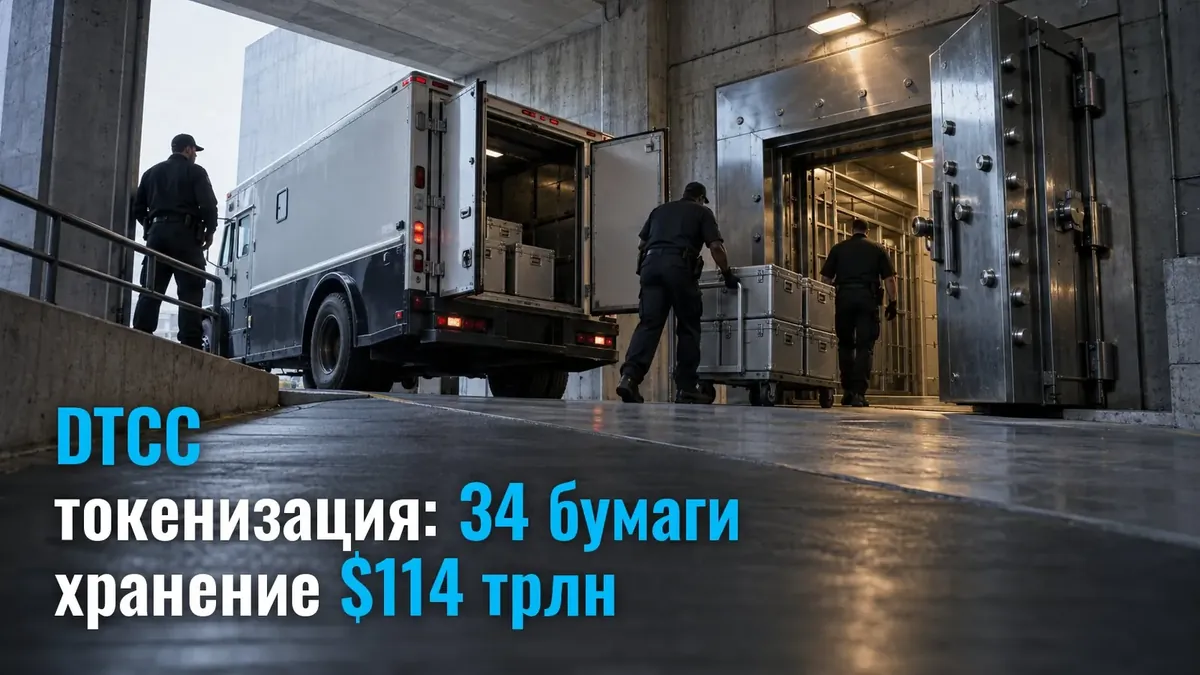
More than $114 trillion in assets is held in custody at DTC. The infrastructure that can now work with blockchain serves almost the entire US market.
20 participants signed on for access: Bank of America, Barclays, BNP Paribas, Citi, Citadel Securities, Fidelity, J.P. Morgan, Morgan Stanley, State Street, UBS, Alpaca, DriveWealth and others. More than 150 companies took part in the working group.
How does it work technically?
- Two blockchains for now. The service is connected to Canton Network and to DTCC's private network on Besu.
- Expansion in 2027. Other blockchains are promised to be added then.
- Different schedules. Token transfers run around the clock. Requests to convert to the regular form and back - on a narrower schedule.
How did they get to launch?
In December 2025, the SEC issued DTC a no-action letter. It allowed tokenizing securities from the Russell 1000 index, index exchange-traded funds and US Treasuries.
Seven months later, DTCC and more than 30 companies conducted the first limited trades in production. It is convenient to track the timing of regulatory decisions on the US market in the economic calendar.
What happens next?
Frank La Salla, president and CEO of DTCC, called the launch the result of years of work to bring tokenized securities into a regulated framework.
- Brian Steele, president of the clearing division - the industry is ready to move out of the experimentation stage
- Nadine Chakar, global head of DTCC Digital Assets - this is only the beginning
- New participants will be connected gradually
The main thing: stocks and bonds are moving onto the same rails as crypto. A trader should understand in advance which market he wants to work in, and pick a challenge to suit his style.
The US market is moving to blockchain. And your account?
Stocks and Treasuries will soon move where you already trade tokens. Around the clock and with the same wallets. There will be more instruments, and one question will remain: how much volume you stand in this with. With a couple of thousand on deposit, any new movement remains an observation, not a result. In prop trading, the company provides the notional: you pay for the selection, pass it and work within its limits. Understanding the mechanics is cheaper now, while these markets are just opening up.