

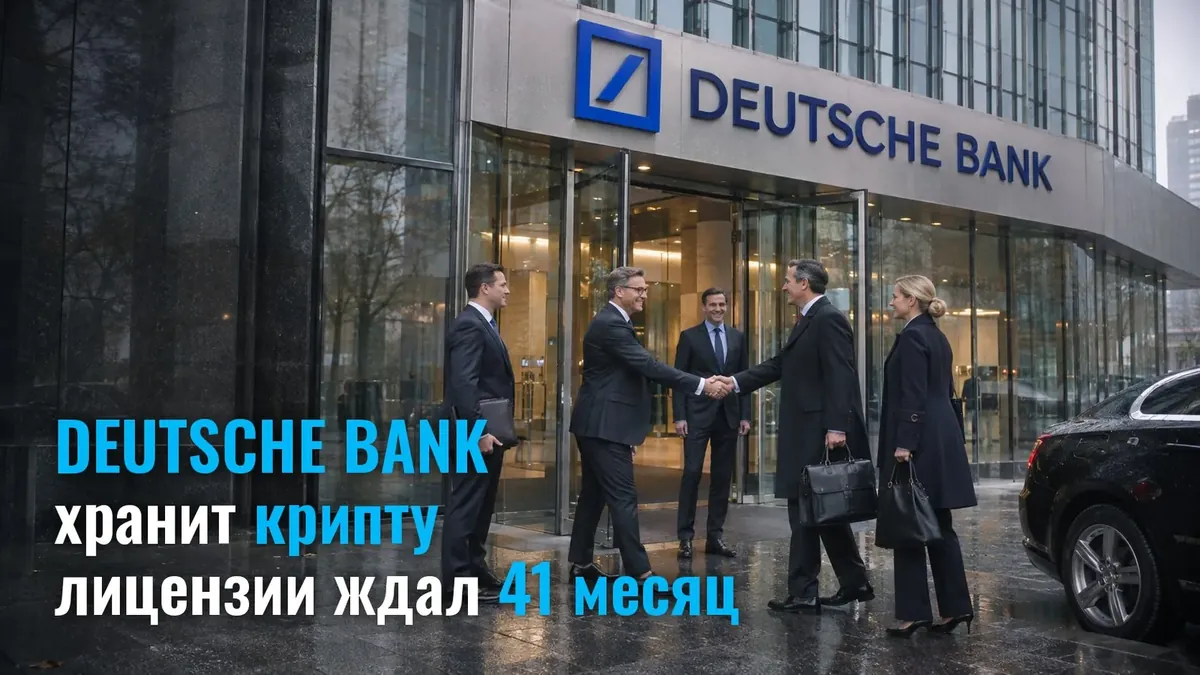
Deutsche Bank began storing Bitcoin and Ether for paying clients on November 11. The assets of Germany's largest bank total around $1.7 trillion.
Cryptocurrency custody means the bank holds the client's coins and is responsible for access to them. Access is granted by a private key: whoever owns it controls the coins. Permission for such a service is issued by BaFin, Germany's financial regulator.
The bank submitted its application in June 2023 and waited 41 months. The service's clients are hedge funds, brokers and depositories — that is, big money in the crypto market.
What exactly was approved?
The bank has two permissions in the register: custody of crypto assets and transfers.
- Bitcoin and Ether — supported at launch.
- USDC, EURC and EURAU — stablecoins and e-money tokens. These are coins with an exchange rate pegged to the dollar and euro.
- No exchange trading or order execution — tokenized securities are promised later.
Who can access the service?
Clients are the corporate and investment division: asset management companies, hedge funds, depositories, brokers and government institutions. Retail clients are not accepted.
The bank warns outright: deposit insurance does not extend to crypto.
- The bank itself holds the keys and wallets — with hardware protection.
- Multi-level transaction confirmation.
- Separate hot and cold storage — the latter without a network connection.
Why the 41-month wait?
While the application sat with BaFin, competitors moved ahead.
- Commerzbank. Received its custody license in 2023.
- Three more German applicants. Managed to complete approval and launch.
- The technical side. The bank's system was built by Switzerland's Taurus and Bitpanda's technology unit.
The rules changed in the meantime: since October 30, a MiCA license is valid in all 30 countries of the European Economic Area. MiCA is the EU's common crypto law. In September, it was Germany alone.
Gerald Podobnik, co-head of the corporate division, calls digital assets "new rails that can coexist with market infrastructure."
What's next?
In the same week, other banks picked up crypto.
- $270 million — that's how much Goldman Sachs, Citi and other banks invested in a joint stablecoin project.
- PNC — opened a USDC payments pilot on Monday.
- Standard Chartered — extended services for large funds to BTC and ETH.
Deutsche Bank's plans: a memorandum with Deutsche Asset Management and expansion into Asia.
- Access to volume for the private trader. How prop trading works — in the academy, company terms — in the prop firm catalog.
Institutions buy in notional, you — with a deposit
Money in BTC and ETH is brought in through licenses and depositories. A private trader is limited by the size of their own account. A forecast can be accurate, but on a deposit of a couple thousand dollars the result remains pocket change. Prop firms trade precisely access to notional: a paid evaluation, then the company's trading account with strict loss limits and an agreed profit share. Understanding the mechanics is cheaper beforehand than on the next wave of big money.