

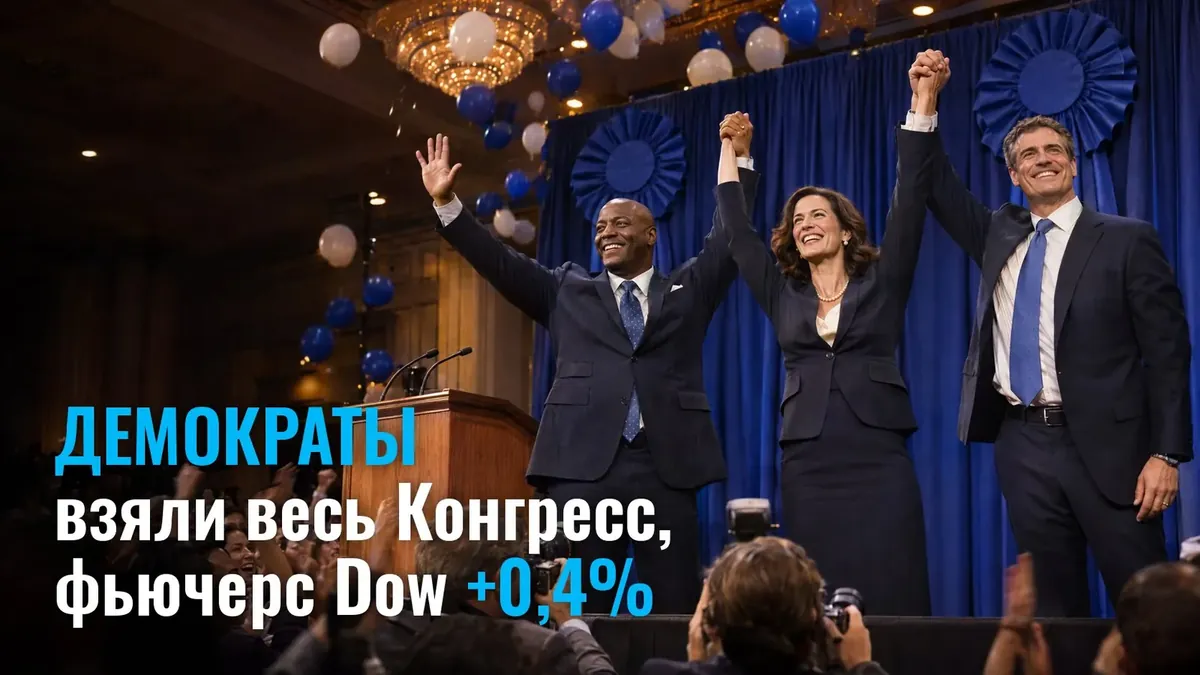
Democrats won both the Senate and the House of Representatives in the US midterm elections. Both chambers of Congress are now under their control. The result became known on the night of November 4.
Midterm elections take place in the middle of a presidential term. They re-elect Congress, that is, the body that passes laws and approves the budget.
The market reacted immediately. US index futures fell overnight, but by the European session on November 4 they had recovered the decline and moved into positive territory. For a trader, this means the elections set the direction even before US markets opened.
Where are the indices traded?
By 11:51 Moscow time, the Dow Jones futures was up 0.4% and held near 52,100.
- S&P 500 - up 0.15% to 7,610
- Nasdaq 100 - up 0.14% to 28,340
Futures are a contract on an index; the market trades it before the main US session opens.
Why did the market turn around?
The market reads the balance of power in Congress as increased corporate oversight. It also means a ceiling for further tax cuts and growth in government spending.
- First reaction - selling. Investors priced in the news of Democratic control of both chambers.
- Then buying back. Buyers absorbed the drop, and futures moved into positive territory.
Who fell the most?
Technology heavyweights held up worst in pre-market trading. Nvidia, Apple, Microsoft, Alphabet, Amazon and Meta declined.
At Rabobank, the morning weakness in Nasdaq is linked to policy: "Democratic candidates repeatedly spoke before the elections about tougher regulation of AI developers."
What about currencies and gold?
The dollar is under pressure. USD/JPY fell below 158.00, and the dollar index is at a one-month low.
- Gold - trading above $4,000
- BTC - approached support near $76,466
What's next?
The market is watching Washington's decision on the US and Israel war against Iran. On the data front, the ADP private-sector employment report is out today.
ADP counts how many jobs US private companies created in a month. The forecast is 69K for October versus 90K in September. The dates of such releases can be seen in advance in the economic calendar.
Did you trade the overnight futures plunge?
Election night is one of the rare windows where the move can be seen on the calendar in advance. The headline sets the scale. The unpleasant part begins when you do the math: half a percent on the Dow in a personal account of three thousand dollars turns into a sum it's embarrassing to call a result. In prop trading, the trading notional is provided by the firm: you pass its selection, work within risk limits and take your share of the profit. Before the next such night, it's worth working through the mechanics on a calm market.