

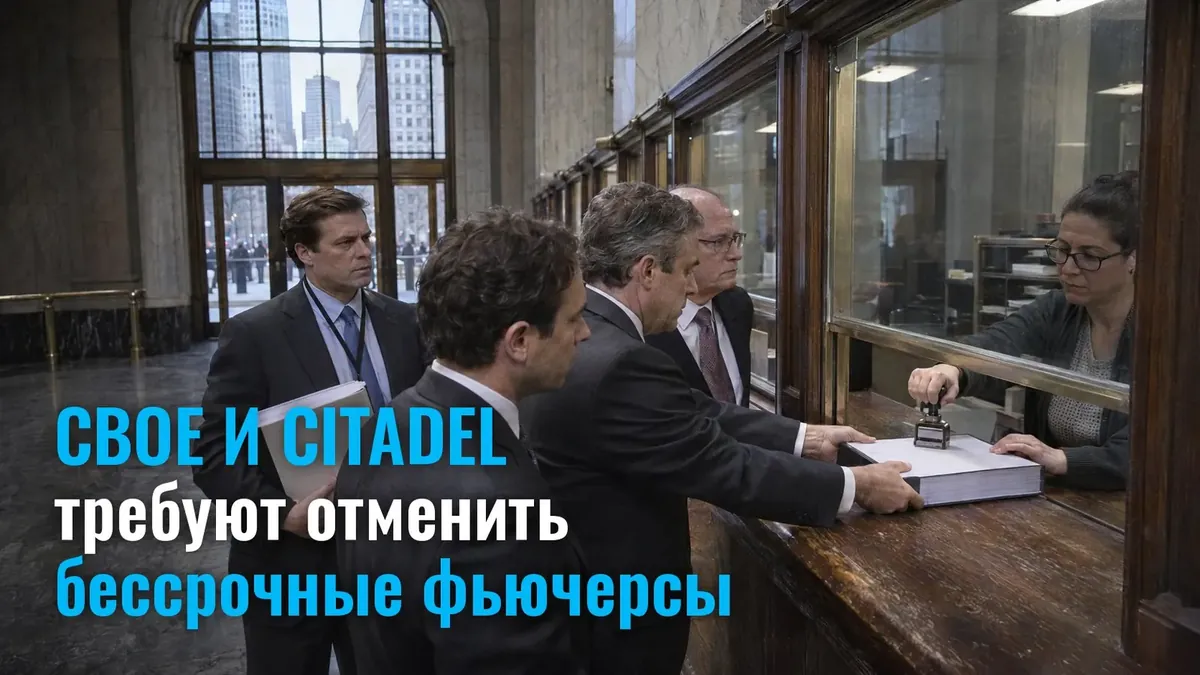
Cboe exchange and market maker Citadel Securities have gone to court against the CFTC's decision on perpetual futures on US stocks. The lawsuit from the Capital Markets Alliance, with their support and with the participation of the Healthy Markets Association, has been filed in the federal court for the Southern District of New York. The plaintiffs are seeking to annul the approval that the commission granted on November 3.
What the instrument is. A perpetual future is a contract on the price of an asset with no expiration date. A position can be held for as long as you like. The CFTC is the US regulator of the derivatives market, the SEC is the regulator of the stock market.
Why this matters to a trader. The venues that were planning to list such contracts are stuck in legal uncertainty. Who regulates them, the CFTC or the SEC, will now be decided by the court.
What exactly did the CFTC approve?
On November 3, 2026, CFTC Chairman Selig stated that perpetual futures on individual stocks could for the first time be traded on commission-registered exchanges. A perpetual future is a contract with no expiration date.
- CFTC Regulation 40.3 - under it, the products were passed in the status of futures on a single security
- The Commodity Futures Modernization Act of 2000 - where this concept comes from
- 55 securities and leverage up to 6:1 - the parameters that were discussed
What is the essence of the claim?
The plaintiffs speak of a procedural violation. In their view, the CFTC violated the Administrative Procedure Act (APA) and "gave no explanations for its decision."
- These are swaps, not futures. According to the plaintiffs, the products are swaps based on individual securities, and such instruments fall under the exclusive jurisdiction of the SEC.
- Annulment of the approvals. The lawsuit asks the court to annul the approvals granted.
- A ban during the proceedings. The plaintiffs want the CFTC not to apply the approval while the case is ongoing.
The commission's position. The CFTC insists that the instruments fall under the rules of both agencies and refers to an agreement with the SEC signed in 2026.
What did the court decide?
Judge Caproni declined to issue an emergency temporary restraining order. The alleged harm does not rise to the level of emergency measures. At the same time, she noted that the plaintiffs have a high chance of winning the case.
- November 6 - deadline for the government's response
- November 10, 2026 - deadline for the Capital Markets Alliance's objection
What does this mean for a trader?
Craig Donohue, CEO of Cboe, says the dispute is about investor protection and the rule of law.
The main point: the venues that were planning to list such contracts remain in legal uncertainty. Who regulates them, the CFTC or the SEC, will be decided by the court.
It is convenient to keep track of the dates of hearings and other market events in the economic calendar.
Have you been thinking about how to trade such contracts?
You have probably already tried the new instrument against your portfolio. And hit the usual barrier. With a deposit of a couple of thousand, even 6:1 leverage leaves a position from which you cannot extract a decent result. In prop trading, the company provides the notional for the trade: you pay for a discipline check, keep within the loss limits, and then work on its account for an agreed share of the profit. While the court drags out the dispute, you can get to grips with the mechanics calmly.