

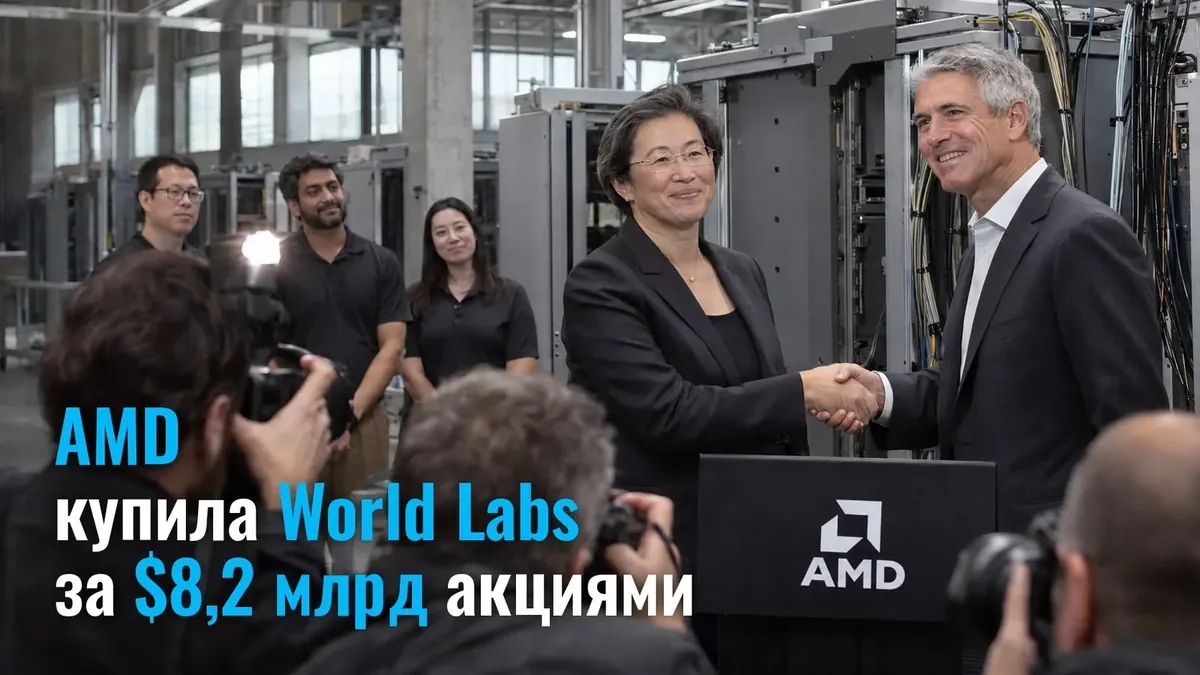
AMD closed the acquisition of World Labs and paid with its own shares totaling about $8.2 billion. The company makes processors and graphics cards, and its securities are included in the S&P 500 and Nasdaq 100 indices.
World Labs is a lab that works on spatial artificial intelligence models. A spatial model describes a three-dimensional scene and the geometry of the world. Language models work with text, while spatial models work with volume and shape.
Settlement in shares means that the seller receives the buyer's securities instead of money. This affects traders through Nasdaq: the revaluation of AMD shares goes directly into the S&P 500 and Nasdaq 100.
What AMD is paying with
There is no cash component in the announced terms. AMD is issuing new securities for the deal, so the $8.2 billion does not leave the company's balance sheet.
- about $8.2 billion - the total deal amount, settled in AMD shares.
- new securities - issued specifically for the acquisition.
- the stake of existing shareholders - decreases in the company's capital.
How the deal proceeded
- September 28, 23:05 MSK - AMD announced the acquisition of World Labs.
- November 16, 17:05 MSK - the deal closed.
- about seven weeks - the time that passed between the announcement and completion.
Who is moving to AMD
Fei-Fei Li, a researcher in the field of computer vision, is moving to AMD. Her position is chief scientist.
- World Labs' research - AMD is bringing it inside the company.
- alongside the chips - the lab was placed with the teams that design chips and complete computing systems.
What the trader sees
AMD securities trade on Nasdaq. Any revaluation of them flows into both the S&P 500 and the Nasdaq 100.
Key point: since November 16, World Labs has lived inside AMD. The lab's results will from now on be visible only in the company's overall reporting.
Access to indices and individual stocks varies among prop firms. Check the instruments in the prop firm catalog or immediately pick a challenge for indices.
Do you trade stocks like AMD?
News like this is traded through the index or through the stock itself. Prop firms differ here: some have no individual stocks at all, only Nasdaq 100 futures and currency pairs. Others have stocks, but holding a position overnight is prohibited. The list of instruments and rollover rules are set out in the terms of each program. Check them against your market in advance, before a position is opened.