

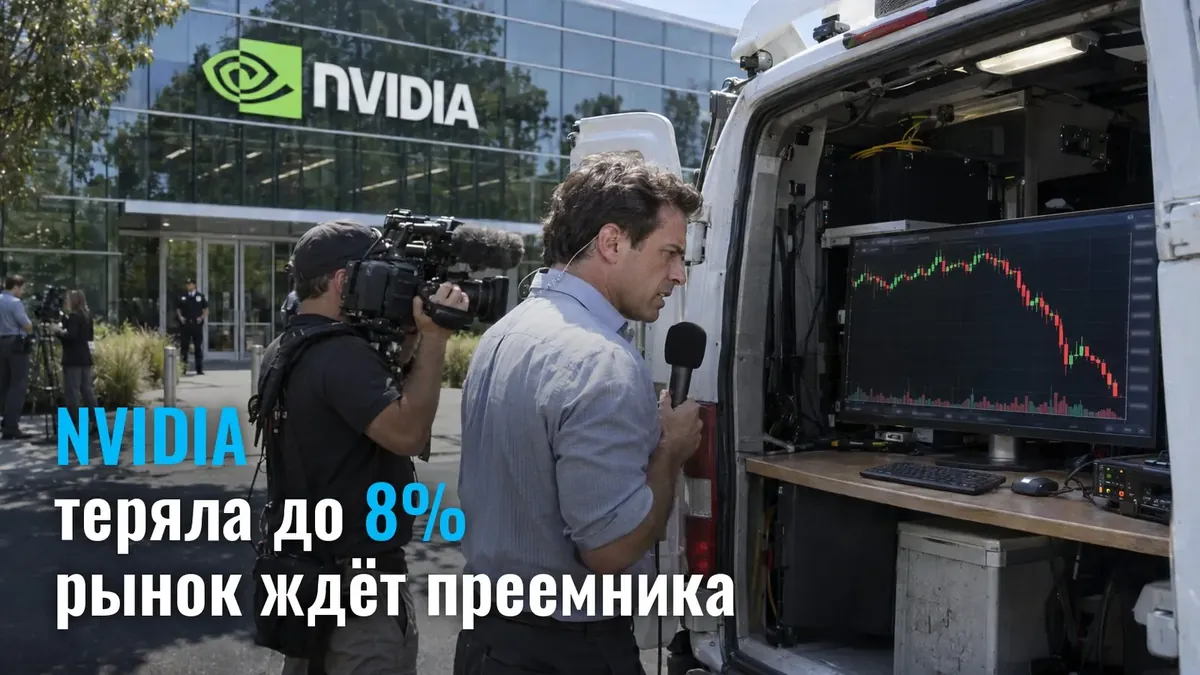
Nvidia shares fell almost 8% during the main trading session on November 9. The reason was espionage accusations. The company's board of directors launched an independent investigation into them.
An independent investigation is a review conducted by people outside the company's management. Before the session opened, the stock was falling in after-hours trading. After-hours trading refers to transactions before the opening and after the close of the main session, when volumes are small and moves are sharp.
For a trader, this is not a story about a single stock. Nvidia carries the largest weight in the S&P 500 and Nasdaq 100 indices.
How much did the stock fall?
- 3.4% - decline in after-hours trading, where the drop began.
- 8% - the drawdown during the main session itself.
- $350 billion - roughly how much market capitalization such a move is worth for a stock of this size.
The scale of the sum. This is more than the entire value of almost any company in the S&P 500 outside the top ten.
Why did the market react this way?
- Espionage accusations. These were the trigger, and Nvidia's board of directors launched an independent investigation.
- A weak stock before the news. The shares had been falling earlier too, so the news landed in an already selling market, not a calm one.
Who will lead the company?
The focus has shifted. The main question for investors now is not the accusations themselves, but Nvidia's future leadership.
- Jensen Huang - co-founder and head of the company, the face of the entire shift into artificial intelligence.
- Successor - the company has no public name, and the market is asking who will lead Nvidia if Huang leaves his position.
What does this mean for a trader?
Key point: an 8% move in Nvidia drags along the S&P 500 and Nasdaq 100, their futures, and the entire semiconductor sector, even if you don't trade the stock itself.
What to check on your end. Not every program allows trading individual US stocks, so choosing a challenge that fits the market and style is worth doing before the trade.
Did you trade this Nvidia sell-off?
When a single stock moves 8% in a session, there is something to capture in index futures too, if the program lets you trade them. Some prop firms don't offer individual US stocks at all, only indices. Some have their own limits on holding a position overnight and a ban on holding it through corporate news. This is spelled out in the terms before you pay for the evaluation. Selecting by market and style will immediately show where such trades are allowed.