

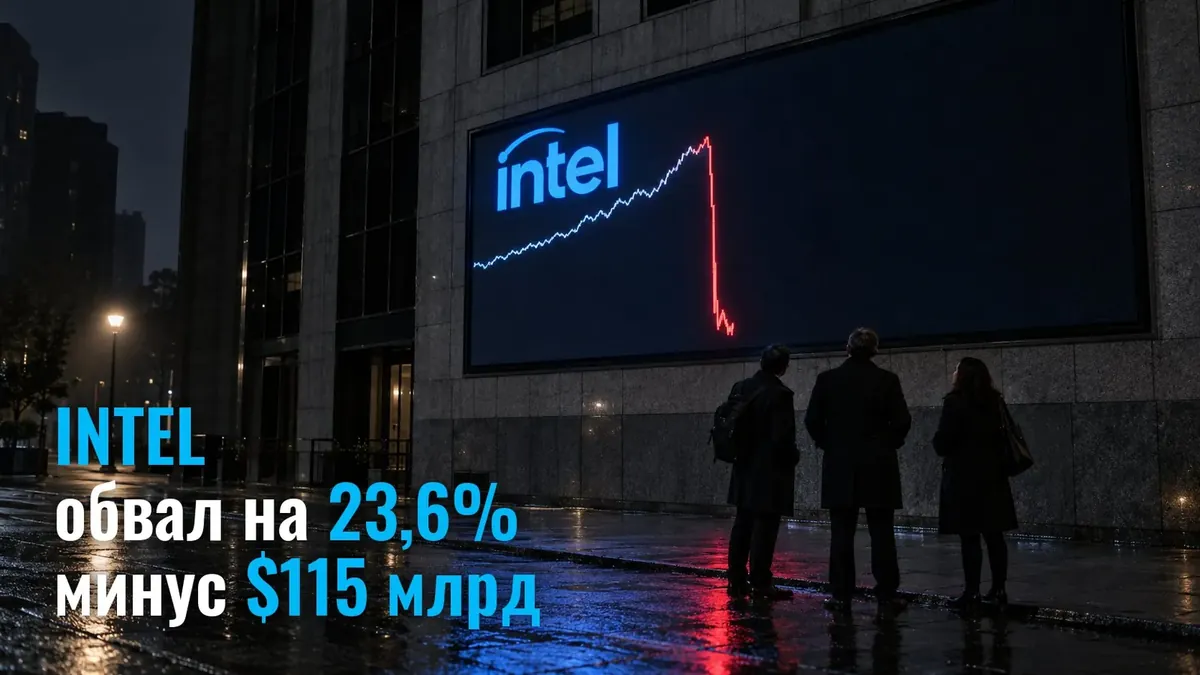
Intel shares lost almost a quarter of their value in a single overnight session. The stock fell 23.56% to $70.39. That's minus $21.69 from Thursday's close of $92.07.
Intel is the largest American processor manufacturer. Its shares trade on Nasdaq. Overnight trading happens outside the exchange's main hours, so in the morning the market opens already at the new price.
The company was punished not for the past quarter, but for the forecast for the next ones. For a trader this is a clear example: a good report on its own doesn't hold a stock up.
How much did the crash cost?
Scale. At the close of the regular session Intel was worth $486.69 billion. The drop wiped out about $115 billion.
- +143.76% - that's how much the stock had gained since the start of the year as of Thursday
- roughly +86% - remains even after the plunge
Why did the market get scared?
- Revenue. The forecast for the fourth quarter is $15.0-16.0 billion, which is minus 6% versus the previous quarter at the midpoint of the range.
- Margin. Adjusted gross margin is expected at 38.0% - six points below the just-reported figure.
- Cash flow. CFO David Zinsner added that 2027 will most likely not deliver positive free cash flow. That's the money left after all expenses and investments.
- PC market. He also said the slowdown in the personal computer market will last at least until the middle of next year.
How was the quarter itself?
Strong. Revenue - $16.51 billion (+21%), adjusted profit - $0.52 per share versus $0.23 a year earlier, margin 44.1% versus 40.0%.
Under standard reporting, profit instead fell 33% - to $0.60 from $0.90.
- +78%, to $7.32 billion - data centers and artificial intelligence, the strongest growth in 15 years
- +58%, to $6.70 billion - contract manufacturing
- minus 5%, to $8.10 billion - consumer segment
What does the factory explosion have to do with it?
It wasn't demand that hit the margin. On October 14, a gas cylinder exploded at the Fab 28 plant in Kiryat Gat (Israel). Two workers died, a third is in serious condition.
The plant was down for about two weeks.
- $300 million - losses in the fourth quarter, with the same expected in the first
- 200 of those very 600 basis points of lost margin - due to this shutdown
What does this mean for a trader?
The main lesson. The market pays for the forecast, not for the past quarter.
Key point: revenue of $16.51 billion and 21% growth did not save the stock from minus $115 billion in market capitalization. The fourth-quarter forecast decided it.
It's convenient to keep report dates and other events at hand in the economic calendar. You can pick a challenge to match your trading style and market.
What's next?
Intel didn't cut investment. Capital expenditure for 2026 is confirmed at $20 billion, equipment orders grew almost 40% over the quarter. The 2027 budget is not yet finalized.
- $21.85 billion - cash on the balance sheet
- $32.16 billion - short-term investments
- $46.32 billion - long-term debt
The sector as a whole. It's a tough week for technology companies: on Thursday Alphabet lost 13% after negative free cash flow of $9.07 billion for the quarter.
Saw this gap in premarket?
Overnight the stock flies down 23%, and in the morning you only see who got in and with what volume. The arithmetic is unpleasant: your maximum notional equals your own deposit. A move of this scale on a small account is a couple hundred dollars, not a month's result. In prop trading, the trading capital is provided by the company: you pay for the selection, work within its risk limits and take your share of the result. Earnings season is still underway, so the mechanics are worth understanding before the next morning like this.