

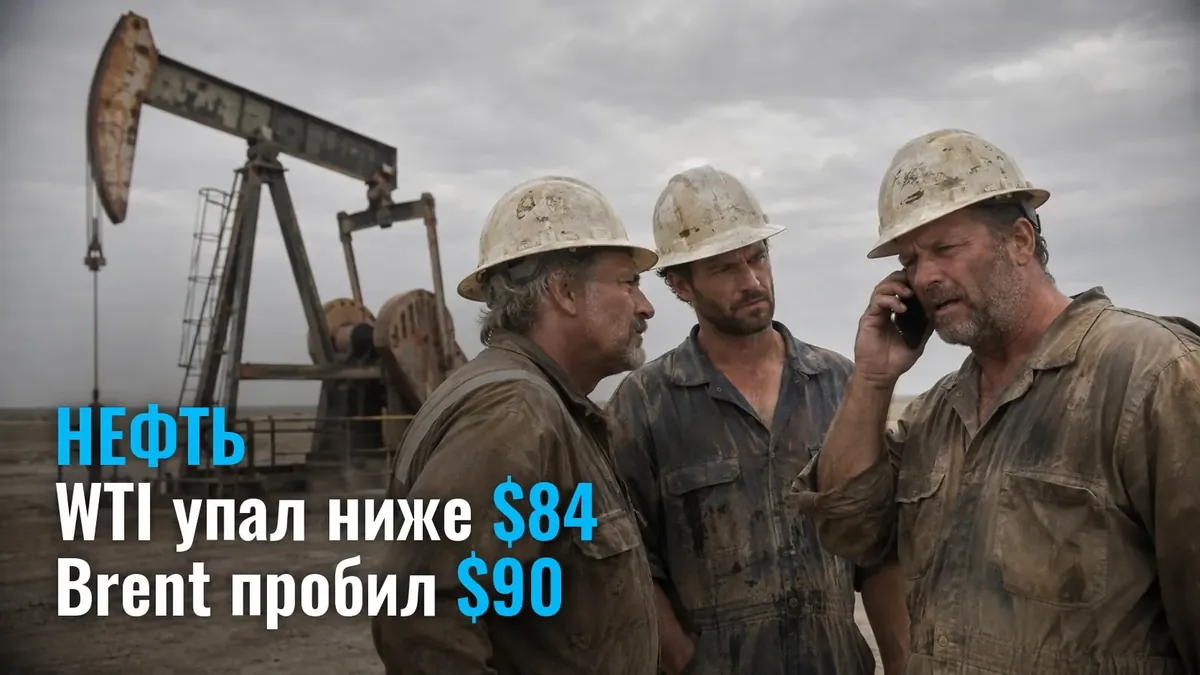
US WTI crude fell below $84 a barrel on Tuesday. It hasn't been this cheap since late August. Brent went below $90 in the same hours, with selling continuing for a second day in a row.
WTI and Brent are the two main grades of oil. They are used to price crude on the global market: WTI is focused on the US, Brent on Europe and Asia.
The reason for the move is Donald Trump's words about the imminent end of the war with Iran. For a trader, this means oil is now moving in wide swings, and news from Washington and Tehran moves it more than inventory reports.
How big is the slump?
The reference point is last month. A barrel cost more then, and the entire current move is measured from that price.
- just above $104 - the WTI price a month ago, the highest since May 18
- about $20 - how much a barrel has given up from that peak
- 5.85% - Brent's decline over the previous day
- $92.57 - Brent's close, and this level has already been broken to the downside
Why is oil being sold?
There is one reason - Iran. Signals from the two sides diverge.
- Trump. The US president said the movement toward ending the war with Iran is heading in a positive direction. He called new strikes unlikely and the conflict itself "effectively over." The market reads this as the removal of the war premium from the oil price.
- Tehran. Mohsen Rezaei, secretary of Iran's Supreme National Security Council, called reports of ongoing negotiations fake. He repeated: Washington must accept Iran's seven conditions.
The result of the divergence. While the signals contradict each other, the depth of the decline is limited: some participants do not believe in a quick deal.
What does the chart show?
WTI has broken through two supports. These are the 200-day moving average at $86.31 and the $85.48 level.
- relative strength index - 33 - right next to the oversold zone
- $81.11 and $74.89 - the nearest support levels below
The oversold zone is when sellers have already used up most of their momentum.
What's next?
The US consumer price index for October is released today. The publication time is in the economic calendar.
The dollar is weakening and may partially support oil. Crude is traded in dollars, and a cheaper dollar makes a barrel more affordable for the rest of the world. Trading style for such moves is conveniently checked in the challenge selection.
The main thing: the oil price is currently being set by statements on Iran. While Washington and Tehran say different things, the movement remains sharp in both directions.
Did you short this oil dump?
Everyone with oil open in their terminal saw twenty dollars a barrel in a few weeks. On a deposit of a couple thousand, a perfect short of such a move covers the utility bills. Entry precision doesn't raise that ceiling. A prop firm works differently: you pay for the selection, trade its notional within loss limits, and split the profit under the contract. Oil repeats such weeks, so it makes sense to figure it out before the next one.