

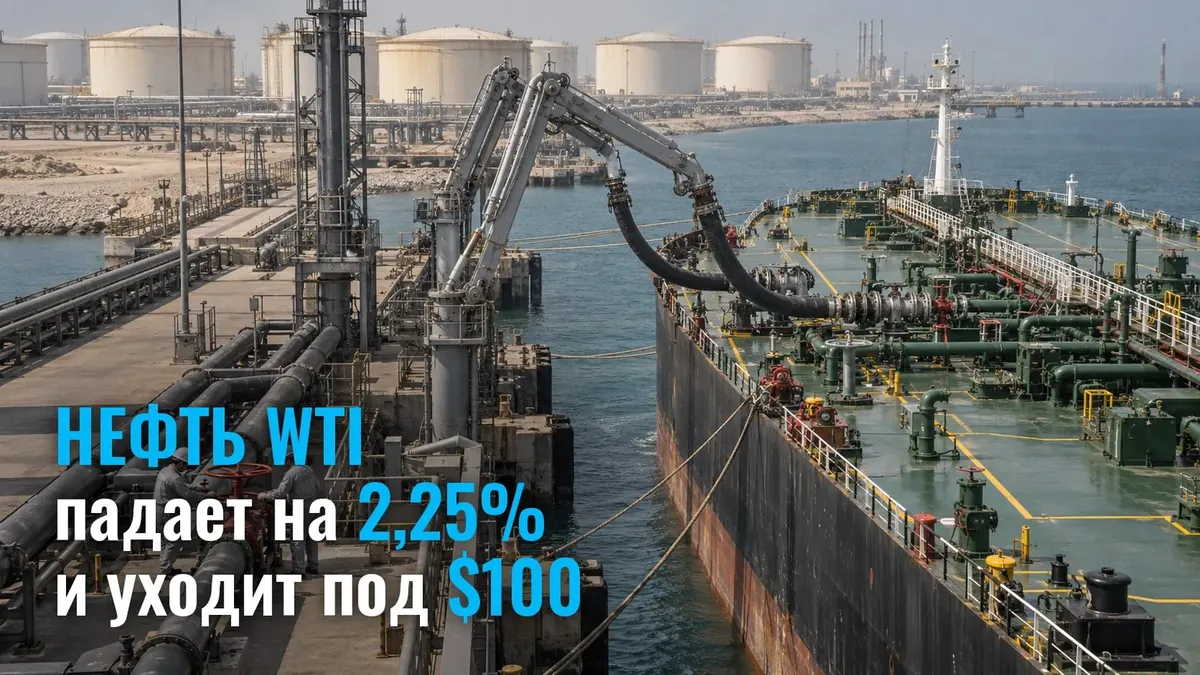
WTI crude oil fell 2.25% on Monday and dropped below $100 per barrel. The futures contract slid to $99.80. On Friday it was worth $104.03 - a five-month high.
WTI is the benchmark American crude oil grade, traded on the NYMEX exchange. The reason for the drop is that fear of a prolonged supply disruption eased in the market. While there was a threat of war, traders paid a risk premium per barrel. Now that premium is deflating.
For a trader, this is a reversal of the weekly trend: the price turned not on the chart, but on political statements.
How strong was the move?
The rally had been going on for a long time. The rise started from the mid-$80s per barrel and hit $104.03 on Friday. It failed to break through this level.
- $104.03 - Friday's peak, a five-month high
- $99.80 - the level oil reached on Monday
- more than $2 per barrel the market gave up in a single day
Why did the market reverse?
Two news items did the trick. Both about reduced risk of a military conflict.
- Marco Rubio's words. The US Secretary of State said there is no decision to resume strikes on Tehran. According to him, Donald Trump prefers a diplomatic settlement. Washington's military capabilities remain in place.
- A signal from Iran. Tehran reported that, through Qatari mediators, a plan is being discussed to open the Strait of Hormuz within two days if the US reciprocates. The Strait of Hormuz is a narrow maritime corridor through which a significant portion of the world's oil passes.
Where is the market now?
Technicals are capping the price from above. The 9-day moving average sits at $100.09. The relative strength index is around 58 - the rally is not confirmed.
- $95.05 - nearest support, the October 20 low
- $104.03 - resistance, it has stayed in place
What does this mean for a trader?
The unwinding of the risk premium hit related markets. Gold plunged below $3900 - a low since October 2025.
- USD/JPY is holding around 158.00
- AUD/USD dropped below 0.7050 ahead of the Reserve Bank of Australia's decision on Tuesday
Key point: a single official's statement reversed oil, gold and currencies all at once. The Australian central bank's decision is already on Tuesday - check the date in the economic calendar.
If you trade commodities, pick a challenge suited to the right market in advance.
Did you hold oil over the weekend?
It wasn't the charts that made the move, but two phrases from an official. They said "diplomacy" - and $4 per barrel evaporated. Anyone who was long from $104 found out in the morning. And here's the nuance: oil isn't available in every prop program, and trading during geopolitical headlines is outright prohibited by the rules at some firms. Some even consider overnight position holding a violation. Read the terms in advance, before the next such Monday arrives.