

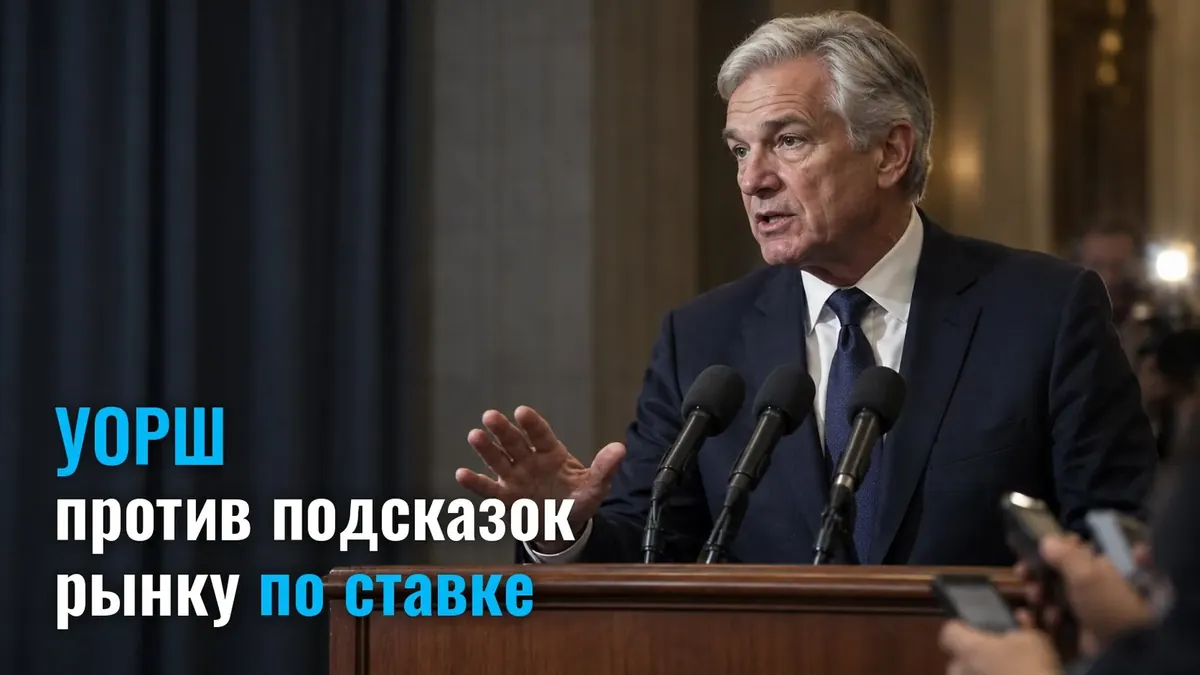
Warsh called it wrong practice to give the market advance forecasts on the Fed rate. On the evening of October 28, he answered questions on the regulator's policy - from 21:52 to 22:05 Moscow time.
What it's about. The Fed is the central bank of the US; it sets the interest rate. Preliminary signals are hints about future decisions that the regulator gives the market before the meeting itself.
Why this concerns a trader. Without such hints, the market stops receiving clues between meetings.
What exactly did he say?
Rates have already begun to decline - this is the first of the key theses of the speech. The rest:
- Economic growth - the economy is growing, but growth in itself does not necessarily accelerate inflation.
- Policy - political factors do not influence the Fed's decisions.
- Signals to the market - anticipating the outcomes of meetings and giving guidance on future steps is wrong.
What about prices and oil?
Inflation expectations diverged. Short-term consumer expectations rose, while long-term ones are normal.
- Rising oil prices - Warsh stressed that he is taking this into account.
- The link between oil and rates - until recently it was stable.
When will the fate of the balance sheet be decided?
Recommendations from the target group on the Fed's balance sheet will be presented at the beginning of the first quarter of 2026.
The Fed's balance sheet is the portfolio of bonds that the regulator either increases or reduces, affecting the amount of money in the system.
- There is nothing to change now - according to Warsh, there is no point in it.
- The reason - there will be no effect at the current stage.
What does this mean for a trader?
If the line of refusing pre-announced guidance takes hold, there will be no more clues between meetings.
- The reaction compresses. The dollar, short rates, gold and indices price in the decision within minutes.
- The waiting disappears. The move does not stretch over the weeks before the meeting.
- The date matters more than the forecast. Fed meeting days should be checked against the economic calendar.
The main thing: the entire reaction now fits into the minutes around the decision itself and the press conference.
If you trade such minutes, it is better to choose the account format in advance - pick a challenge to suit your style.
Ready for a market without hints?
When the regulator stops hinting in advance, the whole move happens within a few minutes. Either you are in it or you are not. Analysis is rarely the problem here; the problem is the nominal: the same surge on a deposit of a couple thousand gives pocket change. Prop trading solves exactly this: the trading account is provided by the company, you pay for the evaluation and work within its limits. It makes more sense to understand the mechanics now, while there has not yet been a new speech from the Fed.