

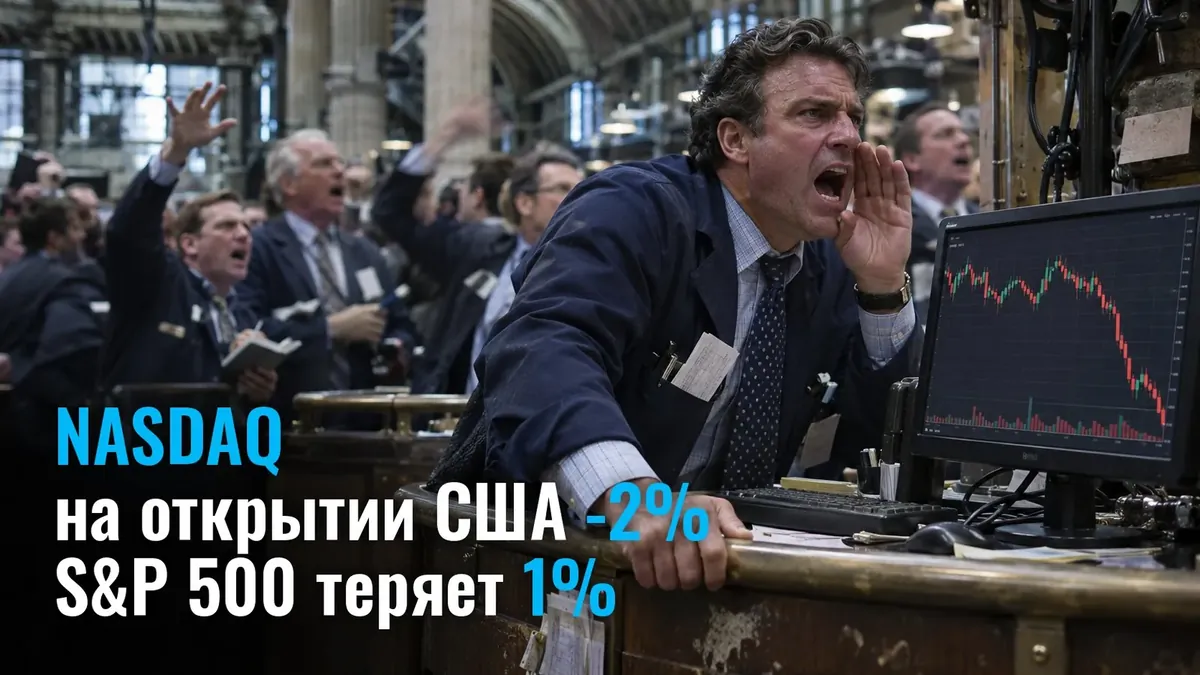
US markets opened lower on November 24, with major indices falling. The American session began at 17:30 Moscow time. Tech stocks were sold off the hardest.
The S&P 500 reflects the broad US market. In the Nasdaq, tech companies carry the main weight. Together, the two indices show at a glance whether the whole market is falling or just one sector.
For a trader, this is a working window. The first minutes of the session move in bursts, and price easily clips stops.
How much the indices lost
The numbers from the first minutes of trading:
- S&P 500 -1% - the broad-market index.
- Nasdaq -2% - the tech index.
The S&P 500 is calculated on the 500 largest US companies, the Nasdaq on securities where the tech sector carries the main weight.
The gap is twofold. It is primarily the tech sector being dumped; the broad market is holding up twice as well.
Was there a bounce?
- 17:30 Moscow time. Session start: S&P 500 -1%, Nasdaq -2%.
- 17:51 Moscow time. The Nasdaq is still at -2%.
- Twenty minutes. They produced no bounce, meaning the opening move was not a single candle on a thin order book. A thin order book means few buy and sell orders, so a small volume moves the price.
What does this mean for a trader?
Execution is more expensive than usual. On a market like this, an order fills at a worse price than the trader saw.
Key point: for trading, a start like this means a widened spread, slippage on entry, and stops that get taken out in a single impulse.
Slippage is the difference between the price in the order and the price at which the trade actually executed. You can find a challenge for trading indices in the calculator.
What's next
The day has only just begun. The American session has only just opened, with the whole trading day still ahead.
What to watch:
- Nasdaq - whether it holds the minus 2% by the close.
- S&P 500 - whether the twofold gap with the tech sector persists.
- Calendar - American session events in the economic calendar.
Have you seen this open at the terminal?
You meet the US session open at the chart, and minus 2% on the Nasdaq in the first minutes is your working window. In prop programs, indices appear on a separate line. Somewhere entry right after the open is closed, somewhere the volume per index contract is cut. Reading these restrictions is cheaper than learning about them from an account-blocking email. It's worth comparing the conditions before the next open like this.