

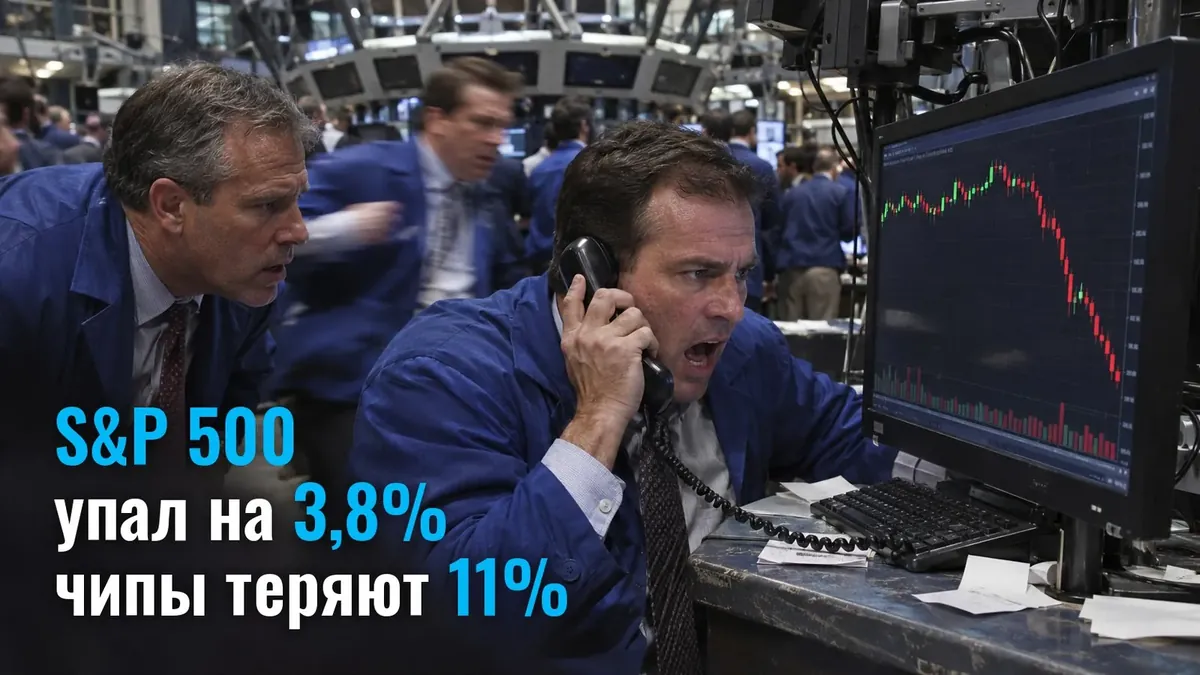
The US market gave back all of the previous day's gains on November 5. By 19:00 Moscow time, the Nasdaq Composite was down about 5%, the S&P 500 - 3.2%. During the session, the S&P's decline reached 3.8%.
The sell-off was driven by shares of companies tied to artificial intelligence. These are chipmakers and those who build data centers for AI. A data center is a facility with servers on which models are trained and run.
For a trader, this is a day when the move is visible in any instrument: from semiconductors to bitcoin.
How hard did the stocks fall?
- Nvidia - down more than 6% for the session.
- The sector semiconductor index - down almost 11%.
- Nasdaq Composite - about minus 5% by 19:00 Moscow time.
- S&P 500 - minus 3.2% at the same time, the day's low - minus 3.8%.
A day earlier the picture was the opposite. The S&P 500 gained 1.6%, its best day in three months. The Dow Jones rose more than 1,500 points, to 53,361.
Trump had time to congratulate investors. He wrote on Truth Social that the market "hit another record high," and "your 401(k) retirement accounts broke through the ceiling."
Why did the market reverse?
- Midterm elections. Investors are recalculating what a Democratic victory means for the tech sector. Tougher oversight could hit the construction of data centers and AI infrastructure.
- Inflation. It remains persistent and won't let the market relax.
- Uncertainty over the Fed. The regulator's next rate decision is still unpredictable.
Ipek Ozkardeskaya, senior analyst at Swissquote Bank, told Reuters that attention to "aggressive AI construction" should be expected.
When will trading be halted?
Because of the speed of the decline, the market recalled exchange circuit breakers. This is an automatic halt of trading during a crash. For the S&P 500, these thresholds were in effect for this session:
- -7% (7,150.41 points) - a 15-minute pause across the entire US stock market, including Nasdaq stocks.
- -13% (6,689.09) - another 15-minute pause.
- -20% (6,150.89) - trading closes for the rest of the day.
The first two thresholds stop applying after 23:25 Moscow time, the third is in effect all session. The index did not reach the first level.
What does this mean for a trader?
Crypto went along with the indices. BTC dropped below $76,000 and gave up the entire post-election rebound. In an hour, $428 million in leveraged long positions were liquidated. Liquidated means forcibly closed.
Key point: the next milestone is Friday's US October jobs report. It will be used to judge the direction of Fed policy, and the date is easy to keep at hand in the economic calendar.
Trading days like these is easier when the instrument and account size are chosen in advance: you can pick a challenge for the indices in a couple of minutes.
Did you watch how the Nasdaq shaped up?
Sessions like these are visible without indicators. Semiconductors down eleven percent, Nvidia down six, the move jumps out at you on its own. It all comes down to position size: with a deposit of a couple thousand, the right idea brings in an amount the size of dinner. Prop firms sell exactly access to size: you pass a paid evaluation for risk control and loss limits, then you trade the company's account for an agreed share of the result. It makes sense to understand this mechanic before the next sell-off like this.