

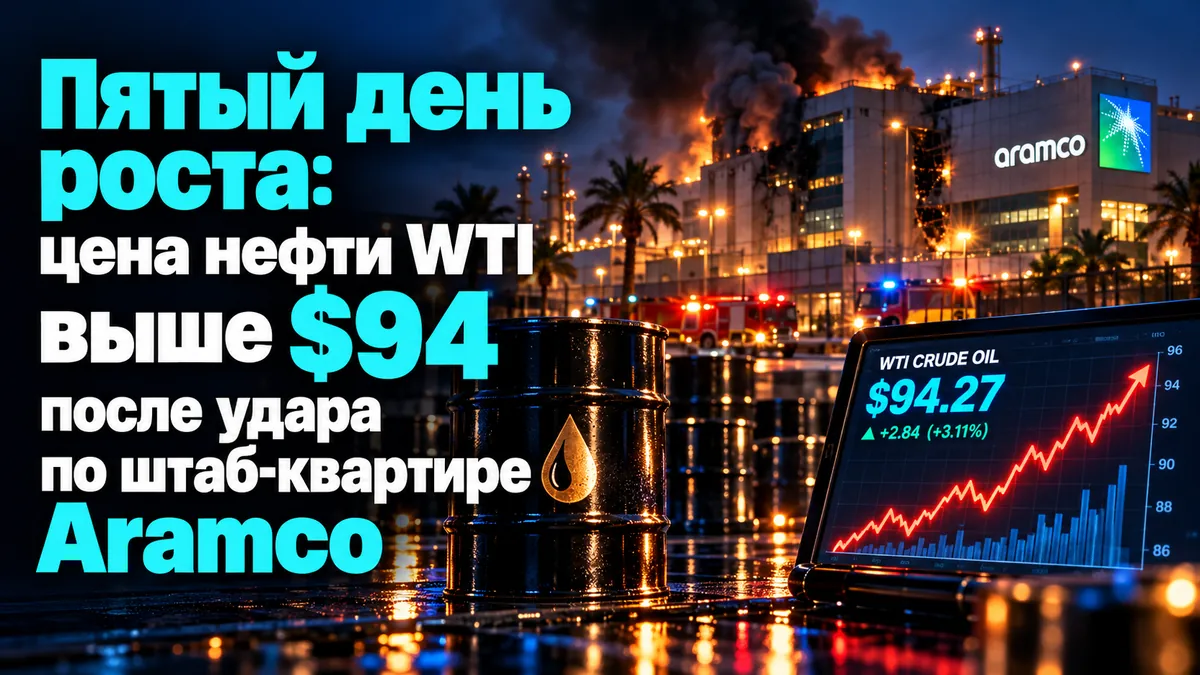
WTI crude oil continues to rise amid a new escalation in the Middle East. Quotes climbed above $94 per barrel, and the rally has now continued for five trading sessions in a row. During the Asian session, the price reached approximately $94.30.
What happened in Saudi Arabia
The new attacks hit Dhahran, where the headquarters of the state-owned oil company Saudi Aramco is located. After the strike, a small fire broke out at the facility. There were also reports of debris falling in Dhahran and Riyadh, as a result of which several people were injured. The market perceived the incident as another signal of growing risks to the region's oil infrastructure.
Why oil keeps getting more expensive
The main factor now is not the current level of production, but the likelihood of supply disruptions. Any attacks on oil facilities, tankers and transport infrastructure increase the geopolitical risk premium. The Strait of Hormuz remains particularly sensitive, as a significant portion of oil supplies from the Persian Gulf passes through it.
The conflict is widening
Amid the new strikes, Saudi Arabia and its allies have stepped up actions in Yemen. At the same time, tensions around shipping in the Strait of Hormuz persist. The more incidents occur around oil infrastructure and maritime routes, the more the market prices in the risk of a future deficit.
Production, meanwhile, is growing
In terms of actual volumes, the situation still looks less tense. In September, OPEC+ produced about 39.07 million barrels per day. That is roughly 900 thousand barrels per day more than in August. Saudi Arabia produced about 8.372 million barrels per day. In other words, the current price increase is driven primarily by geopolitics, not by a reduction in current supply.
Why the market is ignoring the rise in production
Under normal conditions, an increase in supply should put pressure on the price. But right now, traders are assessing not only how much oil is being produced, but also whether it can reach buyers without obstruction. If risks to tankers, ports and oil infrastructure grow, additional production may not offset the logistics premium.
What's next
The main benchmark remains the development of the situation in Saudi Arabia and around the Strait of Hormuz. If the attacks continue, WTI may retain elevated volatility and a risk premium. If tensions ease, the market will again start factoring in OPEC+ production growth more strongly. An additional factor will be the discussion of new sources of fuel supply and possible changes in international trade in petroleum products.
Trading oil on geopolitics?
Five rising sessions in a row create a strong move, but for a prop trader, not only the direction and entry point matter. Different prop firms have different availability of WTI and Brent, rules for holding positions overnight, restrictions on trading during news, and daily drawdown calculations. These conditions are best checked in advance.