

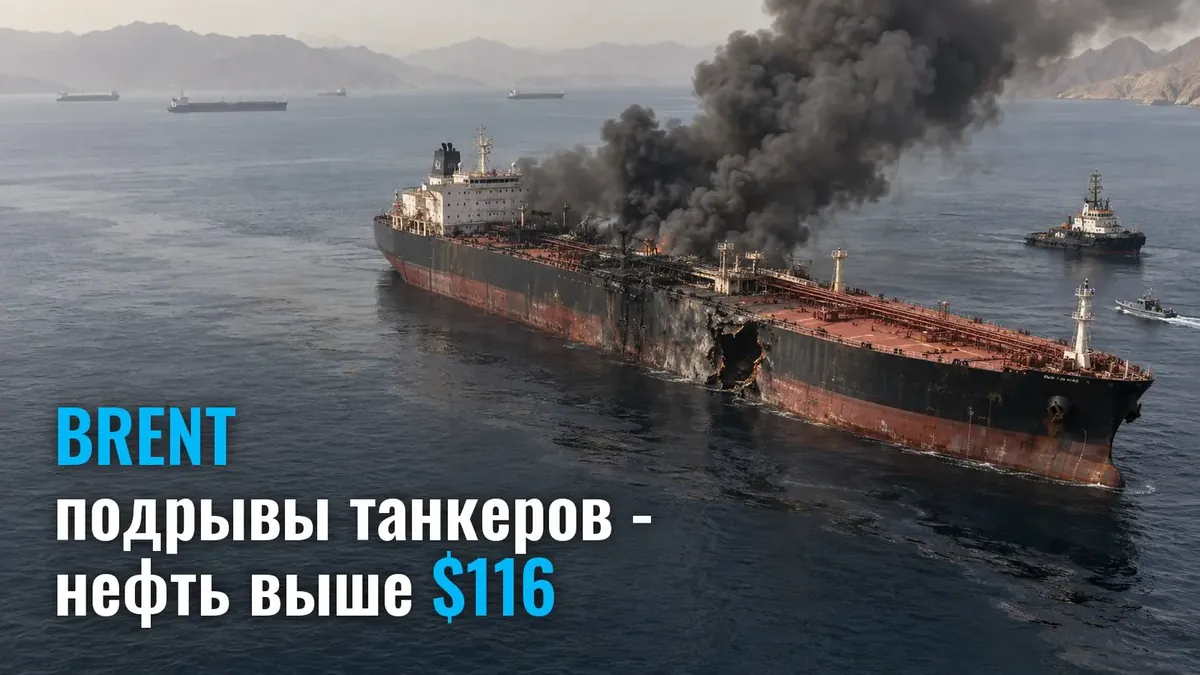
Oil prices jumped after reports of tanker explosions near the Strait of Hormuz. The December Brent futures contract rose $1.20 (+1.04%) on Friday to reach $116.08 per barrel.
The Strait of Hormuz is a narrow sea passage in the Persian Gulf. A significant portion of global oil supplies passes through it by tanker. Any threat to vessels there instantly drives up the price of a barrel.
In October, oil gained almost 11%. This is the fourth consecutive month of growth, and it directly hits the margins of traders who trade commodities and indices.
What are the numbers on the board?
Snapshot as of 06:23 Moscow time, October 30:
- $116.08 - December Brent, up $1.20
- $112.19 - the more active January contract, up $1.39
- $103.37 - US WTI grade, up $1.37
Brent and WTI are the two benchmark oil grades used to price oil worldwide.
October results. Brent gained about 11%, WTI about 14%.
Why did the market turn around?
The reason for the move is explosions on tankers. Iran's Islamic Revolutionary Guard Corps stated that three tankers exploded and caught fire after hitting mines.
- Southern route. The explosions occurred on a route bypassing the Strait of Hormuz; one tanker burned north of Khasab in Oman.
- Fourth vessel. Iran's army reported another damaged ship.
- US denial. US Central Command rejected these statements and said the main transit routes are clear.
- UKMTO confirmation. The British maritime center separately reported that a tanker in the strait itself was damaged by explosive devices attached by a small boat.
Background. On Thursday, the Houthis claimed attacks on the Ras Tanura and Rabigh refineries and on an Aramco facility in Abqaiq. The Saudi-led coalition reported intercepting a cruise missile.
There was also a counterplot. A day earlier, oil was falling: Tehran received a letter from US Vice President JD Vance about resuming negotiations but did not respond.
What do analysts say?
Saul Kavonic, head of energy research at MST Marquee, explains the persistence of high prices simply. Forceful actions continue around the strait, and the market does not believe in diplomacy.
Ole Hansen of Saxo Bank expects that even after the conflict, oil will remain in a range of $70-90 versus $60-70 before the war. The reason is the risk of renewed fighting and the need to replenish inventories.
What's next?
The main technical event is the contract rollover. The December contract expires on Friday, and from Monday the main Brent price will become the January contract, roughly $4 lower. This is a technical contract rollover, not a market decline.
What to watch next:
- $108 on the downside and $120 on the upside - reference levels for the material
- 15:30 Moscow time - Exxon's call with analysts; the third-quarter report is released on Friday
- Exhibition in the UAE - Exxon and Chevron canceled their trip to the oil exhibition due to security concerns
- November 3 - US vote, plus the Israeli parliamentary election adds two weeks ahead
It is convenient to keep track of oil and US dates in the economic calendar, and to check commodity terms in the prop firm catalog.
Were you positioned in oil when the tanker news broke?
Oil moves in bursts on headlines. Here it is important not only to guess the move but also to understand the rules under which you are positioned in it. Prop firms do not offer commodities everywhere: some simply do not have oil in their instrument list, some cut volume on it, some close the account for entering a minute after a geopolitical news release. Add expiration to that: what the program will do with your position when the contract rolls over. These things are checked at the selection stage, not when the position is already open.