

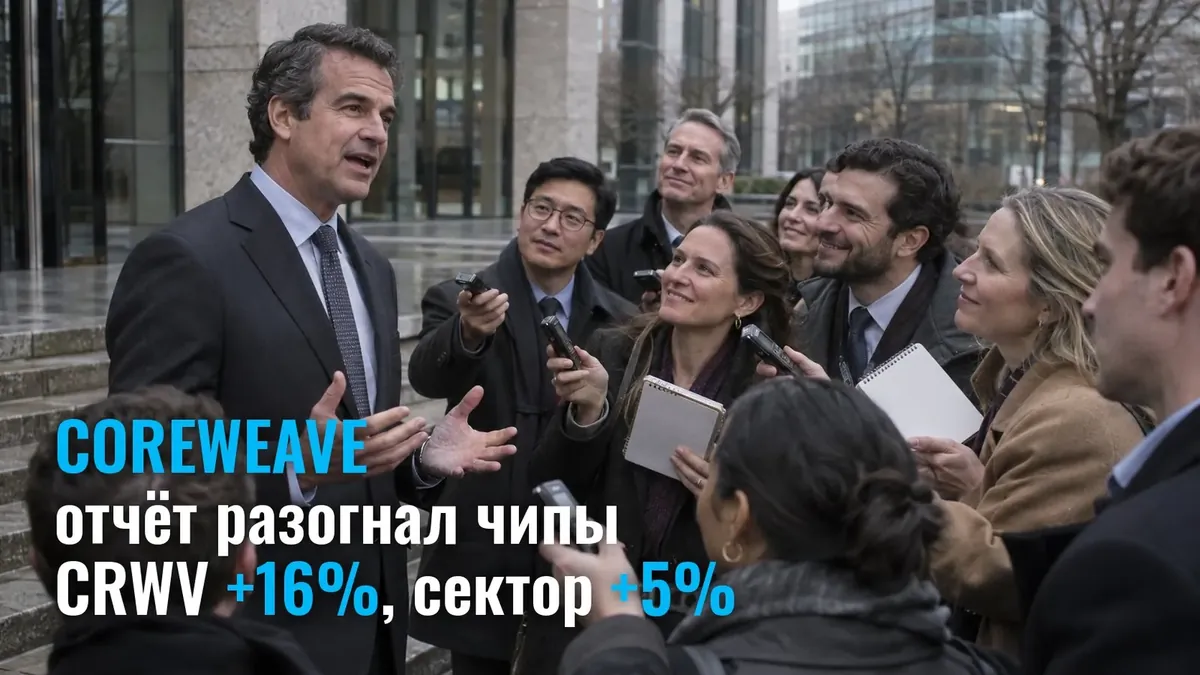
CoreWeave's report sent chipmakers' stocks upward. The rally began at the US market open on November 11 and swept across the entire semiconductor sector.
CoreWeave rents out computing capacity for artificial intelligence to other businesses. SOXX is an exchange-traded fund of semiconductor company stocks; it shows the movement of the sector as a whole.
This directly concerns traders. Chips are currently setting the direction for the Nasdaq and a substantial part of the S&P 500.
Who rose the most?
The movement in the stocks as of 17:39 Moscow time looked like this.
- CoreWeave (CRWV) +16% - the main hero of the day
- Marvell (MRVL) +8%
- Micron (MU) +7%
- Intel (INTC) +6%
- Broadcom (AVGO) +6%
- AMD +3%, Nvidia (NVDA) +3%, Qualcomm (QCOM) +3%
Why did the market turn around?
There is one reason - CoreWeave's quarterly earnings. The company lives precisely on the AI spending that the market had been doubting in recent weeks.
- The numbers were stronger than fears. The fear of cuts to AI budgets retreated for a day.
- They bought the basket. SOXX rising 5% means chipmakers were bought as a whole, not just one story.
- A rebound in what had been sold. The stocks that had been sold more actively before flew back the most, while the largest, Nvidia and AMD, moved more modestly than the average 3%.
What does this mean for a trader?
Semiconductors drag the broad market along with them, so a capacity provider's report moves the indices. For sessions like this, you can pick a challenge for the indices in advance.
The main thing: even someone who trades only the index has to watch the chips.
What's next?
The nearest reference points are the next reports along the AI supply chain.
- SOXX - shows whether the growth is happening across the whole sector or running out of steam
- Nasdaq and S&P 500 - the broad market's reaction to chipmakers' reports
- US market dates - in the economic calendar
Did you watch this gap at the open?
A plus of 6-8% on Micron and Intel in a session looks nice. But count it in your own money. In an account of a couple thousand dollars, a day like that produces a sum that's embarrassing to call a result, and it comes down to the notional size of the position. Prop trading is built for this task: you pay for selection according to the company's rules, then you trade its account with a hard loss ceiling and take an agreed share of the profit. Reports along the AI chain keep coming one after another, so the mechanics are worth understanding before the next open like this.