

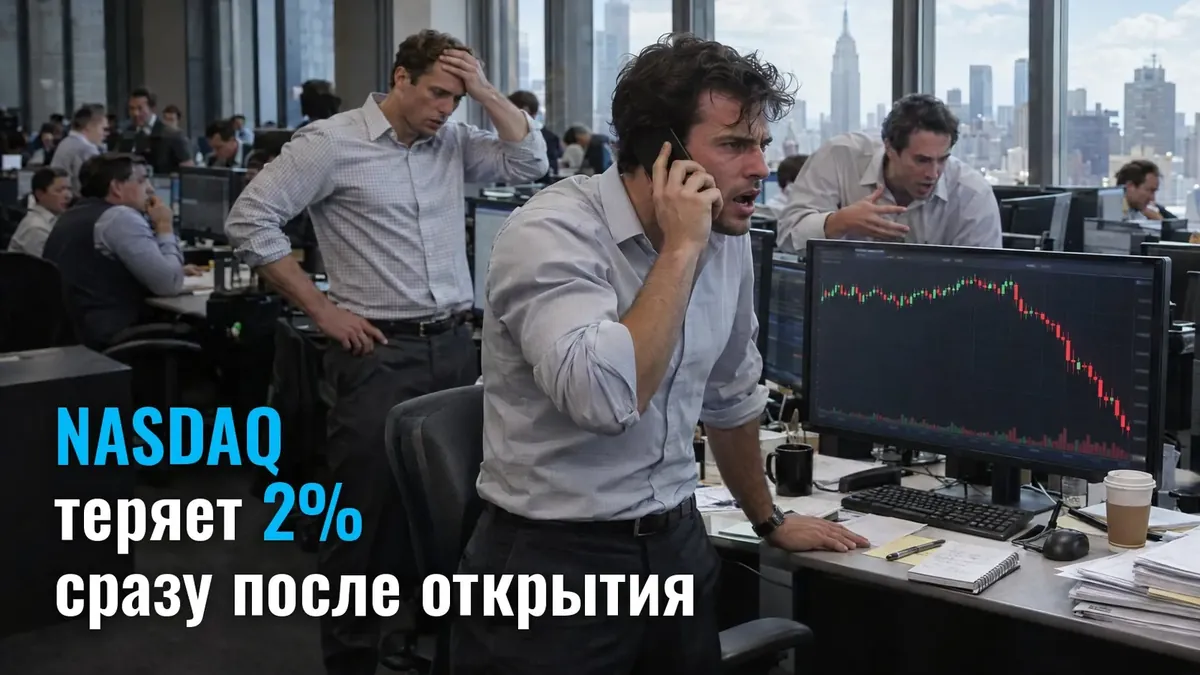
The Nasdaq index fell 2% by 18:08 Moscow time on November 16. The drop occurred within the first hour of the main US trading session.
Nasdaq is an American index where technology companies carry the main weight. It is used to gauge how the tech sector as a whole is trading.
For a trader, this is a day of fast movement: the move in the index is passed on to the instruments that track it.
Down in the first hour
- 2% - the Nasdaq decline by 18:08 Moscow time on November 16
- 17:30 Moscow time - start of the main US trading session
- First hour - the market worked off the entire loss right after the open rather than stretching it across the day
The move came at the open. For the rest of the session, the market did not carry its loss further.
No one named the reason
The source of the drop is not stated in the report. There is no report, no statement, no specific stock to blame.
- Known - the decline in the index itself
- Unknown - what triggered it
What changes in trading
Volatility has increased. Wide candles and fast sell-offs are running through the Nasdaq futures, through tech sector stocks, and through whatever tracks them.
- Stop. Calculated for a calm market, in a session with a two-percent move in the index it gets hit far more readily.
- Slippage. On entry into a trade, it increases.
Key point: stop and slippage in such a session work differently than in a calm market.
Where a trader should look
- Nasdaq futures and the tech sector - this is where the move is strongest
- Position size - choosing a challenge to suit your trading style is better done outside the session
Technique matters more than forecast. The cause of the drop has not yet been named, so all that remains to count is the risk on the trade.
Were you watching these candles on the Nasdaq?
A session like this is visible from any terminal. The outcome depends on the size you enter it with: two percent of index movement on a deposit of a couple thousand is lunch money. The trading notional for a trade is provided by a prop firm: the account is theirs, the risk limits are theirs, and the trader gets an agreed share of the result. Own capital of a comparable size is not needed for this. Reading up on how this path works is easier with a cool head and the terminal closed.