

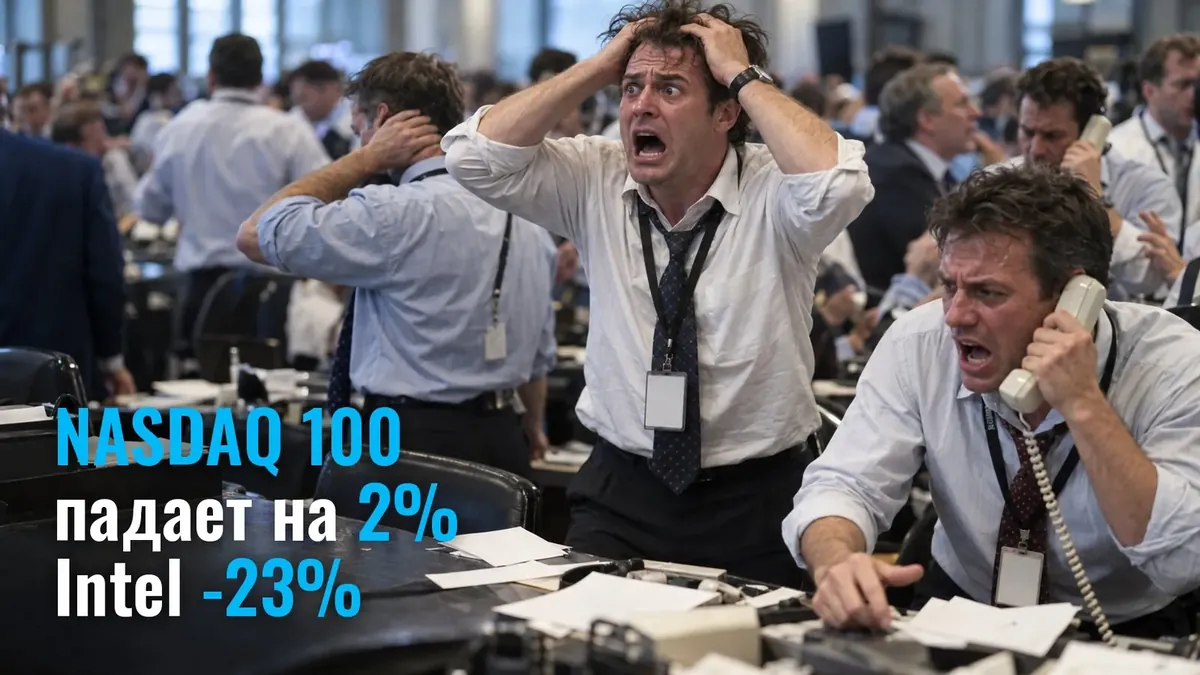
Nasdaq 100 futures fell more than 2% on the morning of October 30. By 11:07 Moscow time it was trading around 28,960 points. The reason - weak forecasts from three of the largest technology companies at once.
The Nasdaq 100 is an index of the 100 largest non-financial companies on the American Nasdaq exchange. It contains almost the entire large tech sector. The index futures are a contract that reflects in advance where stocks will go at the open.
Investors were spooked by spending on artificial intelligence. Companies are spending more and more on AI, but the returns are not yet visible. For a trader, this means a sharp divergence between the tech indices and the rest of the market.
How much did the indices fall?
The other indices are holding up better. The decline is concentrated in the technology segment.
- S&P 500 futures - -0.90% around 7,680
- Dow Jones futures - almost unchanged, -0.05% around 52,490
- QQQ fund - also down more than 2%
QQQ is an exchange-traded fund tracking the Nasdaq 100 index, traded like a regular stock.
The day before, the picture was milder. The Nasdaq Composite closed -1.38%, the S&P 500 -0.3%, the Dow -0.25%.
What did the reports show?
A breakdown by stock explains where the sell-off came from.
- Intel -23%. In the evening session the decline reached 25%. Revenue grew 21% to $16.51 billion, and the data center and AI segment added 78%. But the forecast for the fourth quarter turned out weak due to PC demand and supply bottlenecks, and spending for 2026 is being raised to $20 billion.
- Alphabet -12.6%. Revenue from search and advertising turned out weaker than expected.
- Amazon -7% before the open. Revenue +12% to $201.9 billion, AWS cloud +39% to $46 billion. At the same time, the capital expenditure plan for 2026 has been raised to $220 billion, and free cash flow went negative by $42.4 billion.
- SanDisk -4%. The stock fell even with a report better than expected.
Why did the market react this way?
The market reads this the same way: revenue is there, but the AI buildout is eating money faster than it brings it in.
The main point: the sell-off is happening specifically in the technology segment, not across the whole market.
What about the macroeconomy?
The macro backdrop is against tech. US GDP for the third quarter grew 3.4% year-on-year versus the expected 3.2%.
- The Fed did not change the rate. According to CME FedWatch, the probability of a 25 basis point hike in December is estimated at about 75% versus 84.2% the day before
- Gold - -1% and below $4,000 per ounce
- Silver - -3% around $50
Things are not calm in safe-haven assets either. It is worth keeping the upcoming Fed decisions at hand in the economic calendar.
Did you watch this divergence of the indices?
One futures contract is flying 2% down, the second is standing still. This is that rare session where the divergence between the Nasdaq and the Dow works itself out. The problem is different: on an account of a couple thousand dollars, such a divergence brings lunch, not a quarter's result. In prop trading, the notional is provided by the company: you pay for the selection, work with its account within its risk limits, and take your share. Earnings season is not over, so it is useful to understand the mechanics before the next such night.