

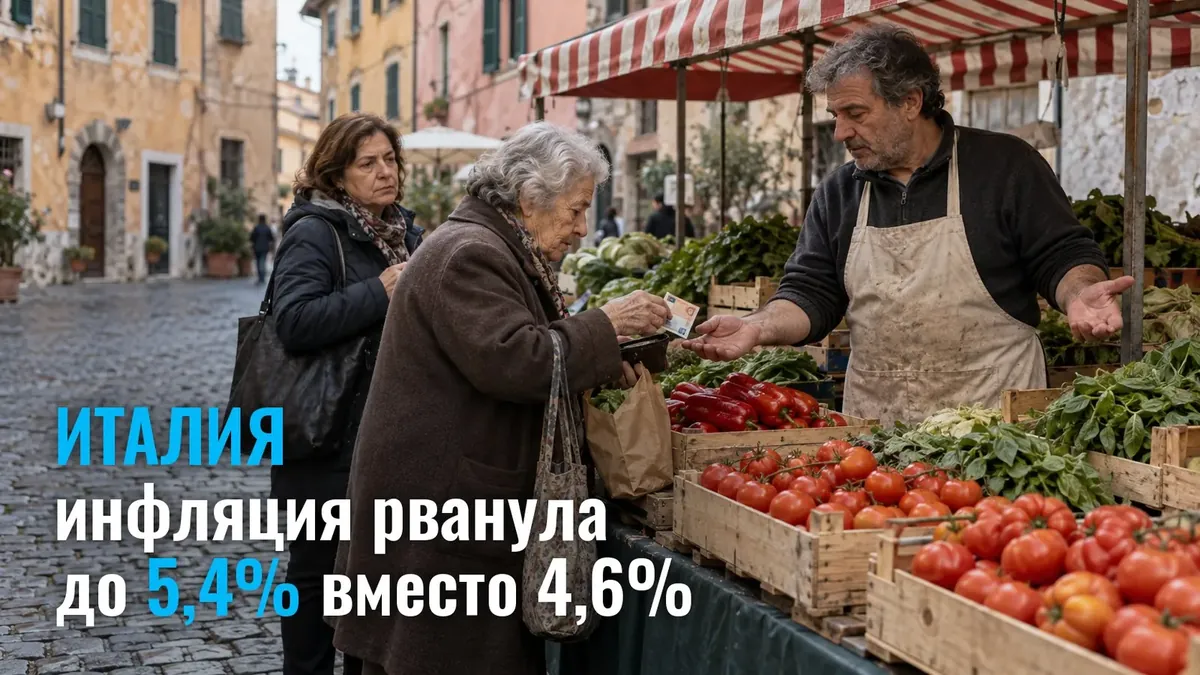
Inflation in Italy accelerated to 5.4% year-on-year in October. The preliminary estimate was published by the statistics agency Istat on October 30 at 13:01 Moscow time. Analysts had expected 4.6%, and a month earlier it was 4.2%.
The miss versus consensus is almost a full percentage point. For a eurozone country, that is a lot. Consensus is the average analyst forecast against which the market checks the actual figure.
Why this matters to a trader. The Italian figures will feed into the aggregate inflation estimate for the entire eurozone as one of its largest components. The market will use it to shift expectations ahead of the December ECB meeting.
How big was the miss?
The harmonized measure came in even higher than the national one. HICP rose 5.6% versus a forecast of 4.6% and the previous 4.2%.
HICP is the single methodology for calculating inflation for all EU countries, and it is the one the ECB compares across countries.
- +5.4% - national inflation estimate for October
- +4.6% - analysts' forecast
- +4.2% - the figure a month earlier
- +5.6% - harmonized HICP
What drove prices up?
Energy made the main contribution. Inflation for regulated energy jumped from 25.8% to 59.5% year-on-year. For unregulated energy, from 22.5% to 29.4%.
Regulated energy refers to tariffs whose prices are set by the state.
But it was not limited to energy alone:
- Unprocessed food. Accelerated from 5.5% to 7.5%.
- Processed food. Returned to positive annual growth.
- Services. Rose more modestly - from 2.6% to 2.9%.
- Transport services. Rose to 3.1%.
What does this mean for a trader?
The key split is goods versus services. The goods component rose from 5.4% to 7.5%, while services remained noticeably more subdued.
The surge is so far concentrated in goods and energy. It is not spread across the whole economy. For monetary policy, these are different stories.
Key point: the source does not record any direct reaction in the euro.
What happens next?
The next step is the aggregate estimate for the eurozone. The Italian data will feed into it as one of the largest components.
Next, the market will rebuild expectations ahead of the December ECB meeting. It is convenient to keep the release date in the economic calendar. And it is worth choosing a news trading challenge in advance.
Were you in the euro at 13:01?
National inflation reports come out in the middle of the European session. The market prices in a full-point miss versus forecast within seconds. The question is not whether you guessed the direction, but how your prop program counts such an entry. For some, news trading is a normal mode; for others, a trade in the release window closes the account, and a sharp spike also burns through the daily drawdown limit. This is baked into the program's rules, not into its advertising description. There is still time to check before the aggregate eurozone data.