

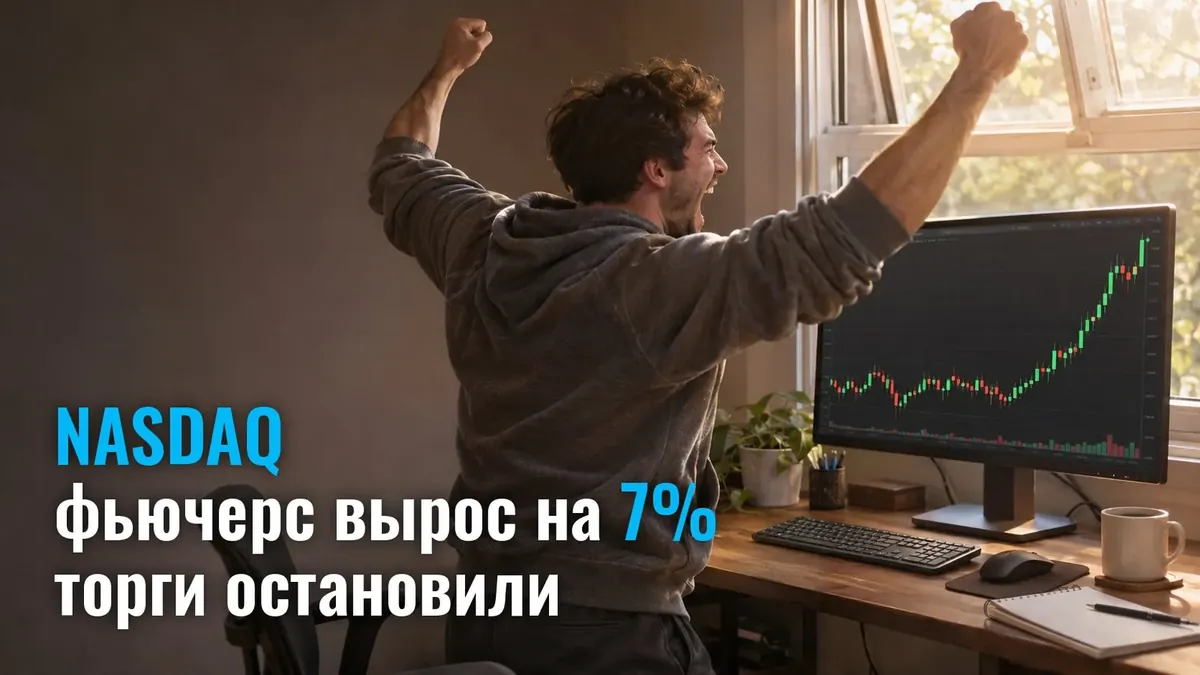
Nasdaq futures rose about 7%, hit the exchange limit, and trading was halted. Trading in Nvidia shares was also halted. The S&P 500 was up 4% at the time.
A futures contract is an agreement on the future price of an index, and it is traded even before the main session opens. The limit is the maximum move within a session; beyond it, the exchange does not accept trades. The Nasdaq and S&P 500 are indices of large American companies, with tech companies gathered in the first.
The market was lifted by Jensen Huang's return to Nvidia. The trader got a morning when the price moved far from Friday's level, and trading was not allowed.
Scale of the rebound
- +30% - how much Nvidia gained in pre-market trading before the main session opened.
- +33% - the maximum after trading resumed.
- $164.46 - the share price at 17:19 Moscow time versus Friday's close of $125.53.
Friday's plunge was just as sharp. The stock fell 14.01% and dropped to $124.50, a one-year low.
The week closed down about 23%: according to CNBC calculations, Nvidia's worst week since October 2008. Market capitalization at Friday's close was $3.03 trillion.
Board decision
- 16:55 Moscow time: the board of directors unanimously returned Jensen Huang to the posts of president and CEO, 11 days after his resignation.
- Six days earlier: board chairman Harvey Jones told analysts they did not plan to reinstate Huang.
- On Sunday: Donald Trump spoke in favor of his return, and Treasury Secretary Scott Bessent no longer ruled out such an option.
According to Nvidia's statement, the board was persuaded by information from senior US officials. It indicated there was no national security threat.
The entire sector moved up:
- CoreWeave (CRWV) +30% - one of the strongest stocks of the day.
- Up to 16% - companies that lease computing capacity for AI gained.
- Arm -14.09%, AMD -13.25%, Broadcom -12.19% - that is how these same stocks fell on Friday along with Nvidia.
What this means for the trader
Part of the move happened while trading was halted. You cannot enter the market at the limit and during a halt, and by that time the price is already different.
Key point: Nasdaq futures delivered 7% in a single morning, and that move was captured by whoever held a position until trading was halted.
How the challenge and payouts work is explained in the academy. You can find an account for trading indices in the calculator.
What remains unresolved
No one has lifted the investigations into the company.
- Board of directors: the independent directors' committee is investigating reports of an attempt by foreign intelligence to approach Huang.
- December 1: Huang faces a closed-door conversation with three House committees about chip supplies to China.
- The SEC is reviewing the reporting. The SEC is the US Securities and Exchange Commission.
Despite the entire jump, NVDA is about 13% below its level at the start of the year.
Did you catch these 7% on your own deposit?
Futures move 7% in minutes a couple of times a year. Such a move is captured by whoever has a large notional at hand. The same percentage on two thousand dollars yields a couple hundred, on a hundred thousand - a sum of a different order. Prop trading works like this: you pay for the challenge, pass it within the company's limits, and then trade its account, giving up part of the profit. It takes one evening to understand this scheme, and trading halts come without warning.