

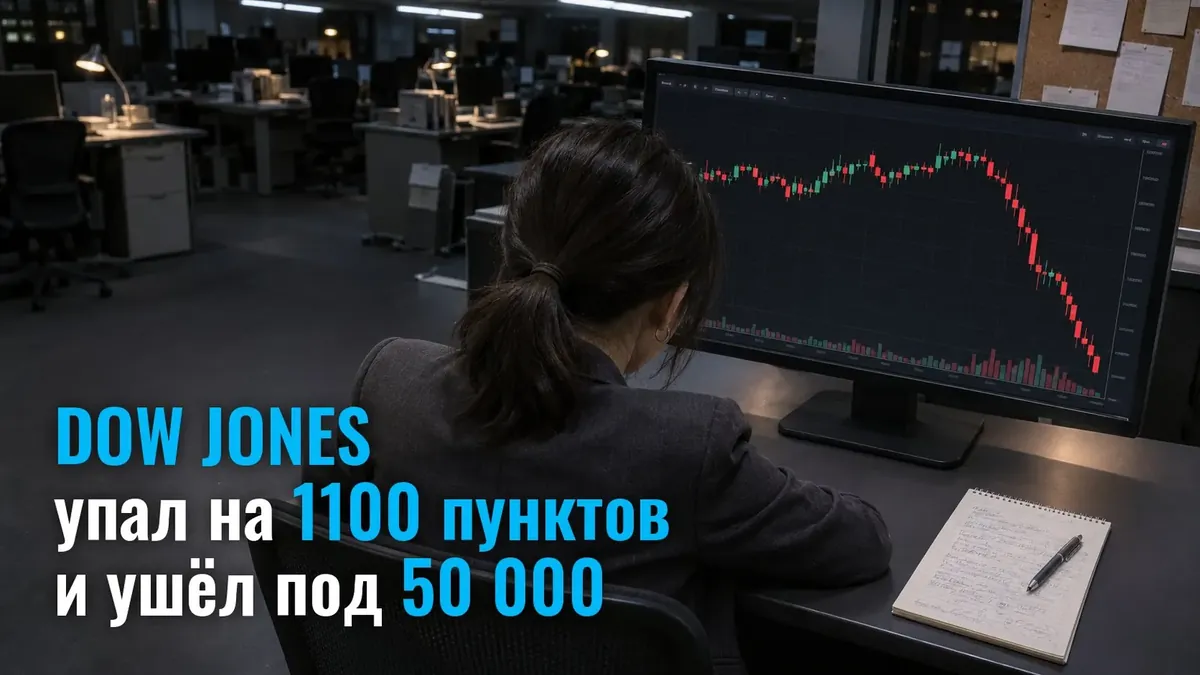
The US stock market fell sharply on November 19. The Dow Jones index lost 1,100 points and closed at 49,097, down 2.19%. It had not been below 50,000 for more than four months.
Dow Jones is a stock index of large American companies. It shows where their prices are heading on average. The S&P 500 and Nasdaq Composite are other indices of the same market, and they also went negative.
The sell-off did not affect only stocks. The dollar rose, gold fell, and the USD/JPY pair approached 160. One day moved indices, gold and currencies all at once.
Closing numbers
The decline was almost across the board.
- S&P 500: -2.00% to 7,177, the sixth consecutive negative session.
- Nasdaq Composite: -2.23% to 23,886.
- Industrials sector: -2.61%.
- Energy +0.14% and consumer staples +0.04%: only these two sectors closed in the green.
What crashed the market
The reason is inflation and rates.
- Fed rhetoric: the head of the Chicago Fed sees no clear path to the inflation target.
- Weak data: the Philadelphia Fed business activity index came in at 6.3 versus a forecast of 20.0, and jobless claims were 203k versus the expected 197k.
- Expensive money: the yield on 10-year US Treasuries remained above 5% (5.048%), and this weighs on stock valuations.
Austan Goolsbee, head of the Chicago Fed: inflation is "far above" the Fed's 2% target, and he sees no clear path to that target.
Intraday reversal
During the day the market was trading in the green. Anthropic held the largest initial public offering in history, its shares opened 34% above the offering price, and the Nasdaq was up more than 2% at its high. By the close, none of that remained.
An initial public offering is when a company lists on the stock exchange.
- Nvidia -3.30%: the quarterly report was strong, but since November 11 the company has lost about $632 billion in market capitalization.
- AMD -7.72%: after Hunterbrook published a report on ties to a blacklisted Chinese server maker.
- Palo Alto Networks +6.42%: a report above expectations and a $4.5 billion acquisition.
- Insmed +20.58%: reports of interest from Sanofi.
What this means for a trader
The decline was almost across all sectors, so a bet on an individual stock rarely saved you. Even Nvidia was not held up by a strong report.
- Yields: 10-year US Treasuries above 5%, 2-year yields fell 3.4 basis points to 4.766%.
- Dollar: the DXY index is rising, money is leaving risk.
- Gold -2.10% to $3,663.50: the metal is falling along with stocks.
- USD/JPY 159.68: the pair nearly reached 160.
The dates of Fed meetings and inflation data releases are collected in the economic calendar. If you trade indices, it is convenient to check the conditions via the challenge selector.
Did you short this six-session streak?
Six sessions down in a row is a stretch that can be traded without guessing a reversal. Beyond that, everything comes down to account size. With a deposit of a couple thousand dollars, a 1,100-point Dow move produces an amount you would not notice on a statement. In prop trading, the trading account is provided by the company: you pay for the evaluation, trade within its risk limits and receive a share of the profit. Before the next week like this, you can figure out the rules by which companies provide that account size.