

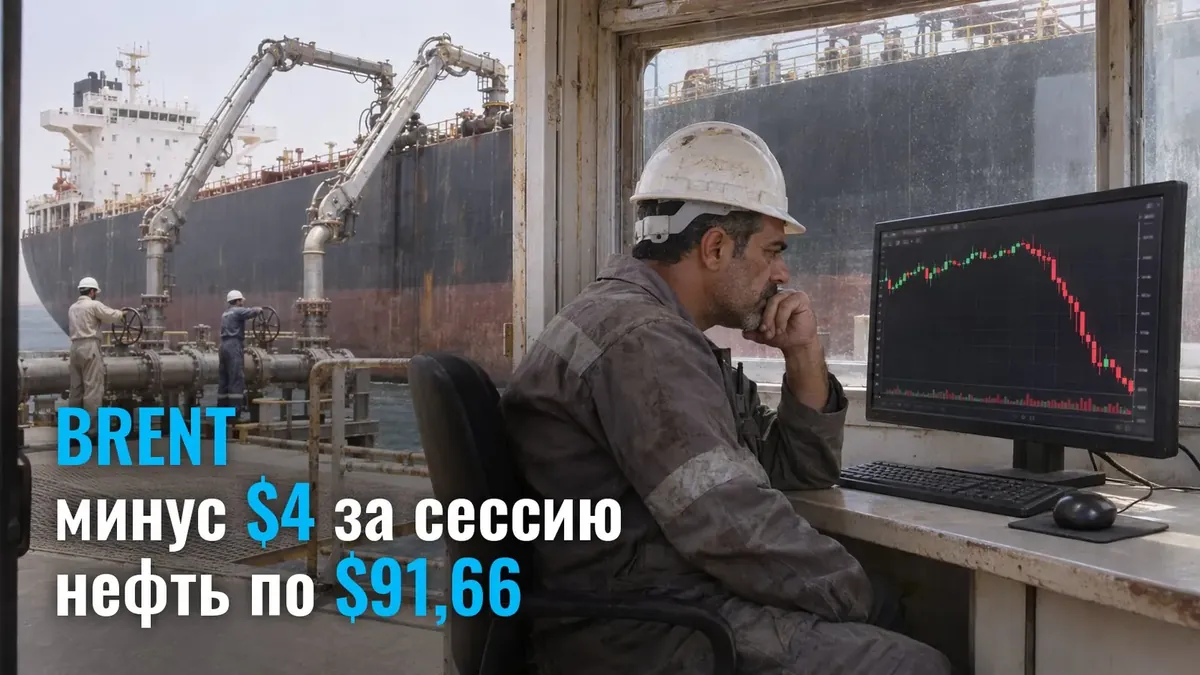
Oil went down: Brent fell on Monday and continued falling on Tuesday morning. The rally triggered by the attack on the US base in Bahrain ended in less than one trading day.
Brent is the benchmark grade of North Sea oil. Its price is used to value oil in Europe and Asia, while WTI serves as the benchmark for the US.
The market is putting excess oil above the risk of supply disruptions. For a trader, this is a change in the main price driver.
How far did the price fall?
- $96.28 - Brent on Monday morning.
- $92.44 - Monday's close, down 3.55%.
- $91.66 - Tuesday, 07:30 Moscow time: down 78 cents, or 0.8%.
- $84.99 - WTI on Tuesday; on Monday it fell by about 3.6%.
The nearest marker is below. The price has approached $91.49 - the November 10 close, the lowest since August.
Why is oil falling?
- Exports have recovered. Supplies from the Middle East are growing faster than demand.
- The IEA sees a surplus. On Friday the agency reported that in the fourth quarter supply will exceed demand for the first time since the war began. Production is about 105 million barrels per day, 1.7 million barrels more than consumption.
- Goldman Sachs lowered its target. The bank factored an average Brent price of $88 in 2027 and $78 by December 2027 into its calculations.
The war premium has not left the price. Attacks on ships and energy facilities in the Persian Gulf and the Strait of Hormuz continue, but the market puts the surplus above this risk.
The war premium is a surcharge on the price for the risk of supply disruptions.
What does this mean for a trader?
Key point: the November range for Brent is currently capped at $88 on the downside and $96 on the upside.
A separate figure. The US Strategic Petroleum Reserve has fallen to 276.4 million barrels - the lowest since August 1982.
The Strategic Reserve is a government stockpile for use in case of disruptions. For such an amplitude, you can find a challenge for oil.
What's next?
- November 18, Wednesday - weekly inventory data from the US Energy Information Administration (EIA) and the minutes of the October Fed meeting.
- November 29 - the OPEC+ ministerial committee.
Both events are listed in the economic calendar.
OPEC+ is an alliance of the largest oil exporters.
Did you hold oil through this reversal?
Anyone who was in oil on Monday went through both the spike to $96 and the reversal down in a single session. After that, it comes down to the program's rules. Some prop firms don't have oil in their instrument list at all. Others prohibit holding a position overnight, and calculate the daily drawdown from the account's maximum. This is visible in the terms before you pay for the evaluation. There is time to check before the OPEC+ committee on November 29.