

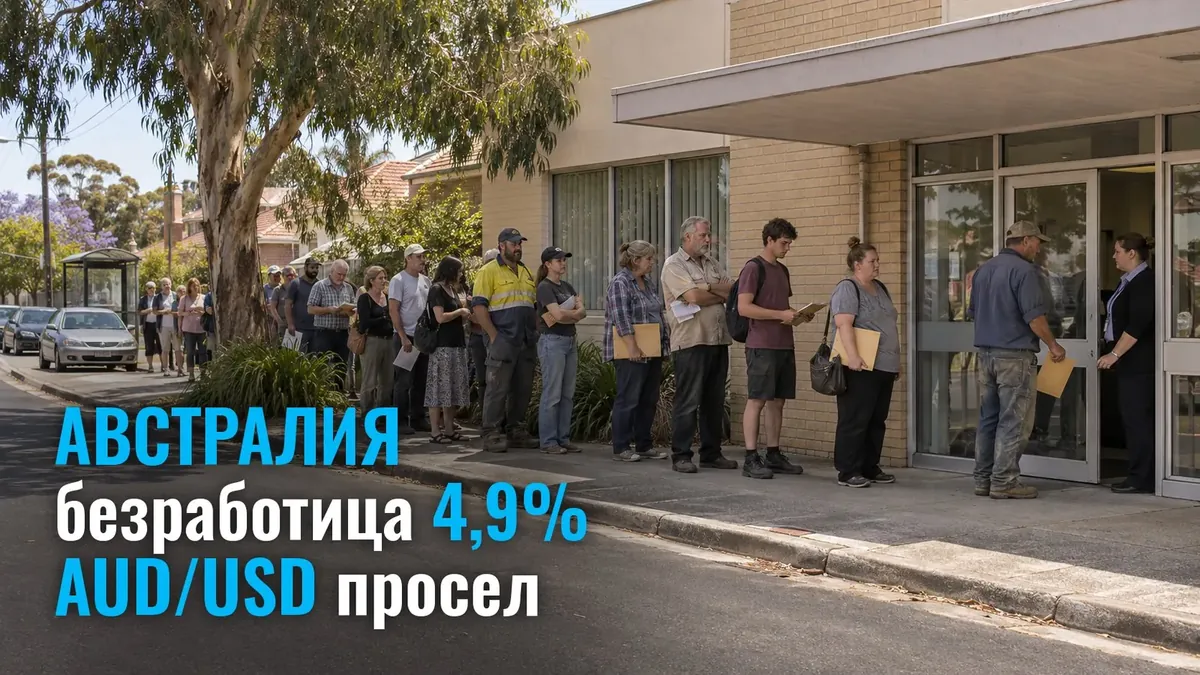
The Australian Bureau of Statistics reported that the country's unemployment rate rose to 4.9%. The October report was released at 03:30 Moscow time. Employment fell by 43.5 thousand, although the market had expected a gain of 25 thousand.
The labour market report is a monthly count of employed and unemployed people. AUD/USD is the Australian dollar to US dollar rate, AUD/JPY is to the Japanese yen. The Australian dollar weakened after the report: AUD/USD headed to its lowest since January, and AUD/JPY is falling for the sixth day in a row.
Report figures
- 4.9% - unemployment versus a forecast of 4.7% and September's 4.7%, a five-year peak.
- -43.5 thousand - employment in October after a fall of 39.3 thousand in September.
- -2.9 thousand and -40.6 thousand - full-time and part-time employment.
- 66.6% - the labour force participation rate, versus 66.8% a month earlier.
The labour force participation rate is how many people are actually looking for work or working.
Why there was no rebound
The market expected October to make up for September's slump. Instead, part-time employment fell for a second month.
- September: part-time employment lost 73.7 thousand, and almost the entire month's slump came from it.
- Expectation: such swings usually reverse after a month, so the market priced in a rebound.
- October: part-time employment lost another 40.6 thousand.
Where the rate is now
- 0.6695 - the AUD/USD level, below the 100-week average of 0.6704.
- 0.66602 - the low of the year, set on 6 January and so far holding.
- 106.60 - AUD/JPY is trading around this level, an almost ten-month bottom.
The 100-week average is the average price over the last 100 weeks; technical traders kept it as their first reference point.
The high-rate paradox
The Reserve Bank of Australia raised the rate by 25 basis points to 4.85% in November. This is the fifth hike of 2026 and the highest since 2008. A basis point is one hundredth of a percentage point.
The votes in the minutes were split: six of nine in favour of the hike, three warned of the risk of a sharp economic downturn.
Key point: Australia's rate is higher than America's, yet the currency is falling. Traders believe the local hiking cycle is over, while the Fed's is not.
The next window is February
- December - the market has already priced out a hike.
- February - the next real window for the RBA.
Publication and meeting dates are collected in the economic calendar. For the rules on trading the news, see the cards in the prop firm catalogue.
Did you trade this overnight candle on the Aussie?
Australian statistics are released at 03:30 Moscow time, and a trade around them lasts minutes. In prop firm rulebooks these are two separate points: whether entry at the moment of data release is allowed and whether there is a minimum position holding time. Plus, AUD/JPY itself is not on every instrument list, even though it has been falling for six days in a row. Checking both lines for your pair is cheaper than finding them out from an account closure email.