

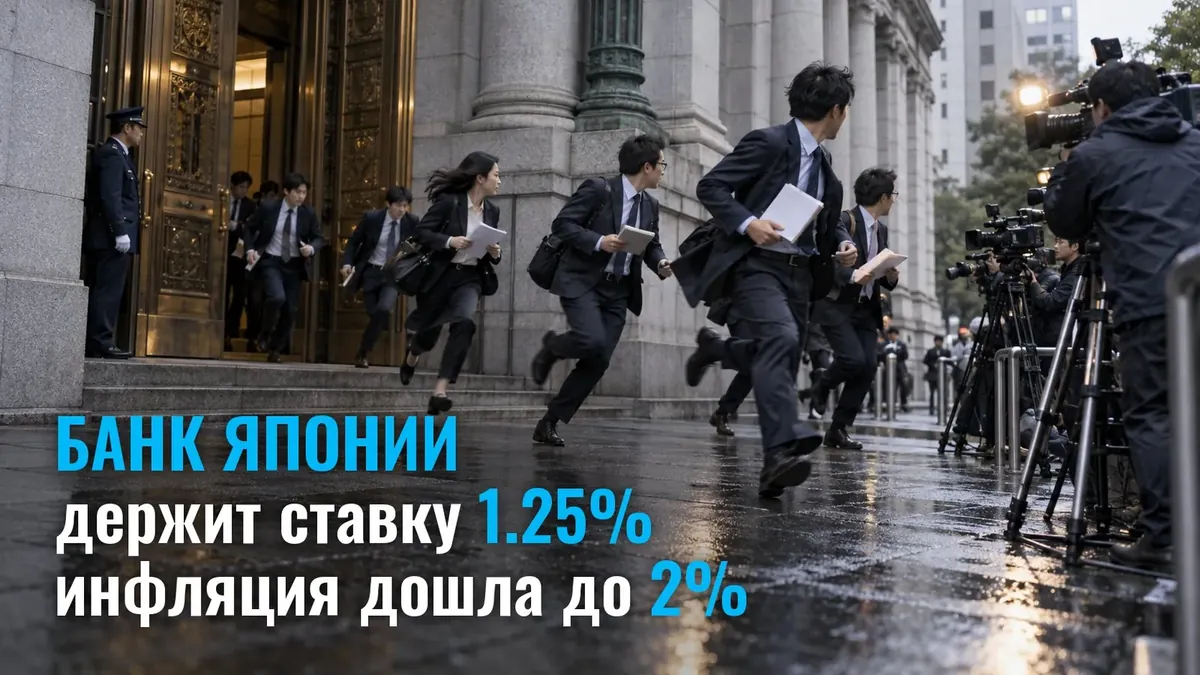
The Bank of Japan kept its short-term rate at 1.25%. The decision was made by an 8-to-1 vote following a two-day meeting. At the same time, the regulator hardened its language: core inflation reached the 2% target for the first time since 2013.
What the short-term rate is. It is the main price of money in the country, and the yen's yield depends on it. The higher the rate, the stronger the currency. Core inflation is price growth excluding the most volatile items such as fresh food.
Why this matters to a trader. The yen is strengthening, and USD/JPY has been falling for the third day in a row. All yen crosses are currently trading on the regulator's words, not on the decision's numbers.
What exactly did the regulator say?
The decision came out at 06:00 MSK following the two-day meeting. Board member Takata voted against - he demanded a rate hike right now.
The statement says directly: price risks are skewed to the upside, and the regulator will continue to raise the rate.
The main point: this is a reversal of rhetoric. Previously the Bank of Japan feared inflation undershooting, now it fears overheating.
Why did the regulator tighten?
The morning data provided the reason. Price and labor market statistics came in better than forecasts.
- Tokyo inflation. For October - 2.8% year on year versus a forecast of 2.7%, core (excluding fresh food) - 2.6%.
- Unemployment. Fell to 2.4% against expectations of 2.5%.
- Outlook report. Core inflation for fiscal 2027 was raised to 2.7% from July's 2.6%.
- Exchange-traded funds. The regulator is accelerating the sell-off - to 860 billion yen per year versus the previous 330 billion. These are the funds through which the Bank of Japan bought stocks for years.
How did yen crosses react?
The yen rose against almost everything. The moves so far fit within the usual ranges.
- USD/JPY - -0.20%, around 157.40, below the middle of the 157 range in which the pair has traded between 156 and 159 for six weeks.
- EUR/JPY - at 176.10, ending a two-day rise.
- AUD/JPY - at 110.80, falling for the second day.
- GBP/JPY - holding around 210.80, keeping the 50-day average at 210.77.
What happens next?
Next up is the press conference. Bank of Japan Governor Kazuo Ueda speaks at 08:30 MSK, and it is from this that the market expects a signal about December.
According to a Reuters poll before the meeting, 54 of 78 economists expected a hike to 1.5% already this quarter. The date of the December meeting is worth marking in the economic calendar.
Were you holding the yen at the moment of the decision?
Such meetings take place at night and in the morning MSK. A position in them is either open or not yours. The problem is not the direction but the rules: some prop firms count the daily loss from the morning balance, others from the account maximum, and still others explicitly prohibit entering minutes before a central bank decision is published. Add to this the volume limit per pair and the list of available yen crosses. There is time before the December meeting to check this against the programs.