

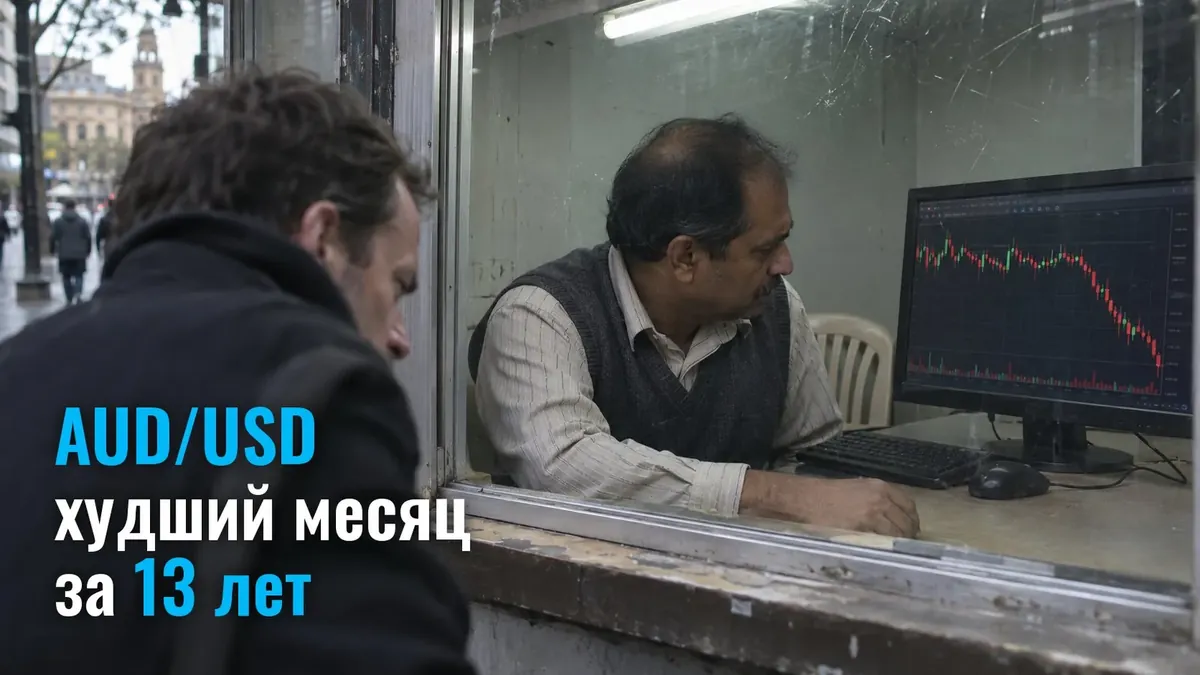
The Australian dollar is falling against the US dollar more sharply than in any month over the past 13 years. The market figure was published on November 25 at 10:57 Moscow time. There are still several trading sessions left before November closes.
AUD is the Australian dollar. It is measured by the monthly change in the AUD/USD pair (how many US dollars are given for one Australian dollar).
Within individual sessions, such a record is not visible. The shift is only apparent on the long-term chart.
Where the scale is visible
The move is spread out across days, but on the monthly chart it is a record. Across individual sessions, it does not stand out.
- Monthly chart - the heaviest candle for the Australian dollar in 13 years.
- Individual sessions - the shift is spread out and almost unnoticeable.
- The count - based on the monthly change in the AUD/USD pair.
USD strength or AUD weakness?
The decline is against the US dollar. Therefore, part of the move is the strength of the USD itself, and part is AUD weakness.
Crosses help separate one from the other. A cross is a pair without the US dollar.
- AUD/JPY - the Australian dollar against the Japanese yen.
- AUD/NZD - the Australian dollar against the New Zealand dollar.
- EUR/AUD - the euro against the Australian dollar.
Why the Australian dollar is weakening
The author of the post does not give a reason. It only provides the scale of the movement.
The Australian dollar in forex is classified as a commodity currency. Here is what it reacts to:
- Commodity prices. The exchange rate follows the commodity market.
- The Reserve Bank of Australia rate. Decisions on it move the AUD; meeting dates are in the economic calendar.
- Demand from China. The third factor for the Australian dollar.
What to watch until November 30
The final figure for the month will be fixed on November 30.
Key point: until November is closed, the record is calculated based on current levels, and over the remaining days it could shift in either direction.
If you trade currency pairs, you can choose a challenge to suit your style.
Did you short the Aussie all November?
A monthly trend in a currency pair can be seen in advance. A position for it is held for weeks. On a three-thousand deposit, this entire move turns into a couple hundred dollars, and then your hand reaches for leverage. In prop trading, the trading notional is provided by the company: you pay for the selection, trade within its risk limits, and receive your share of the profit. It makes sense to understand the mechanics before the December currency moves.