

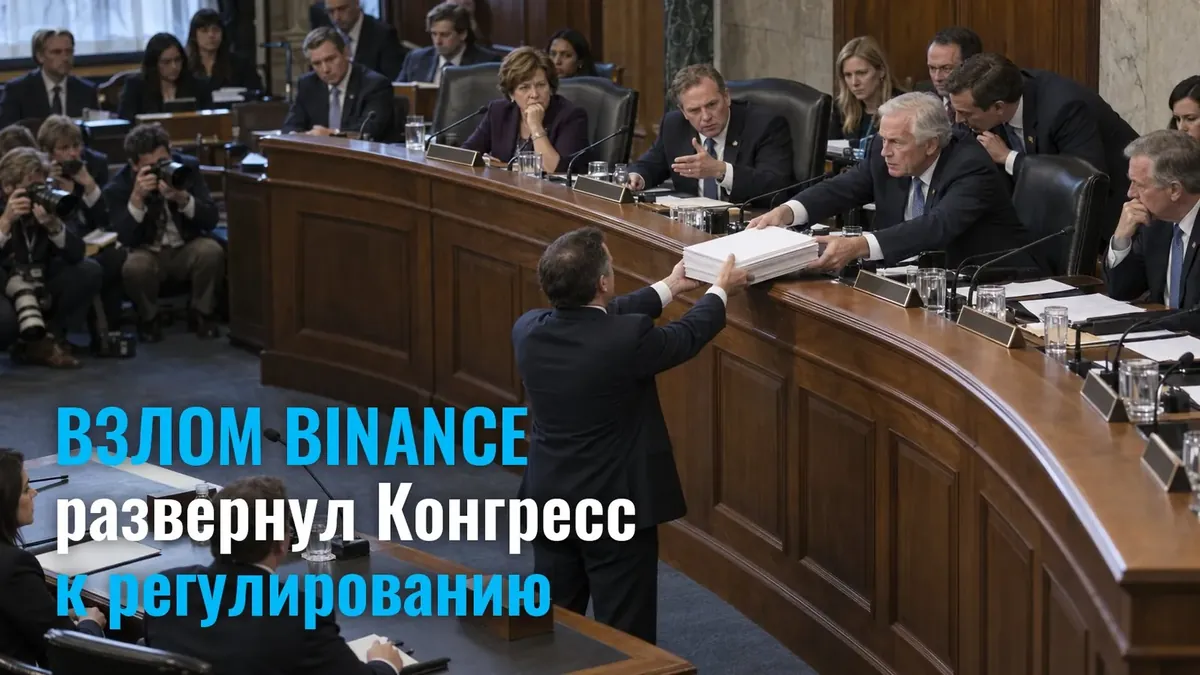
Hackers withdrew $6.3 billion in assets from Binance hot wallets. The attack occurred on October 29. Two days later, the topic became political.
What they said in Washington. Donald Trump stated that the administration is dealing with the incident. Letters demanding federal oversight of exchanges were sent to Congress.
In simple terms. Hot wallets are exchange storage connected to the network. Fast client withdrawals pass through them. Federal oversight means uniform US rules for all platforms where crypto is traded.
How much money was lost?
The exchange promises to cover clients' losses itself.
- more than $6.34 billion - Binance's reserve of its own funds for compensation
- about $3 billion - frozen together with blockchain networks and token issuers
- approximately $3.33 billion - remained under the attackers' control
How was the exchange breached?
- Infected laptop. Binance first linked the hack to the laptop of an engineer who maintains the infrastructure.
- Other entry points. The exchange then acknowledged additional points of penetration.
- Keys intact. According to the exchange, private keys did not leak. Access to the system that sends withdrawal requests was enough.
- Trail of the attack. TRM Labs and Chainalysis attribute the attack with high confidence to the North Korean group TraderTraitor.
Why did Congress swing into action?
Regulator's signal. CFTC Chairman Michael Selig called the incident proof of the risks of offshore platforms that operate outside American requirements.
On October 30, The Digital Chamber CEO Cody Carbone sent a letter to Congressional leaders. In it, he asks:
- CFTC authority. Expand the regulator's powers to oversee exchanges.
- Asset segregation. Require exchanges to keep client assets separate from corporate assets and protect them in bankruptcy.
- Transfer controls. Introduce multi-party confirmation of transfers and round-the-clock monitoring.
- Incident reporting. Make reporting of hacks mandatory.
What does this mean for a trader?
The main risk. Assets can be lost even with keys intact. Access to the withdrawal system proved sufficient.
What can actually be recovered. USDT and USDC can be frozen through issuers. BTC and ETH are not stopped that way.
The main point: money on an exchange depends not only on your own protection, but also on its internal procedures. How prop trading works and how it differs from trading from your own wallet is covered in the academy.
What happens next?
Laws not yet passed. The digital asset market bill passed the House of Representatives in 2025. On September 15, 2026, it failed in the Senate in a 49-50 vote.
On October 5, the CFTC issued two draft crypto rules. They are at the advance notice stage.
- until December 14, 2026 - comments on the drafts are being accepted
- cybersecurity - the drafts do not yet contain mandatory requirements
- until November 2 - Binance promised an updated proof of reserves
- withdrawals - the exchange is enabling them in stages after checks
Was the money sitting on the exchange that night?
On the night of October 29, half the market was watching not the chart, but whether withdrawals were going through. When you trade with your own deposit, you bear that risk. And the ceiling is yours too: your position size equals what you have saved. Prop trading works differently - the company provides the trading account: you pay for the selection, keep to its risk limits, and share the profit. Understanding the mechanics is calmer now than on the next such night.