

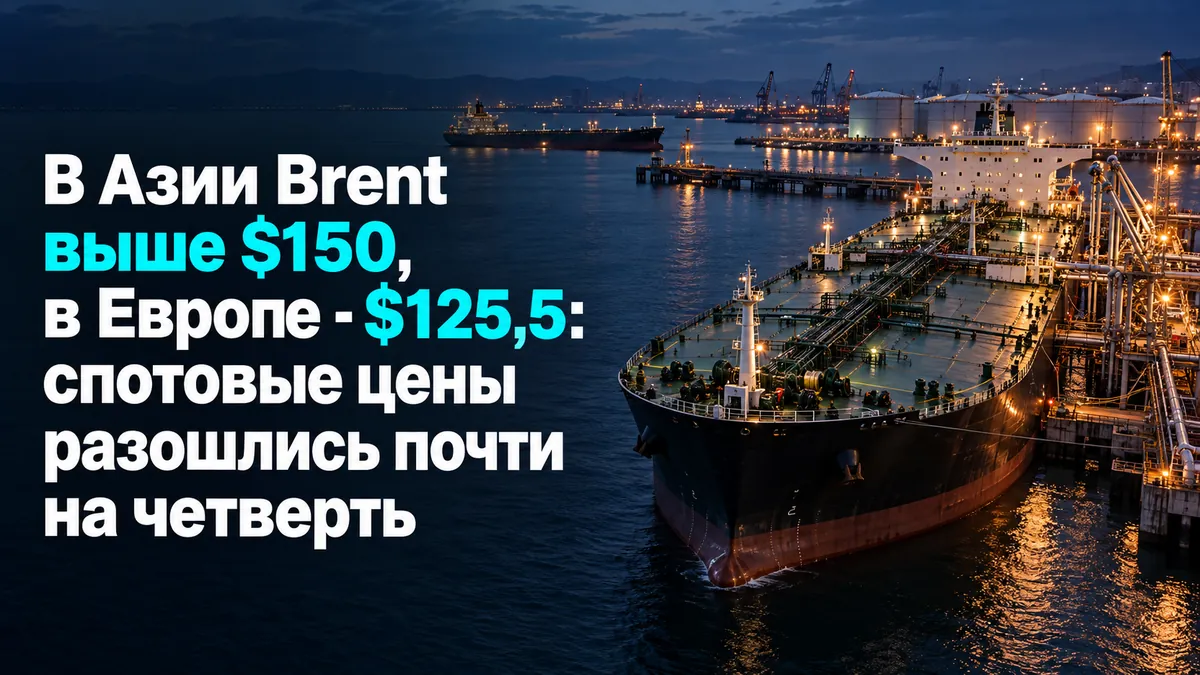
The Brent spot market is showing an unusually large gap between Europe and Asia. In Europe, the price is around $125.5 per barrel. In Asia, the same grade of oil is trading above $150. The difference is about $25 per barrel, or roughly 20% of the European level.
Why this gap is unusual
Under normal conditions, the same grade of oil should not cost significantly different amounts in different regions for long. The difference is usually quickly narrowed by arbitrage: traders and suppliers send oil to where the price is higher. But for this, the physical commodity must move freely between markets. Right now, it is logistics that is the problem.
The Strait of Hormuz has become the key factor
The main bottleneck is the Strait of Hormuz. A significant portion of oil exports from the Persian Gulf countries passes through it. As long as shipping does not return to normal, the market will price in an elevated risk premium for delivery. This is precisely why the spot price can differ noticeably from region to region.
Why Asia is paying more
Asian buyers are more dependent on oil supplies from the Persian Gulf. When there are disruptions in the Strait of Hormuz, they are the first to face a shortage of available barrels. This increases competition for physical supplies and drives up the price. The European market is further from the main logistical bottleneck in this chain, so the pressure there is weaker.
What this says about the market
Such a gap shows that the problem now is not so much overall global oil demand. The main question is whether oil can physically reach the buyer on time and in the required volume. When logistics are disrupted, regional prices begin to diverge even when the quality of the crude is the same.
Why spot matters more than futures in this situation
A futures contract reflects the market's expectations regarding the future price. The spot price shows the cost of oil with delivery here and now. If it is spot that is sharply rising in one region, this indicates a real shortage of physical supplies. That is why the current gap between Asia and Europe is especially important.
What's next
The main reference point remains the restoration of full-fledged shipping through the Strait of Hormuz. If the route starts operating without serious restrictions, the regional gap should gradually narrow. If disruptions persist, the Asian premium may remain high. In such a regime, news about tankers, insurance, and maritime logistics can move the market more than ordinary inventory statistics.
What this means for a trader
Right now, the oil market is trading in a regime of elevated logistical premium. This means wider spreads, sharp intraday moves, and high sensitivity to individual headlines. For short-term trading, it is especially important to consider that the price can change quickly even without new data on demand or production.
Have you been watching these $150 from the sidelines?
When oil moves tens of dollars in a short period, the outcome of a trade depends more and more on the available trading nominal. In prop trading, the trading account is provided by the company after passing a skill evaluation, and profits are distributed according to pre-established conditions. It is better to understand the mechanics in advance, while the market remains in a regime of elevated volatility.