

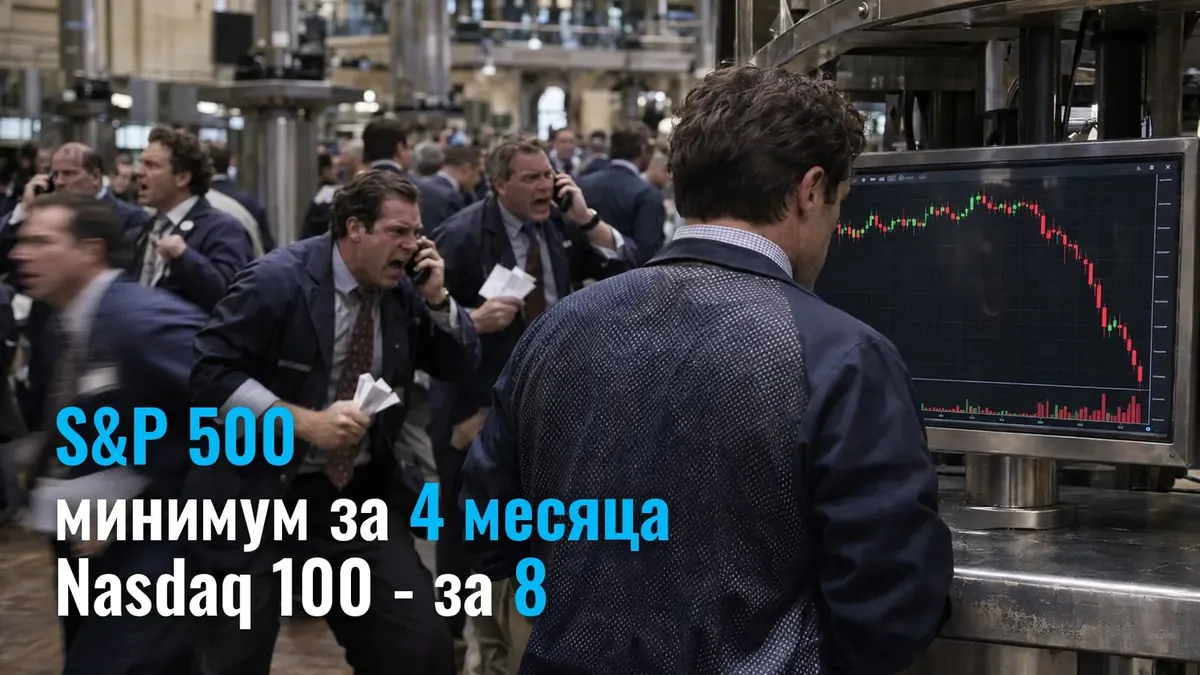
On the evening of November 17, US and European stocks were hit by broad selling. The S&P 500 fell to a four-month low, the Nasdaq 100 to an eight-month low.
An index is an aggregate quote of a basket of stocks. The S&P 500 gathers the 500 largest US companies. The Nasdaq 100 is the hundred largest non-financial companies on the Nasdaq exchange, with the main weight there falling on technology.
This affects traders directly: US and European indices moved down in sync, and on such days ranges widen.
Where the indices went
The lows were recorded as of 18:51 Moscow time.
- S&P 500 - a four-month low.
- Nasdaq 100 - an eight-month low.
- DAX - worst day in nine months.
The different depth of the pullback shows where the drawdown is stronger: the technology index wiped out eight months of gains, the broad market - four.
How the evening unfolded
- 18:37 Moscow time. The feed recorded selling in stocks.
- 18:49 Moscow time. Nvidia was down 4%. It is the maker of the chips on which artificial intelligence is computed, and one of the heaviest-weighted stocks in the Nasdaq 100.
- 18:51 Moscow time. Lows were recorded on the indices.
Europe fell along with the US
The DAX closed its worst day in nine months. It is the index of the 40 largest German companies, the main benchmark of the continental market.
When US and European indices move down in sync, a common flow is driving the market. Individual company stories take a back seat on such days.
What changes in your work
For a trader, the character of the move matters.
- The link between indices - strengthens.
- Ranges - widen.
- A stop at the usual distance from entry - triggers more often than usual.
The main thing: on such days the market is driven by a common flow, and the usual risk settings work worse.
The cause has not yet been named
Market participants have not yet named the cause of the sell-off.
- The schedule of market events - in the economic calendar.
- A challenge for trading indices - can be picked in the calculator.
Were you counting your dollars this evening?
An evening when everything on the screen is red, and a trader counts their dollars, not the index's percent. The percentages on the S&P 500 are the same for everyone. The money depends on trading nominal, and that is what it comes down to for most. In prop trading, the company provides the nominal: you pass its paid evaluation, trade by its risk rules and take an agreed share of the result. Such days on indices come without warning, so the account size is decided in advance.