

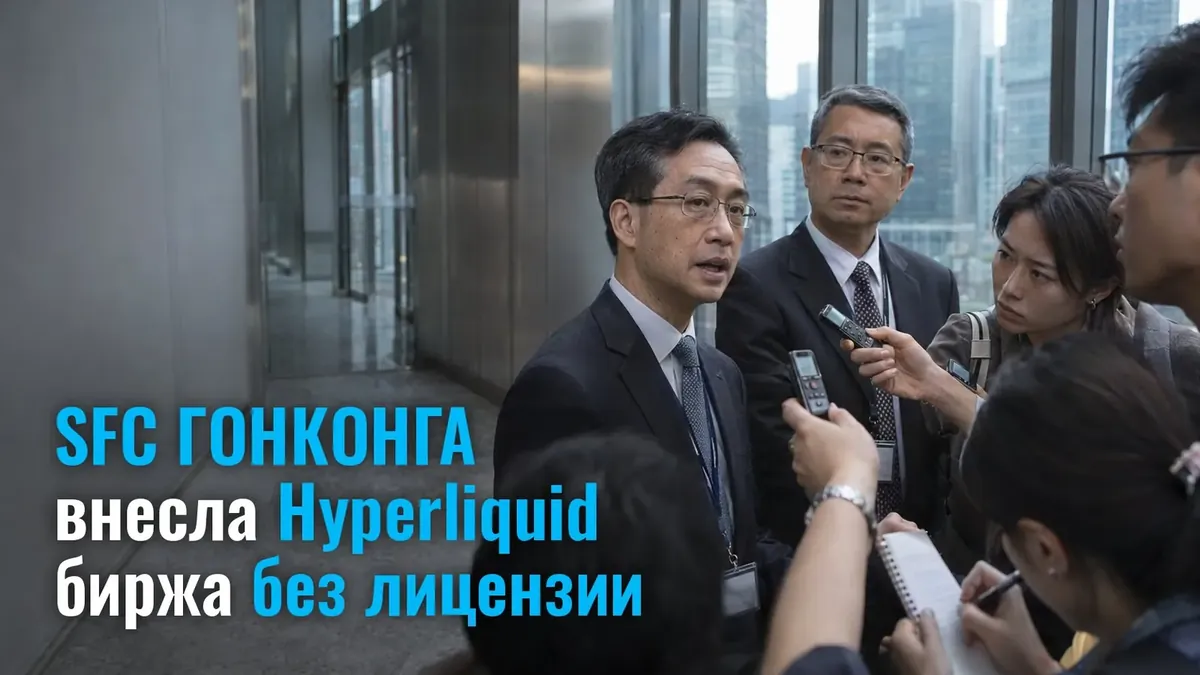
The SFC has added the decentralized exchange Hyperliquid to its public list of suspicious platforms for trading digital assets. The exchange does not have the commission's authorization.
The SFC is Hong Kong's Securities and Futures Commission. It oversees the local stock and futures market. Hyperliquid operates as a decentralized exchange: trades go through the blockchain, without accounts held by an intermediary company.
This listing directly affects traders. The commission does not monitor the exchange's operations, and in a dispute over a trade there will be nowhere to file a complaint.
What the SFC listing says
- Hyperliquid and Hyperliquid Hong Kong - two companies are named in the listing at once.
- Trading via the website - the SFC states that the platform offers digital assets without its authorization.
- Company address - not stated in the listing.
What gets you onto the list
The regulator sees a violation in one of two things.
- An exchange without authorization. The platform operates in Hong Kong as a virtual asset exchange or claims to do so.
- Advertising to the local public. The platform actively promotes its services in Hong Kong without SFC authorization.
The exchange's format did not change the decision. Trades go through the blockchain, the intermediary company does not hold accounts, and the listing still appeared.
What this means for the trader
The list of suspicious platforms is part of the overall list of unlicensed companies and questionable websites on the SFC website. This is how the commission warns investors about platforms that operate outside its supervision.
The SFC explicitly advises trading on Hyperliquid with caution. For a trader from Hong Kong, the situation is this: the exchange has no license, the commission does not control its operations, and in a dispute over a trade there will be nowhere to go to file a complaint.
Where to check the terms
- Prop firm catalog - risk rules and terms for each company.
- Academy - how prop trading, the challenge and payouts work.
Do you trade on decentralized exchanges?
A platform ends up on a list like this, and you immediately start thinking about where your money is and how much of it is even there. A large notional on a personal account is built up with leverage. The risk remains entirely yours. With prop firms, the trading capital is provided by the company itself: you pay for the evaluation, stay within its risk limits, and take an agreed share of the result. It is calmer to understand the scheme in advance, before the next regulator warning.